PSI in central Singapore rises to 145; air quality in south, east and west also hits unhealthy level
Rhea Yasmine and Marisa Yeo
The Straits Times
Sept 14, 2026
Air quality in Singapore worsened on Sept 14 with the Pollutant Standards Index (PSI) across the island, except for the north, hitting unhealthy levels, following several days in the moderate range.
The 24-hour PSI for the central region hit 102 at noon on Sept 14 and rose to 145 at midnight.
Air quality in eastern and western Singapore also crept into the unhealthy zone at 4pm that day, with official readings from the National Environment Agency (NEA) putting the 24-hour PSI then at 101 in those regions.
At midnight, the PSI rose to 124 in the east, and 120 in the west.
In the southern part of Singapore, air quality entered the unhealthy range at 10pm, with the PSI rising to 104. It then climbed to 107 at midnight.
The northern part of Singapore remained in the moderate range at 99 as at midnight.
Air quality is considered unhealthy when the PSI is in the range of 101 to 200, during which NEA advises the public to cut down on outdoor activities.
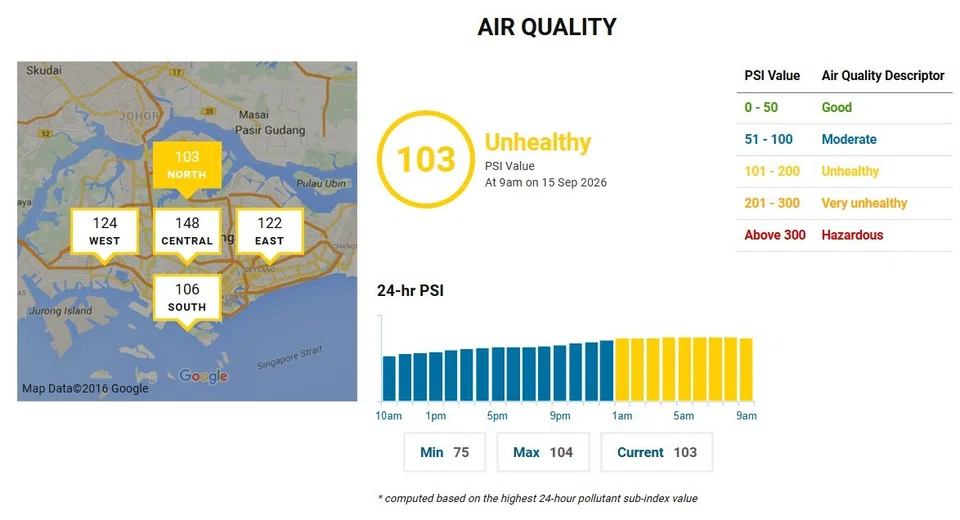
PSI readings of 51 to 100 are considered moderate, while values of 0 to 50 are in the “good” range.
The one-hour PM2.5 readings across the island on Sept 14 remained elevated, ranging from 60 to 120 micrograms per cubic m, as at midnight.
Readings of 56mcg per cubic m to 150mcg per cubic m are considered elevated, while levels of 151mcg to 250mcg per cubic m are in the “high” range.
In an advisory at about 6.30pm on Sept 14, NEA said air quality for the next 24 hours is forecast to be in the high moderate to mid-unhealthy range.
The PSI crossed into the unhealthy range two weeks ago, hitting 101 in central Singapore on the morning of Sept 4. In the following days, readings in the central, eastern and western parts of Singapore occasionally crossed into the unhealthy range.



The recent developments mark the first time since October 2023 that the PSI in Singapore hit unhealthy levels because of haze, with the authorities earlier warning of the risk of haze between June and October as a result of warmer and drier conditions brought on by both El Nino and the Indian Ocean Dipole.
In its Sept 14 advisory, NEA added that moderate to dense smoke plumes, some of which were noticed to be drifting towards Singapore, continue to be observed from fires in Kalimantan.
Smoke plumes were also observed in southern Sumatra.
Dry conditions are forecast over Singapore and the surrounding region in the coming days, NEA added.
“With the prevailing winds forecast to continue blowing from the south-east to east-southeast, Singapore will likely be affected by smoke haze,” the agency said.
Haze and worsening air quality are shown through two readings on the NEA’s website: the 24-hour PSI and the one-hour PM2.5 readings. Both measures serve different functions.
PM2.5 is an indicator of fine micro-pollutants in the air. These particles – which can get lodged deep in the lungs and enter the bloodstream – are the dominant pollutant during periods of transboundary haze.
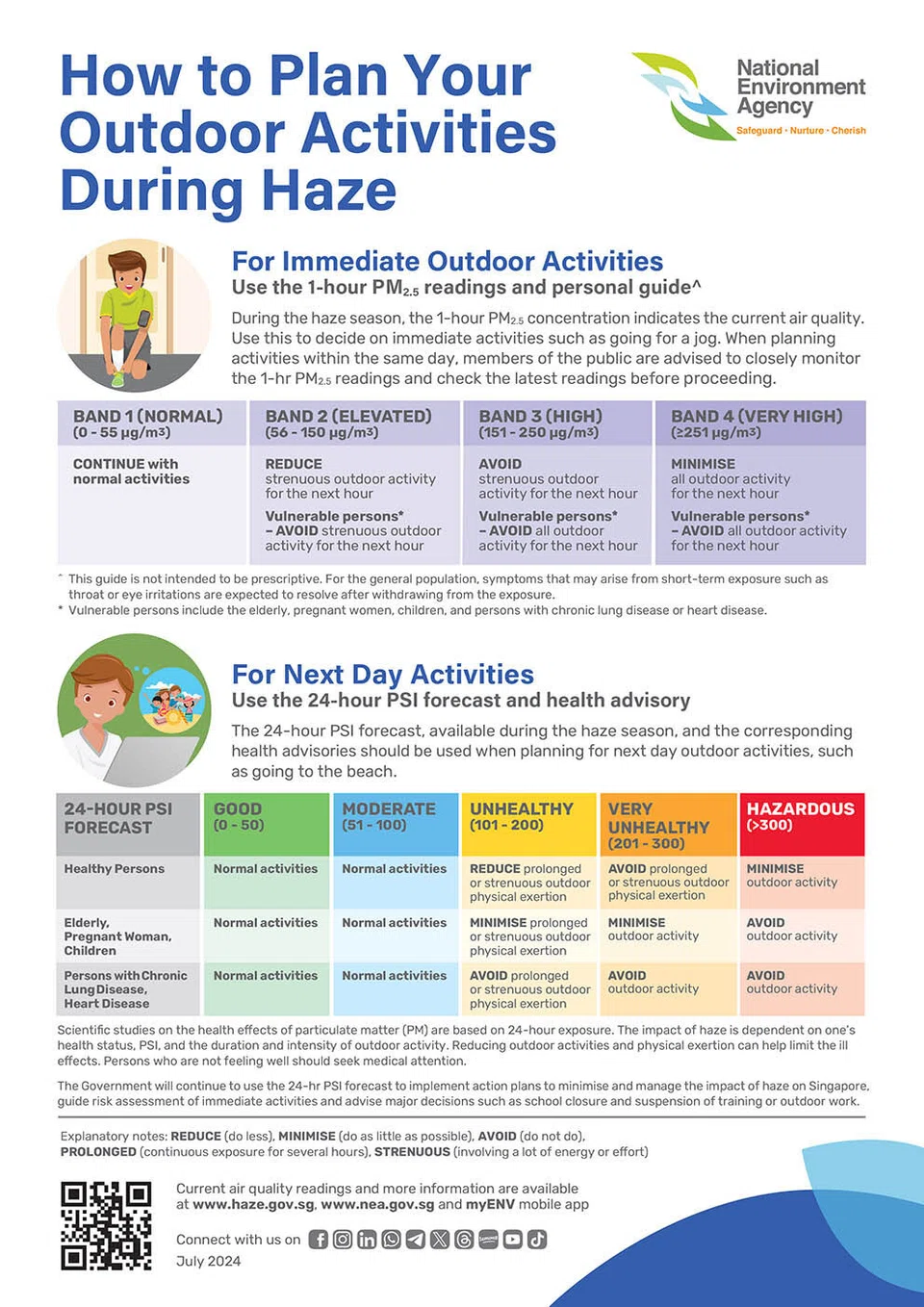
The PM2.5 concentration levels can be volatile and tend to fluctuate over the day, and serve as an indicator of current air quality.
NEA advises checking PM2.5 levels when planning outdoor activities within the same day. Vulnerable people should avoid going outdoors when PM2.5 levels are high.
PM2.5 has the most influence over the 24-hour PSI readings.
The 24-hour PSI is computed based on the daily average concentration of six pollutants, including PM2.5, sulphur dioxide, carbon monoxide and ozone. The calculations are done based on readings from the past 24 hours.
It is an index to provide easily understandable information about daily levels of air quality.
NEA advises people to use the 24-hour PSI forecast, available during the haze season, and corresponding health advisories when planning outdoor activities for the next day.

Explore more on these topics
See something interesting? Contribute your story to us.
