‘Don’t swat them’: Bee rescuer says bees ‘don’t want to attack us’, though he’s been stung a lot

Think Singapore is just a nation of people working typical corporate jobs? Introducing Stomp’s new original series, Don’t Try This At Work, where we spotlight individuals with risky, exciting, unconventional and even downright terrifying jobs.
From cleaning up after death to exploring kink, the series offers a behind-the-scenes look at occupations most people would never dare to try — and the people who do them every single day.
It’s a humid weekday afternoon in June. Eugene Goh stands in the bulky refuse room of a Compassvale block, studying the bee hive that is wedged in the top right corner of the ceiling. The neighbourhood town council had called him to safely relocate the hive, which had recently appeared.
Goh, who runs his own photography business, has been volunteering with non-profit The Sundowner Bee Rescue since April 2022, after joining The Sundowner Nature Experience Centre earlier the same year to curate its ant experiences.
The 48-year-old also helps to manage volunteers, and patiently guides this writer through putting on the bee suit and walking through the process of relocating the bees step by step.
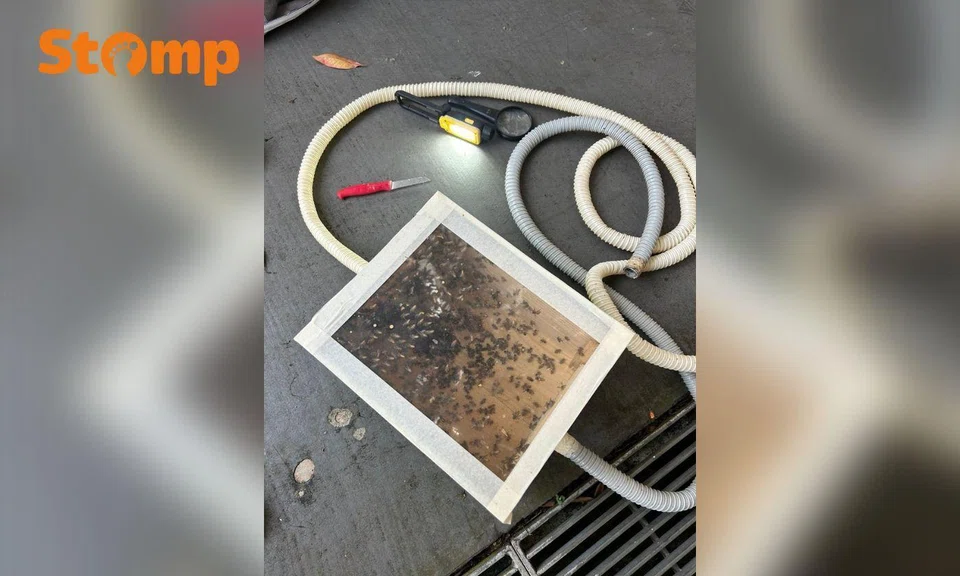
His bee suit donned, Goh unfolds his ladder, positioning it near the hive, and sets up a contraption that sees two suction tubes connected to a wooden box.
The end of one of the tubes is attached to a handheld vacuum. With the end of the second tube, Goh will vacuum the bees surrounding the hive.
“This one is not too big, about one or two weeks only,” he points out as he manoeuvres the vacuum gingerly around the hive, stopping periodically to cut each honey comb one by one.
The vacuum is how most of the bees will be removed from their nest, before Goh is able to cut away all the combs and search for the queen bee — the adult, mated female that the other bees follow.
Bees don’t want to attack us — ‘by stinging someone, they die’
As the Compassvale hive was situated higher than Goh had anticipated, cutting off the combs proved a tad more difficult than usual, with Goh having to nimbly seek leverage with one foot on the wall to lift himself just a bit higher.
At one point, part of a comb dropped onto the tiled floor of the room, leading to frenzied buzzing.
“They did not like that,” quips Goh, who maintains a jovial but calm air.
He emphasises that bees are defensive by nature, and will only sting if they perceive a threat to their home. “They will not sting people if they can help it, because by stinging someone, they die,” Goh adds with a shrug.
He’s been stung “plenty of times” on the job, but these stings have not been too serious as Goh remains cautious while working.
“The bees somehow always know how to sting the sensitive areas when it is the holidays and when I’m meeting family!” he jokes.
Goh explains that some stings — such as those to the face, neck and lips — can swell a lot if not dealt with immediately, but they are often cosmetic and not long-lasting or painful.



“Risk is relative,” Goh adds, stressing that being properly attired and having the right equipment, tools and knowledge can go a long way in helping to mitigate risks.
In addition, not all rescues look the same.
For this particular hive relocation that Stomp witnessed, Goh was unable to find the queen bee on the spot, even as baby bees wiggled out from their cells — a sign that there is, or was, a queen.
“We can have some shared knowledge and experience that we can take with us to the next bee rescue or relocation, but primarily, we are dealing with wild insects so we are unable to completely predict or know the outcome every single time,” says Goh.
‘Don’t swat them’
Despite the uncertainties and challenges of bee rescuing, the winged insects are an important part Singapore’s ecosystem and it is critical to relocate them instead of simply exterminating them.
“Exterminating bees would cause a huge disruption to our ecosystem,” Goh says, explaining that while most bee species in Singapore are not in threat of extermination, the honey bees are the ones that grow in colonies and provide great numbers to the important task of pollination.
“For our city in nature to thrive and have a good level of biodiversity, the insects (including bees) play an important role in pollination and keeping plant life healthy,” Goh explains, adding that nature is an “important part of (his) family identity”.
Goh and his wife Dr Tricia Seow — co-chair of the Sustainability Learning Lab in National Institute of Education — developed haBEEtat, an educational card game about Singapore’s honey bees. Together, they strive to educate the public on the importance of nature and how everything in our environment is interconnected.
The 48-year-old advises those who encounter these buzzing creatures not to swat or get too close to nests.
“Swatting is often seen as an offensive and aggressive move,” he says, and will aggravate bees, or similar-looking hornets and wasps, who are just protecting their home.
In such encounters, one should contact a bee rescuer — such as Goh and his team — who are happy to help assess the situation.
As much as the team at The Sundowner Bee Rescue assists with rescue and relocation, they also field questions on how bees and humans can co-exist.
“The simple reality is that local honey bees have gotten very adapted to urban living,” Goh answers.
He highlights that co-existence between bees and humans happens in almost every major city now, and in the most unexpected places — the Notre Dame Cathedral in Paris being one of them.
“It’s all about finding the right balance of space and respect.”

Explore more on these topics
See something interesting? Contribute your story to us.
