S’pore drone pilot leaves son preparing for national exams, joins 34 others on Nepal disaster relief mission

Just as his 16-year-old son was preparing for his national exams, Senior Staff Sergeant (SSSgt) Hasrin Hasmoon had to leave home on short notice for a humanitarian mission in Nepal.
The 44-year-old Singapore Police Force (SPF) drone pilot told Berita Harian that while the timing was difficult, he understood the urgency of the assignment.
With the support of his wife and family, SSSgt Hasrin joined a 35-member Singapore contingent deployed to Nepal under Operation Vanguard from Sept 1 to 18.
The team comprised SPF officers and personnel from the Health Sciences Authority (HSA) and Home Team Science and Technology Agency (HTX), who were sent to support rescue and disaster victim identification efforts after devastating floods in the region.
Floods that hit parts of Tibet and Nepal in August claimed more than 1,450 lives and left more than 5,700 missing, including nine Singaporeans.
Challenges in different terrain
In Nepal, SSSgt Hasrin faced physical and technical challenges very different from what he was used to in Singapore.
He was tasked with training more than 20 Nepalese police officers to operate unmanned aerial vehicles (UAVs) for search and rescue operations in hard-to-reach areas.
His team also produced manuals on drone operation, training and maintenance so the Nepalese police could continue developing their UAV skills.
Six drones were also donated to the Nepalese police for use, including in disaster areas that may be difficult or impossible for rescue workers to access on foot.
According to SSSgt Hasrin, one of the biggest challenges was operating drones in an environment that is vastly different from Singapore’s more predictable climate.
In Nepal, flight training was conducted at an altitude of around 1,300m above sea level, requiring pilots to account for stronger winds and other conditions.
He also had to overcome the language barrier when conveying technical information and safety procedures.
“The Nepalese officers were very eager to learn. Although there were concerns at first about the language differences, eventually we were able to communicate well and they were able to follow the instructions given,” he said.
Credits wife for holding the fort back home
Reflecting on the support he received from his family, SSSgt Hasrin said he was especially grateful to his wife, Nurul Ashikin Daud.
He said her strength in managing family matters and guiding their children allowed him to focus on his duties abroad.
“I didn’t want her to worry while I was in Nepal, and she also didn’t want me to be burdened with thinking about the situation at home.”
“She always reminded me not to think too much, while I constantly reassured her that I was safe. Whenever we got the chance, we would video call each other to check on things and make sure we were doing well,” he said.
Asked how he felt about leaving his son, who was sitting for his exams, he said: “Of course I was worried. With my wife’s guidance, things are going well.
“He is also working hard to be able to join the course he is interested in, so he is studying very hard to get through the exams.”



Contingent applauded at welcome-home reception
The contingent’s efforts and sacrifices were recognised at an event at HomeTeamNS Bedok Reservoir on Sept 26, which was attended by Minister for Law and Second Minister for Home Affairs Edwin Tong.
He commended the officers for their operational excellence, professionalism and courtesy shown throughout the mission.
Tong also paid tribute to their families who were a source of encouragement throughout the mission.
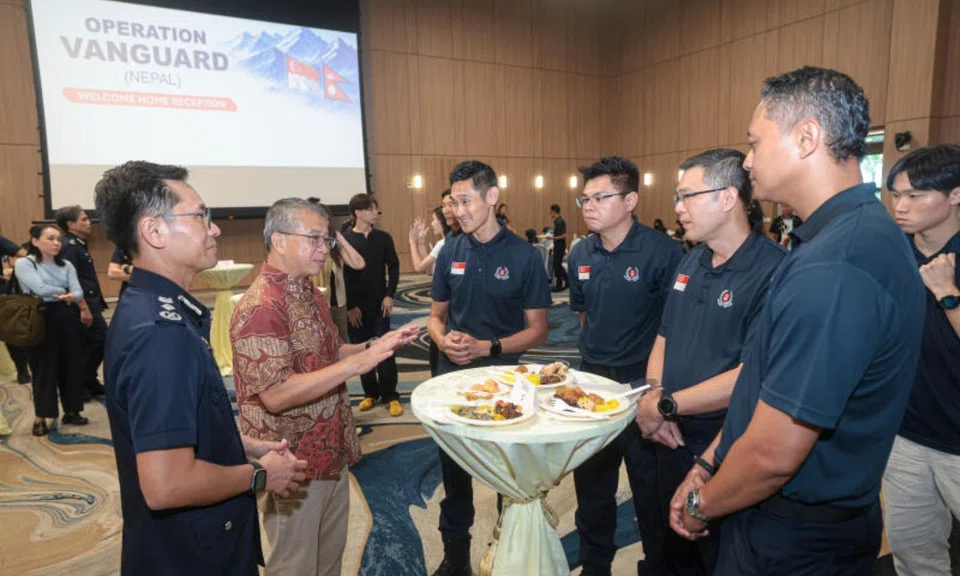
Tong said: “To all our 35 deployed officers, you’ve really represented Singapore with tremendous distinction.
“You left home on short notice and worked tirelessly in very unfamiliar and very challenging conditions, but carried out your duties with professionalism, with resilience and with compassion.”
Contingent commander, Assistant Commissioner of Police (AC) Patrick Tan, said the team faced a challenging operational environment, along with physical and emotional stress while carrying out disaster relief duties.
He said the contingent’s strength came from officers across different agencies combining their expertise.
“Although we are a small country and team, our strength is multiplied when our capabilities are combined.
“By bringing together expertise from various agencies, we can gain access to where it is needed and channel assistance more effectively,” he said.
Identifying victims among decomposing human bodies
Apart from UAV training, another key part of the mission involved disaster victim identification (DVI), including post-mortem examinations, fingerprinting and record comparison efforts to assist in the victim identification process.
DVI officer and Assistant Superintendent of Police (ASP) Corelle Tan Pei Shan said the scale of the disaster demanded intense focus, especially when dealing with decomposing bodies.
“When we arrived, about a week had passed since the disaster occurred. So, many of the bodies and human remains had already undergone further decomposition because some were in water and mud,” she said.
According to ASP Tan, working in such conditions also required emotional resilience.
HTX fingerprint expert Yong Heng Wei faced the challenge of comparing fingerprints obtained from victims with existing records, particularly when the condition of the body affected print quality.
“It’s quite challenging because not all bodies have a set of fingerprints that can be used due to damage caused by the disaster.
“For some bodies, only a few fingers were still in a suitable condition to obtain fingerprints, making the comparison process more difficult,” he said.
Meanwhile, HSA forensic pathologist Dr Benjamin Kuek said seeing photos of missing people on hospital walls underscored the human impact of the team’s work.
“Seeing pictures of missing people plastered on hospital walls reminded me that the work we do means a lot to someone and to the family who is searching for answers,” he said.
“It’s not just routine work or gathering scientific evidence. Ultimately, we’re trying to help families get some certainty and closure.”

See something interesting? Contribute your story to us.
