‘Not allowed to use the home Wi-Fi’: How domestic workers get online in Singapore

Teo Kai Xiang
The Straits Times
April 11, 2026
Singapore is one of the most connected countries in the world, with a wireless broadband population penetration rate of around 180 per cent, according to Infocomm Media Development Authority (IMDA) data from 2025.
Even though the Republic has 10.8 million wireless broadband subscriptions – more subscriptions than there are residents – accessibility may be a different story for the 300,000 or so domestic workers here.
Yet, as contract-free SIM-only plans with generous data allowances have become ubiquitous – with mobile data prices falling from more than $20 a gigabyte to mere cents between 2017 and 2025 – there remain holdouts.
Jane (not her real name), a 48-year-old domestic worker from the Philippines, has worked for the same family in Singapore for 13 years, but does not have access to the home Wi-Fi.
“Sometimes, employers do not allow it, as they believe you don’t work when you use the Wi-Fi,” she says. Instead, she pays $10 a month to top up her prepaid SIM card from M1.
She believes her Internet use is closely watched. Her employer has placed CCTVs around the house, with the expectation that the phone is not to be used during the day. This means that her daytime phone use is in “blind” spots, like the toilet.
Her friend Judith (not her real name), a 42-year-old Filipino domestic worker who has been employed by five households over 22 years, says the usual rule is for her to deposit her phone on a living room desk at the start of her work day.
When she retrieves it after her chores are done, sometimes as late as 10pm, there is little time to speak to her family back home, who are in bed by the time she is online. There is no time difference between Singapore and the Philippines.
Some like Ms Siti Kholifatun, a 38-year-old domestic worker from Indonesia, appreciate having an employer who does not restrict Wi-Fi or phone access, with the understanding that it should not interfere with her responsibilities. “I will not be on my phone when the kids are around,” she says.
Why prepaid dominates
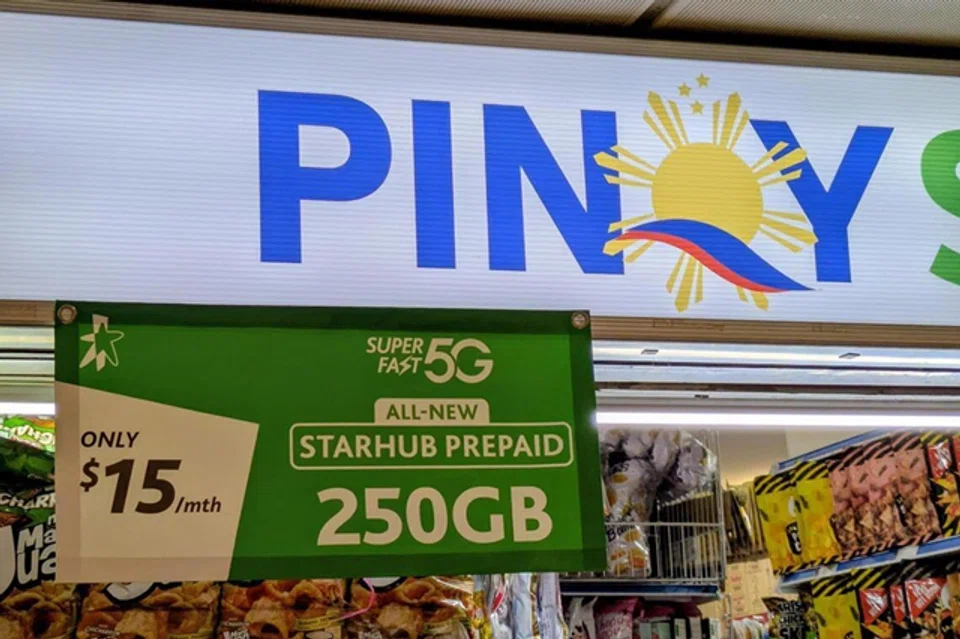
Filipino domestic worker Jo Ann, 53, who has been working here since 2007 and declines to share her last name, says that in her six years volunteering at a help desk with local migrant workers’ non-profit Humanitarian Organisation for Migration Economics (Home), she has found that such experiences are not uncommon.
Home’s help desk for Filipino workers was previously located at Lucky Plaza, a frequent haunt for the community. “There are still some employers who don’t allow their helper to use her phone,” Ms Jo Ann says, relating the experiences of domestic workers who have sought help.
“In their home, they need to put their phones where the CCTVs are, so their bosses can monitor their phone use.”
Ms Jo Ann forks out $10 a month for a prepaid StarHub SIM card that comes with 80GB of data and 100 minutes of international calling time.
Asked why she does not opt for a contract-free SIM-only plan with a more generous data allowance – priced as low as $8 for 388GB at StarHub’s budget sub-brand Eight – she says she was turned off by the requirement to put down a financial deposit when she last checked around 2010.
Home deputy director Prashant Somosundram says that over the past three years, about a third of the domestic workers who stayed at the non-profit’s shelter reported having employers who imposed restrictions on phone use, such as confiscating their phones or allowing them to use their phones only late at night after their work is complete.
“Given that domestic workers do not have clearly defined working hours, it is even more important that they have meaningful and regular access to their mobile phones,” he says. Such access is essential for their well-being and ability to seek support when needed, he adds.


One case the organisation dealt with in March involved a domestic worker whose phone use was monitored by her employer, which prevented her from seeking help from the authorities for malnourishment.
For Ms Mimi, a 42-year-old Filipino who declines to share her last name, prepaid plans are a natural choice because of the uncertainty of domestic workers’ lives, she tells The Straits Times, while queueing to top up her Singtel SIM card at Lucky Plaza.
There are periods when her expatriate employer does not need her and she spends a month back home in Iloilo. That is when the obligation-free nature of a prepaid plan makes more sense.
Prepaid mobile data has also become cheaper in recent years, mirroring the increasing affordability of mobile data in general. The cheapest plans from Singapore’s four major telcos offer between 80GB and 500GB for $10 to $15.
Hotly debated topic
Dr Natalie Pang, head of National University of Singapore’s department of communications and new media, has interviewed more than 90 migrant workers as part of her research on immigrants’ media practices and is conducting a survey with migrant workers as part of an ongoing study. She says that the experiences described by domestic workers speaking to ST reflect the findings of her research.
“Nearly all of the domestic workers we interviewed mentioned that they faced restrictions on their phone and internet use,” she says.
“Structurally, the digital sphere and consequently, the experience for domestic workers is quite different. Their access is often mediated and dependent on employers and agencies.”
As for why they opt for prepaid top-up plans, she says those “allow greater budget control for domestic workers; and due to the precarity of their employment, such plans offer flexibility as there is no need for credit checks and contractual lock-ins”.
“They are also perceived to offer greater privacy for domestic workers. But prepaid plans can come with limitations such as slower speeds and data caps, which contribute to inequalities in digital access.”
As the digital sphere becomes increasingly important, with the Government gearing up for an AI transformation, discussions in Singapore’s online spaces indicate little consensus over how phone access for domestic workers should be managed.
“No phone for personal usage during working hours, especially when caring for children (except in emergencies),” writes one employer looking for a new helper, in a 22,000-strong Facebook group for employers and domestic workers called Maid, FDW in Singapore.
In another Facebook group, FDW in Singapore, which has over 61,000 members, discussions over when and how phones should be used are rife.
In one 2025 post, more than 200 comments responded to an anonymous employer asking for advice on managing domestic workers’ phone use during the day. Most users advised judging the helper on the quality of her work, rather than her phone use.
In another post from the same year, members discussed a screenshot of an anonymous domestic worker asking for advice after her boss asked her to install a tracker app on her phone to share her whereabouts.
“There are some families like this, it is just a safety precaution,” writes one anonymous commenter.
Another chimes in, writing: “She has the right to go anywhere during her day off.”

Explore more on these topics
See something interesting? Contribute your story to us.
