New private not-for-profit hospital to be located in the east due to high occupancy rates: MOH

Yap Wei Qiang
The Straits Times
Aug 31, 2026
Consistently high hospital occupancy rates in the eastern and central regions are one reason the new private not-for-profit hospital in the works will be built in the east, said the Ministry of Health (MOH).
This is despite the majority of public and private hospitals already being situated in these two regions of Singapore.
There is also no private acute hospital in the western region.
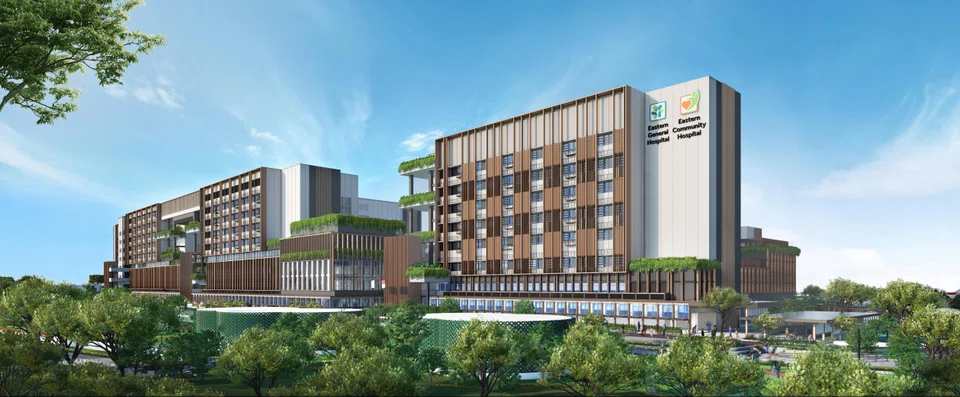
In addition, the upcoming Eastern General Hospital in Bedok North will eventually provide 1,000 acute hospital beds, starting in 2029.
The new private hospital, first announced in 2024, will have 300 to 400 beds, adding to the at least 9,200 acute beds currently available in the eastern and central regions.
MOH has said the plan for the new facility is to increase acute hospital bed capacity as demand for healthcare services rises due to Singapore’s ageing population and to increase options for private healthcare.
Health Minister Ong Ye Kung announced on April 9 that the Government intends to release a plot of land in eastern Singapore for the development of a private not-for-profit acute hospital, which would be the second in the country after Mount Alvernia Hospital.
But he did not say at the time why it was to be located in the east.
Replying to The Straits Times’ queries about the choice of location, an MOH spokesman said: “Among various factors, one key consideration was that hospital bed occupancy rates were higher in the central and eastern regions.”
The spokesman did not mention other factors.
Public hospitals’ bed occupancy rates since 2018 show that the three hospitals that frequently had the highest rates were Tan Tock Seng Hospital (TTSH) and Khoo Teck Puat Hospital (KTPH) in the central region, and Ng Teng Fong General Hospital (NTFGH) in the western region.
TTSH and KTPH recorded their highest annual average occupancy rates in 2023, with TTSH averaging 95.8 per cent and KTPH 96.9 per cent. Both hospitals topped the annual average rates for four years after 2018.
NTFGH’s occupancy rate was the highest in the western region, reaching a record 93.8 per cent in 2023.
The other public hospitals in that region are National University Hospital and Alexandra Hospital. The latter’s rates have been the lowest among all public hospitals since 2018.
Public health specialist Jeremy Lim said the high population density and larger number of older people in the eastern and central regions would have been considered by MOH in deciding to build the new hospital in the east.
Lim, who is the author of Myth Or Magic: The Singapore Healthcare System, said he was “confident MOH has correctly projected future demand”.
“Land use in constrained Singapore has to be very strategic with inevitable trade-offs,” he said. “Hospitals in particular have very high development costs and high ongoing operating costs.”



Other details about the new hospital – such as the specific site, proportion of beds set aside for subsidised care for Singaporeans and permanent residents, and the level of subsidy to be accorded – are not yet available.
MOH aims to announce more details by end-2026.
Possible sites in Simei, Paya Lebar and Serangoon
ST also asked MOH how many potential sites it is considering for the new hospital and whether the sites have been zoned accordingly.
In its reply, MOH repeated what Ong had said earlier – that it had identified a suitable plot of land in the eastern region of Singapore, without providing additional details.
ST has identified three possible sites in the east that have been rezoned and could be used to build the new hospital. Two have been rezoned for health and medical care use, and one site with two land parcels has been proposed for similar rezoning.
They are located in Upper Serangoon, Paya Lebar and Simei.
At the intersection of Upper Serangoon Road and Lorong Low Koon, there is a plot of land – about 11,000 sq m in size – that the Urban Redevelopment Authority (URA) has rezoned for health and medical care use. It was previously zoned for places of worship.
Separately, on Aug 14, URA said land parcels bounded by Simei Avenue and the PIE were proposed to be rezoned for health and medical care use, transport facilities and roads.
The land parcels are directly opposite Changi General Hospital (CGH). They are on a site estimated to be 5,682 sq m in area, according to Christine Sun, chief researcher and strategist at property firm Realion (OrangeTee & ETC) Group.
The third possible site, about 22,800 sq m in size, is near Paya Lebar MRT station, next to SingPost Centre. Previously zoned for commercial use, it was earmarked in 2025 primarily for a health and medical care development.
Of the three possible sites, the one in Paya Lebar covers an area closest to that of Mount Alvernia Hospital, which sits on a land area of about 27,000 sq m and has 353 beds.
But Sun said the new private hospital with a similar bed capacity does not necessarily need a land plot of similar size if it can be built higher, or if it does not need to set aside land for traffic networks, including those for ambulance conveyances and parking spaces.
If there are existing structures around the plot of land, such as those opposite CGH, the new hospital probably will not need to set aside additional land for traffic, she added.
Lim thinks the Paya Lebar site is the most probable of the three as the new hospital needs to be large enough to achieve economies of scale and to hold sufficient inpatient beds and outpatient facilities.
“It also has to offer high-quality clinical services, be reasonably priced, accessible by public transport and have surrounding amenities like malls, restaurants and shops which help uplift the entire area,” he said.
Ong said in Parliament in 2024 that the not-for-profit model did not mean that such hospitals operate at a loss, as all hospitals would need to be financially viable. Otherwise, they would have to close at some point.
He added that under the model, profits are not distributed to shareholders but instead reinvested in the hospital or used for charitable purposes.

Explore more on these topics
See something interesting? Contribute your story to us.
