‘My retirement savings, it’s all gone’: Retiree, 68, loses over $70k in AI investment scam after meeting woman on TikTok


Within the span of a month, a man poured more than $70,000 into what he thought was an investment in AI robots, only to realise he had fallen victim to a scam.
James (not his real name), a 68-year-old retiree, told the media that he became acquainted with a TikTok user, who claimed to be a 35-year-old woman from Malaysia, in November 2025.
“She followed me first, then I followed her back,” he said. “She told me she worked at an AI technology company.”
The pair would chat on WhatsApp or speak over voice calls for anywhere from a few minutes to several hours a day, discussing daily life and investing.
“I trusted her as a friend,” James explained. After conversing with her for a few days, she persuaded him to set up an account to invest in AI robots.
The investment website showed high returns, convincing him to put in a few thousand dollars every two to three days.
Within just several days, James had invested about $20,000, with the expected profit estimated to be around $30,000.
Scammers continued demanding payments
However, James was then told that the $50,000 in his investment account had been “locked” due to a slow connection, and that he had to put in another $50,000 within three days to “mobilise” the amount.
When he asked for an extension, the scammers demanded another $10,000 to delay the deadline by two days.
At his wit’s end, James turned to a moneylending account he found on TikTok in hopes of borrowing $40,000 — but ended up losing $2,600 to unlicensed moneylenders who made off with the sum.
James then asked his son for a loan, which immediately raised his suspicions. The pair proceeded to make a police report after realising the investment website was a ruse to siphon money from him.
Victim poured in more funds to recover money
Thinking he could get his money back, James continued communicating with the scammers, who convinced him that he could recover the sum by coughing up an additional 20 per cent of his investment.
However, once he transferred the money, the scammers insisted that he had invested in the wrong product and told him to funnel the same amount into another product.
A police report seen by Stomp showed that a total of 23 transactions amounting to $70,755 were transferred to the scammers.
My retirement savings, the savings I had when I was working, it’s all gone.
‘You won’t be able to think clearly’: Victim reflects on incident
Reflecting on the incident, James felt he was “too simple-minded” and had never imagined others would harbour malicious intentions.
“A few years ago, I saw people being scammed, and I wondered why. But when it came to me, I understood why they were being scammed. At that time, you can’t control yourself,” he mused.



James also stressed the importance of communicating with family and friends when faced with similar situations:
Because you will be confused. You won’t be able to think clearly.
“After that, I felt my actions in the moment were stupid, that I actually believed what they told me,” he said. He now looks back on the incident as a “lesson learnt”.
Investigations into the case are ongoing.
Investment scams recorded highest losses
According to mid-year scam and cybercrime statistics released by the Singapore Police Force (SPF) on Aug 26, the number of scam cases fell by 14.4 per cent year-on-year to 16,821 cases in the first half of 2026.
However, specific categories rose significantly, such as e-commerce scams, which surged by about 20 per cent over the same period.
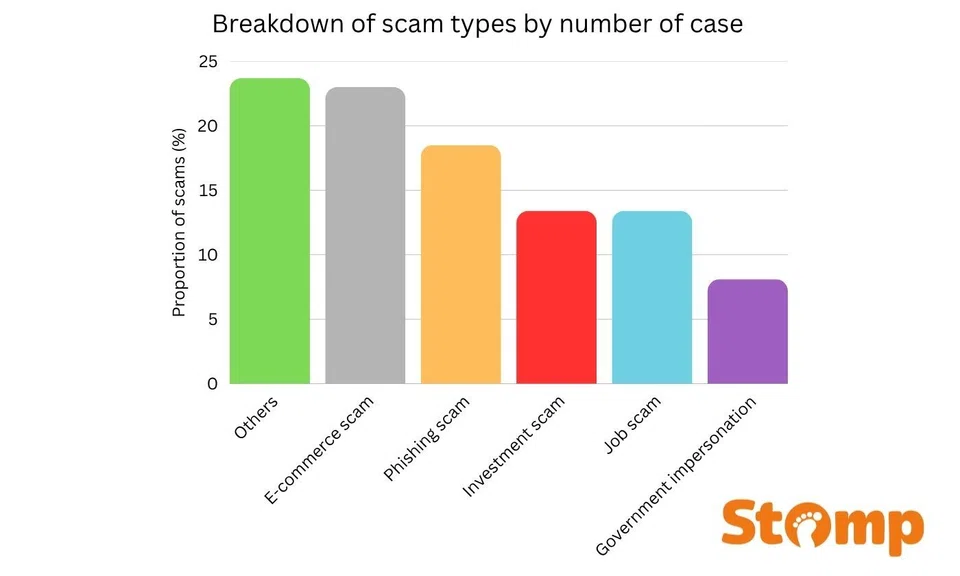
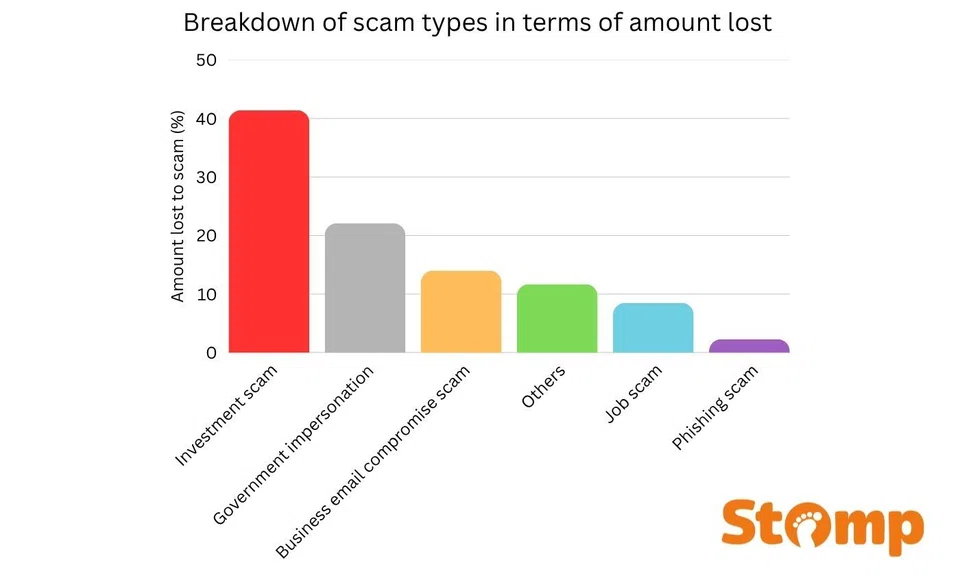
While investment scams were the third most common scam type, excluding “others”, accounting for 13.4 per cent of cases, they recorded the highest losses at $169.8 million in the first half of 2026.
Police also said it observed an emerging trend where scammers would impersonate entities such as the National University of Singapore (NUS), and MooMoo — an online investing platform — to lend credibility to their schemes.
The scammers would post online advertisements offering free investment tips or strategies, luring in victims who would be invited into WhatsApp chat groups masquerading as “investment learning communities”. Once inside, scammers posing as fellow members would pressure newly joined members to continue investing.
According to MoneySense, a national financial education programme, members of the public can verify claims made by suspected scammers by checking the following resources:
- Financial Institutions Directory: A list of financial institutions regulated by the Monetary Authority of Singapore (MAS) and the regulated activities they are authorised to provide
- Financial Institution Representative Register: A list of individuals who conduct activities regulated by MAS
MoneySense also highlighted several “red flags” indicative of investment scams:
- High returns at low or no risk
- Pressure tactics
- Offers of commissions
- Fictitious track records
Victims who have been scammed after authorising multiple transactions are advised to follow these steps:
- Contact their bank immediately
- File a police report online or in person, only call “999” if you require police’s urgent assistance
- Notify all contacts and service providers if their online contact is compromised
Love scammers might have ‘mental hold’ on victims
Speaking to the media, Scamshield Helpline agent Ashley Teh Jie Jing noted that scams are becoming increasingly complicated, and can span multiple platforms.
Victims of love scams can also be difficult to persuade, she added, as scammers may have a “mental hold” on victims, making them less likely to heed warnings from authorities.
Since a person’s love life is deeply personal to them, family and friends would often be unaware of the victim’s entrenchment in the scam.
When members of the public suspect they may be scammed, Teh advised checking with official websites directly, such as contacting a TikTok store to verify if a product is actually being sold.
Teh also recommended downloading the Scamshield app, which allows users to check, block, and report scams.
No matter what age you are at and things like that, scams will always fall to anyone. So, just be careful and double check.

Explore more on these topics
See something interesting? Contribute your story to us.
