KTPH says no lapse in care of patient who died at 52, family questions communication and monitoring

A woman has disputed Khoo Teck Puat Hospital’s (KTPH) account of her father’s final hours, saying important details about his care were only revealed in the hospital’s public statement after she raised concerns about his death on Facebook.
The woman’s father died on Oct 4, aged 52, after being unconscious for a week following a cardiac arrest while hospitalised at KTPH.
In a Facebook post shared on Nov 17, under the account name Kiinnoo Tohh, she questioned whether her father had been adequately monitored before he was found unresponsive in the early hours of Sept 27.
She said her father had been admitted on Sept 24 after experiencing a persistent fever for eight days.
“We were informed that antibiotics could not be administered immediately because he was an alcoholic and still had alcohol in his system,” she wrote.
The family was apparently informed that they had to wait until the “alcohol had been withdrawn from his system before starting antibiotics”.
According to her account, her father subsequently developed hallucinations during alcohol withdrawal and was sedated after becoming restless and repeatedly trying to get out of bed.
She said the last time she saw him conscious and able to communicate was around 10pm on Sept 26. He appeared extremely tired and struggled to wake up when nurses checked his blood pressure, prompting the family to raise concerns.
The family member said she received a call at around 3am on Sept 27 informing her that her father had suffered a cardiac arrest and was in the intensive care unit (ICU).
She claimed the family had been told that his blood pressure was last checked at around 1.30am and that he was found unresponsive at around 2.15am.
She questioned why the medical team could not establish when his cardiac arrest began, flagging the 45-minute gap between the two timings.
Her father was resuscitated and his heartbeat was restored after about 14 minutes, she said.
He remained unconscious in the ICU for about a week, where an MRI subsequently showed severe brain damage, and the family was informed that multiple organs were failing.
The family eventually agreed to withdraw his ventilator on Oct 4 and he died about four hours later, at around 2pm.
She also raised concerns about the medical team’s communication with the family, including remarks she said a doctor made about her father’s prognosis that she called “insensitive”.
KTPH says antibiotics were given on day of admission
In a public Facebook statement on Nov 20, KTPH said it was aware of the Facebook post and expressed its condolences to the family.
The hospital said its review found that antibiotics had been administered to the patient on the same day he was admitted, contrary to the daughter’s claim that doctors had declined to give him antibiotics because he still had alcohol in his system.
KTPH also disputed the alleged 45-minute lapse in monitoring.
It said a review of CCTV footage showed that nursing staff assisted the patient to the toilet at 1.40am on Sept 27, before helping him back to bed at 1.56am.
At 2.15am, a staff member entered his cubicle and found him unresponsive. The Code Blue medical team was immediately activated and resuscitation efforts began, the hospital said.
KTPH added that the patient was promptly transferred to the medical ICU.
Regarding the family’s concerns about remarks made by doctors, the hospital said its ICU team had provided regular verbal updates and held a family conference to explain the patient’s prognosis, the severity of his brain injury and available care options.
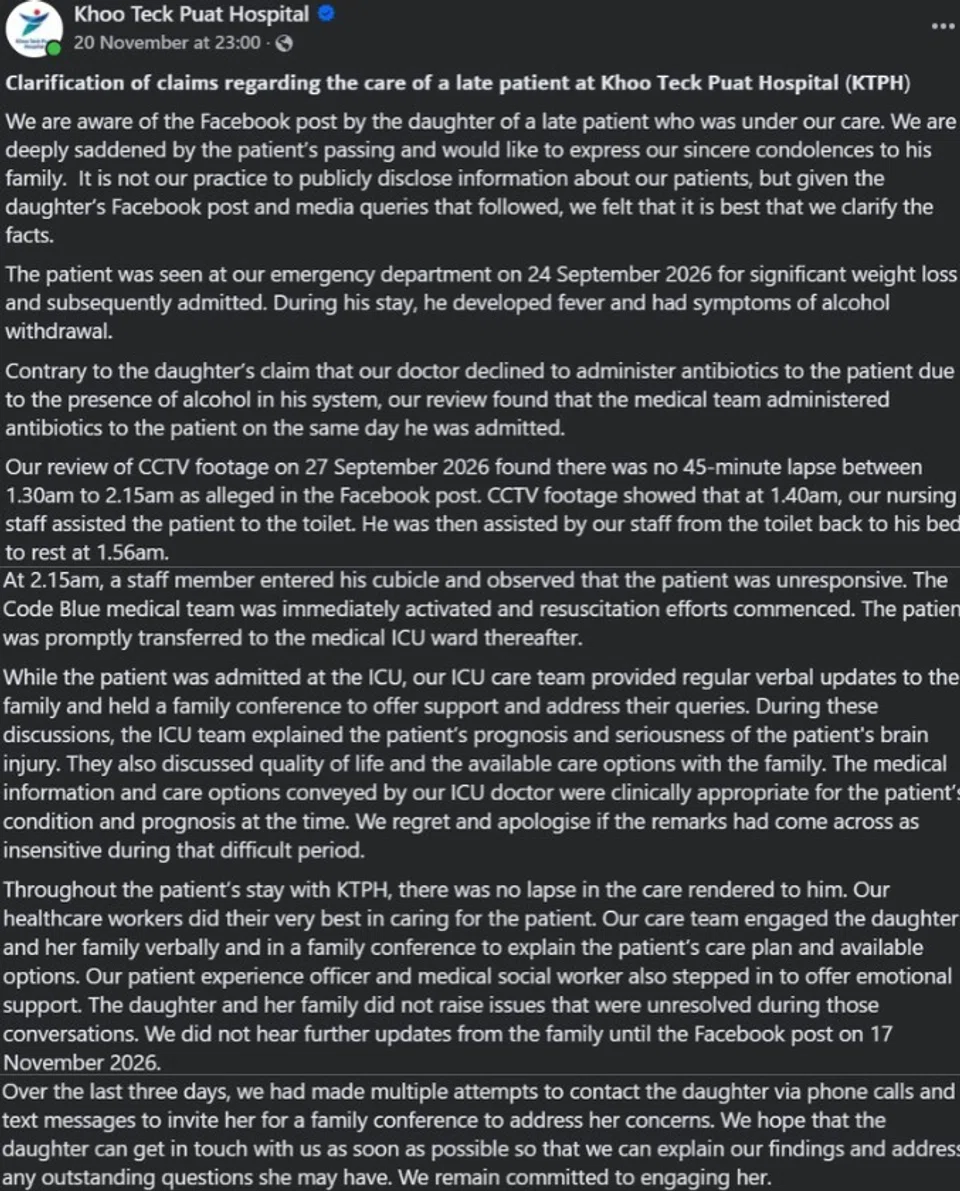
It said the medical information and options discussed by the ICU doctor were clinically appropriate for the patient’s condition and prognosis at the time.
“We regret and apologise if the remarks had come across as insensitive during that difficult period,” it said.
The hospital maintained that there had been no lapse in the care provided to the patient.

It also said its patient experience officer and medical social worker had offered emotional support to the family, and that the family had not raised any unresolved issues during those conversations.
KTPH said it had made multiple attempts to contact the daughter by phone and text message over the three days before its statement to invite her to a family conference.
“We remain committed to engaging her,” the post said in closing.
Daughter says family was not told about toilet visits
In a follow-up Facebook post on Nov 21, the man’s daughter responded to the hospital’s clarification, alleging that much of the information in its statement had never been communicated to the family during her father’s hospitalisation.
The woman said the family was not previously told that nursing staff had assisted her father to the toilet between 1.40am and 1.56am.
She questioned why this information was only disclosed publicly after the family had repeatedly asked the medical team about the events leading up to his cardiac arrest.
The woman also maintained that a doctor had told the family that antibiotics could not be administered because her father still had alcohol in his system.
She "strongly emphasised” that the family’s original account was based on what they had personally heard from doctors and nurses, with several family members present.
“We did not fabricate information, make up stories, or deliberately spread false accusations,” she stressed.
Another major concern raised in her latest post was that her father had been physically restrained and sedated.
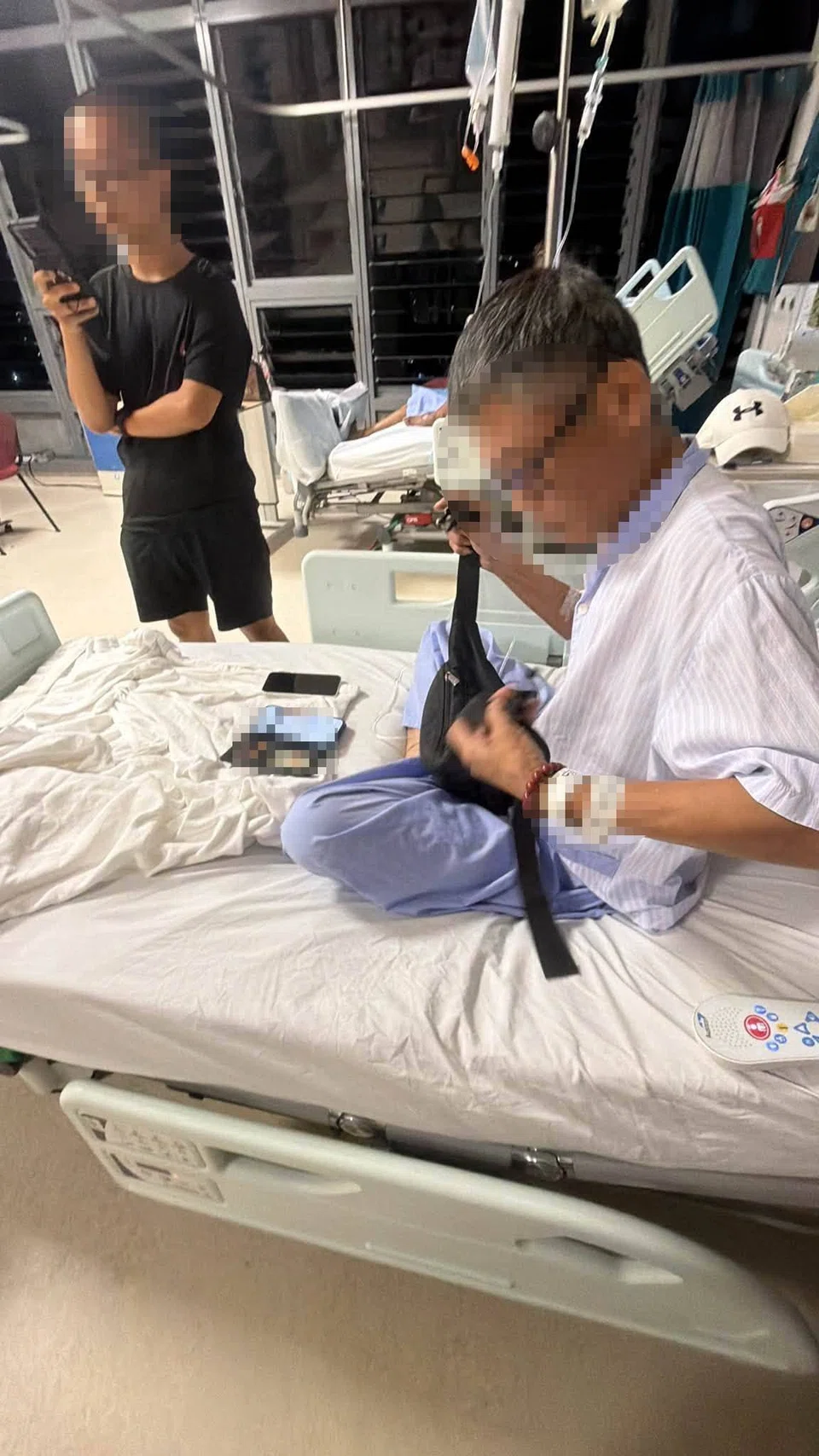
She shared an image which she said showed him restrained to his hospital bed at 7.52pm on Sept 26, about six and a half hours before he was found unresponsive.
According to her, staff had restrained him because he was experiencing hallucinations and repeatedly trying to get out of bed, to prevent him from falling and injuring himself.
She questioned why he was not connected to an ECG machine or continuous vital-sign monitoring equipment while restrained and sedated.
“If a patient is restrained and sedated, how is he expected to physically struggle, call for help, or alert anyone that he is having difficulty breathing?” she asked.
She further claimed that the family had made numerous calls to the ward before her father became unconscious to ask about his condition, but were often told that someone would call them back.
She said some of those calls were never returned.
The woman said her father had sought medical attention before being admitted to KTPH, having first taken paracetamol at home and later visiting a general practitioner when his fever did not subside.
She also stressed that the family was not seeking financial compensation, but clarity on the events leading up to her father’s cardiac arrest.
She requested that KTPH preserve the relevant CCTV footage, medical records and documented timeline, and make them available for an appropriate independent review, with access provided to the family where legally permitted.
She added that the family was waiting for the hospital to contact them about the proposed conference.
Despite her concerns, she thanked the ICU healthcare workers who cared for her father in his final moments.
“I witnessed with my own eyes how much effort they put into caring for him, and I truly believe they did their best.
“Thank you for your dedication, care and compassion during his final days.”
Stomp has reached out to KTPH regarding the family’s latest claims.

Explore more on these topics
See something interesting? Contribute your story to us.
