JB buses struggle to attract commuters before RTS launch despite major investment
Harith Mustaffa
The Straits Times
June 11, 2026
When university undergraduate Lai Huan Zhe moved from Sarawak to Johor Bahru last year to pursue his studies, he was impressed by one thing – the city’s public buses.
The 22-year-old Universiti Teknologi Malaysia student said Johor’s buses are “generations apart” from his hometown of Sibu, where public bus routes are virtually non-existent.
But after a year of using them, he has also come to understand why many Johoreans still prefer driving.
“If there is a special occasion and I want to go to a restaurant or places in other suburbs with my friends, I still need to take a Grab after the bus,” he told The Straits Times, noting that routes are limited.
His experience reflects a wider challenge Johor faces as it prepares for the launch of the JB-Singapore Rapid Transit System (RTS) Link in 2027 and seeks to improve connectivity under the Johor-Singapore Special Economic Zone (JS-SEZ).
Over the past few years, the state and federal governments have invested heavily in public bus services, expanding routes, increasing fleet sizes and improving infrastructure ahead of the RTS launch.
Yet despite these improvements, only around 37,000 commuters – 2.1 per cent of Johor Bahru’s 1.7 million population – use public buses daily in the city, according to figures shared with ST by the Johor Public Transport Corporation (PAJ).
Commuters said low frequencies and limited route coverage continue to make driving the more practical option. Meanwhile, transport experts argued that Johor’s next challenge is not merely to build more transport systems, but to make buses reliable enough to connect people to the RTS and their final destinations.
Responding to questions from youth at an outreach programme on May 22, Johor Menteri Besar Onn Hafiz Ghazi said the state’s immediate focus ahead of the RTS launch is to increase bus frequencies and expand park-and-ride facilities. The Johor government was recently dissolved on June 1 to make way for a state election that must be held by July 30.
“While bus services already exist, they may not cover Johor entirely. As a short-term measure, we will increase bus frequencies,” he said, adding that commuters would be encouraged to park outside the city centre and take shuttle buses into JB.
Lai, who attended the May 22 programme, told ST that due to limited route coverage of public buses, he often forks out between RM50 (S$16) and RM60 per day on private hire rides. This amount translates into a financial burden for many youth from all over the country at JB’s private and public universities.
“It could exceed RM100 during peak hours and on days where the congestion is really bad,” he added, noting that it strains his monthly allowance from his family.
Challenges navigating JB’s public buses
Currently, JB’s public bus network is primarily supported by two publicly funded services.
BAS.MY JB, operated by Handal Indah, runs 162 buses across 21 routes serving JB, Kulai, Kota Tinggi and Pontian. Complementing it is the state-funded Bas Muafakat Johor service, which operates 79 buses across 65 routes serving residential neighbourhoods and smaller towns including faraway districts like Mersing, Segamat, Batu Pahat and Kluang.
According to PAJ’s Public Transport Master Plan, bus services now cover about 72 per cent of JB district, an area spanning roughly 1½ times the size of Singapore.
PAJ chief executive Mohd Fa’iz Salehon told ST that BAS.MY records an average daily ridership of about 31,000 passengers, while Bas Muafakat Johor carries around 6,137 passengers daily.
He said ridership is mostly concentrated along routes connecting residential areas to the city centre, where most jobs, schools and commercial activity are located.
To encourage bus use and reduce car dependency, Mohd Fa’iz said the state is considering “quick-win” measures such as park-and-ride options in downtown JB, supported by pedestrian bridges linking the RTS Bukit Chagar station to nearby malls and the immigration checkpoint.
But using the bus remains a steep learning curve for many commuters.
Bus stops across JB vary widely in quality, from sheltered stops with signage to unmarked roadside pick-up points. In some areas, the bus stops at carparks.



On a recent ST ride from JB Sentral to Larkin Sentral, passengers were seen using Google Maps due to unclear bus-stop markings.
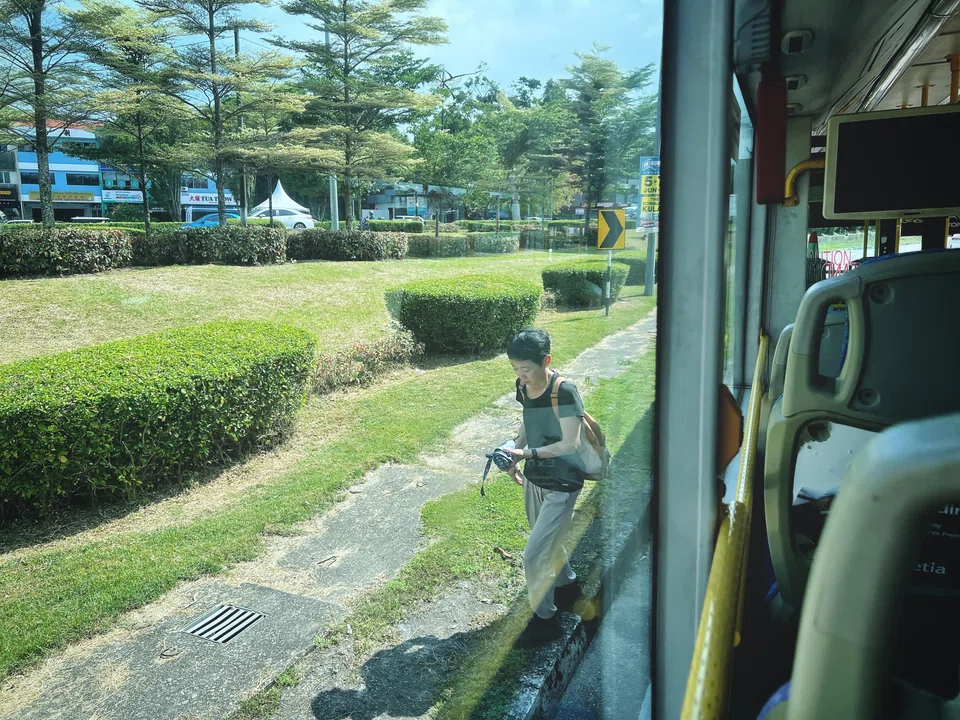
At bus terminals, service frequencies per route range between 15 minutes and 45 minutes.
Part-time barista Rin Azhar, 21, who commutes regularly between Skudai and Bandar Baru Uda, said bus travel requires passengers to be proactive.
“Travelling by bus in Johor Bahru can be challenging if you are introverted,” she said. “You need to learn to use your mouth and ask the bus captains where the bus will stop.”
For some Johoreans, the buses’ low frequency makes them largely invisible.
IT solutions engineer Desmond Ko, who usually drives or takes Grab, was taking a public bus to Senai Airport for the first time when ST met him at JB Sentral in March. The RM8 fare was far cheaper than an RM80 Grab ride.
“Personally, I’ve never taken the bus, nor am I aware that there were actually public buses here in JB,” he said.
Congestion across Johor Bahru also continues to affect bus reliability. According to the PAJ’s transport master plan, journeys by public bus in JB take on average 2.4 times longer than travel by private vehicle.
Service improving, but frequency remains key
Despite the challenges, regular users said JB’s bus services have improved significantly over the years.
Accounts executive Niccole Liau, 43, switched from driving to buses six years ago to avoid worsening traffic congestion. She said services have improved over the years and saved her the stress of driving in traffic.
“Previously, I spent more than RM200 a month on petrol and parking; now I spend only RM50 using the bus,” she said when ST met her at the Larkin Sentral bus terminal.
“But you can’t expect the bus services here to be like in Singapore, so you have to plan and time your travels according to the bus schedule,” said Liau, who used to work in Singapore for several years in her 20s.
Singaporean retiree Shah Aril Zin Othman, who travels between JB and Kukup by BAS.MY, said the system has improved over the years. At RM6 a trip, it remains far cheaper than taking a taxi or ride-hailing vehicle, which costs 20 times more.
“But I reckon if you work in JB and depend on the bus to get to work on time, I am sorry, but I don’t think that is going to be easy,” he said.
In 2022, the federal government allocated RM150 million over three years to improve the myBas project (since renamed BAS.MY), while Johor set aside RM31 million in its 2026 state budget to strengthen the Bas Muafakat Johor network.
Transport Minister Anthony Loke said in May the federal government approved an elevated Autonomous Rapid Transit (ART) proposal to support the RTS, which is expected to serve 10,000 commuters per hour, while Onn Hafiz said it could be ready at the earliest by 2030.
Universiti Teknologi Malaysia professor Muhammad Zaly Shah said Johor should continue planning for the proposed ART system, in part to reduce the cost of land acquisition before Johor becomes fully developed.
However, it should also simultaneously improve bus frequencies and infrastructure, which will ultimately serve as Johor’s feeder network.
“Feeder buses on suburban routes at 20- to 30-minute headways are functionally useless. Nobody will use them,” he said.
That contrast plays out vividly across JB today – where some bus stops are sheltered and signed, and others sit in carparks.
“If the infrastructure is right, drivers will genuinely shift modes... If it is a bus stop in a carpark, they won’t,” said Zaly.

Explore more on these topics
See something interesting? Contribute your story to us.
