‘I don’t want anyone to look down on Dad’: A son’s tribute to his special father
D. Pannerchelvam cannot read a clock. He struggles to tell the value of different dollar bills and knows little about his two adult sons’ jobs.
Yet every night, the 67-year-old carefully packs his younger son’s work bag. “Socks, T-shirt,” he said when asked what he places inside.
“Morning, say bye-bye,” as he describes their daily routine.
His face lights up as he recalls the names of his two grandchildren from his elder son.
For most of their lives, brothers Shanger Pannerchelvam, 29, and Karthigeyan Pannerchelvam, 27, have occupied an unusual role: not only as sons, but also protectors of a father with mild intellectual disability.
“I don’t want anyone to look down on Dad,” said Karthigeyan repeatedly in an interview with The Straits Times ahead of Father’s Day on June 21.
People with intellectual disability may face challenges in understanding information, communication and daily living tasks. Those with mild impairment, like Pannerchelvam, have an IQ score of between 55 and 69.
There are around 8,640 people with intellectual disability in Singapore aged 19 or older who are known to the Government, according to the Ministry of Social and Family Development’s 2024 disability trends report. About 3 per cent of them are at least 65.
But this medical term did not cross his family’s minds at first.
Growing up, his father just seemed like a slow learner, said Karthigeyan, who noticed that he could not tell the time or answer some questions directly.
At shops, his father would hold on tightly to his favourite $2 bills and was unable to calculate the correct change.
Their parents were match-made and got married in 1992. No one told their mother, Pusppa Nadeson, 59, about her groom’s condition.
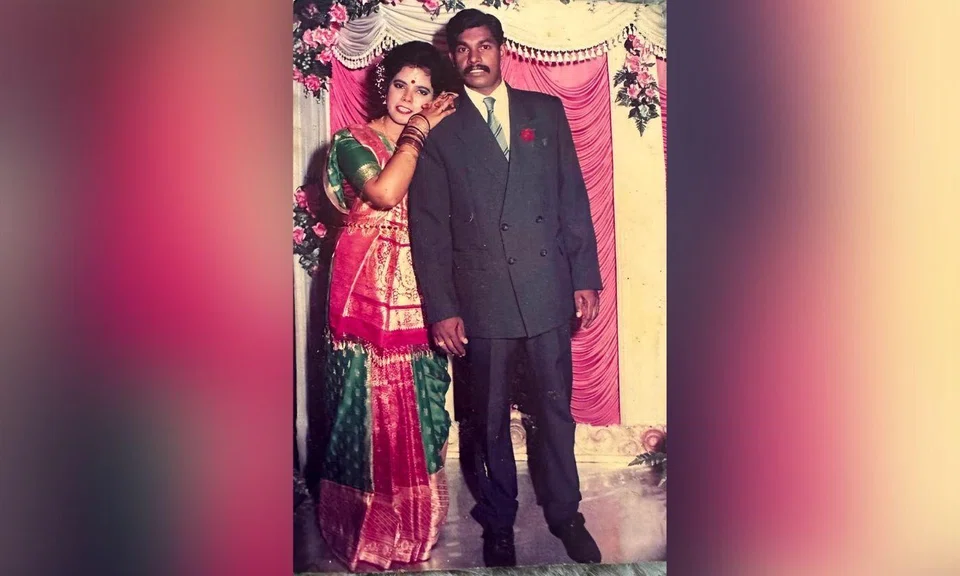
Still, Pusppa liked him. She rattled off a list of her husband’s good qualities: He didn’t smoke or drink, was hardworking, kept the house clean and had a good temper.
Their first son, Shanger, was born in 1997, and Karthigeyan followed a year later. At first, her husband did not understand that they were having children, said Pusppa.
But he slowly realised he was a father and grew into the role.
Working as a cleaner at a fast-food restaurant, he took an active part in raising the boys. He fed them, changed their diapers and checked in on them when he came home.
“He wouldn’t take dinner first (after work), and would ask, ‘Baby drank milk already?’” said Pusppa.
If Karthigeyan forgot to take something to school, his father would travel to the school to deliver it, though he had to rely on a note Pusppa wrote to communicate with school staff.
Falling on hard times
In 2011, Pannerchelvam’s usual peaceable behaviour suddenly turned erratic.
He would return home from work early without a reason and lose his temper at home.
Alarmed, the family took him to the Institute of Mental Health, where doctors diagnosed him with mild intellectual disability and epilepsy.
Epilepsy is a neurological condition characterised by recurrent seizures. Symptoms include sudden changes in emotion, such as fear or anxiety.
Doctors said his father had the cognitive abilities of a child. For Karthigeyan, who was 13 at the time, the news explained instincts he had carried since young.



“If anyone asked (him) questions, I would be the first one to answer... because I didn’t want them to find anything odd or suspect that Dad is not normal,” he said.
“Deep down, I knew it was different compared with my friends’ (parents).”
Pannerchelvam eventually stopped working. In a double whammy, Pusppa developed a vascular condition which made her legs swell, and she had to quit her job as a cleaner.
The loss of both incomes plunged the family into one of their hardest times. They relied on financial assistance and Shanger’s and Karthigeyan’s earnings from part-time jobs to get by.
The family also took turns keeping watch over Pannerchelvam during his outbursts in case he harmed himself.
Life was a flurry of work and caregiving, said Karthigeyan, who learnt to calculate how many lessons he could afford to miss at the Institute of Technical Education to accompany his parents to medical appointments.
He later dropped out of his digital precision engineering course at Nanyang Polytechnic to work full-time. He returned to school only after national service, eventually earning a part-time Diploma in Health Science Management from Republic Polytechnic.

Unreserved trust
Today, Karthigeyan is a patient service associate executive at KK Women’s and Children’s Hospital, while Shanger runs his own logistics and event management firm.
From a two-room rental flat in Whampoa, the family moved a few times before settling down in a similar rental flat in Hougang in 2019. Karthigeyan lives with his parents, while Shanger has since married and moved out.
Karthigeyan is currently dating a woman based in Thailand and hopes to get married. His girlfriend has met his family and gets along well with them, including his father, he said.
Pannerchelvam’s condition has since stabilised. He attends a daycare and rehabilitation centre in Hougang run by the Home Nursing Foundation, where he does art and craft and plays games with other seniors.
His routine rarely changes. He wakes at 5am to have breakfast, watches cartoons or Tamil movies on television before catching a chartered bus which takes him to the daycare centre.
A man of few words, he stayed close to his wife and son throughout the interview with The Straits Times, turning to them whenever he was asked a question.
When the conversation shifted to Mother’s Day, Pannerchelvam excitedly hurried to his room and returned with a card he had made for Pusppa in daycare, proudly showing it off.
On June 10, the family marked Pannerchelvam’s 67th birthday by taking him to eat his favourite chicken meal and presented him with a special frame with vintage $2 notes.
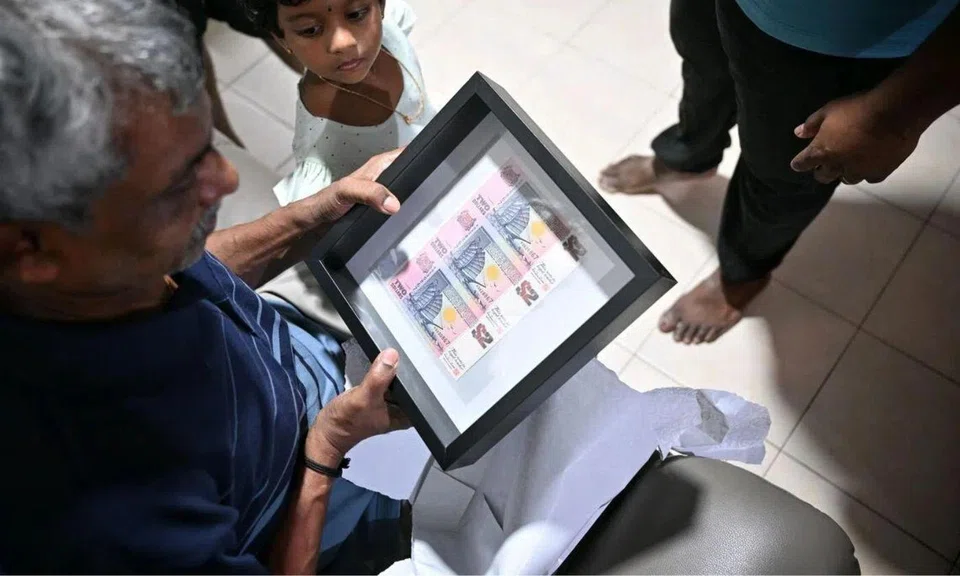
Afterwards, Karthigeyan took his father to the arcade. When the brothers were growing up, their father would take them there after payday. “Dad loves to play basketball there,” he said.
For Father’s Day, Karthigeyan gave him a new bag to take to the daycare centre.
He is frank about the remaining gaps in their relationship. While other sons may seek recognition from their dads, Karthigeyan knows he cannot experience that.
His father does not know about his diploma course, job scope or the journey he took to get there. His mother is also not familiar with these details.
“I just feel like my parents will never understand what I’ve achieved in life,” he said, holding back tears.
But he trusts his father unreservedly. He recalled how he and his brother used to ask their father for chocolates that cost $2. Although it is his favourite currency note, he would hand one over without hesitation.
“Two dollars is equivalent to $100 for him,” said Karthigeyan. “But somehow, he would give it to us.
“If you ask me to close my eyes and fall back, I know that Dad will catch me.”

Explore more on these topics
See something interesting? Contribute your story to us.
