Half-priced beers and discounted tea: Retailers slash prices on drinks without Return Right logo
Chin Hui Shan
The Straits Times
Sept 15, 2026
With more than two weeks to go before the full implementation of the Beverage Container Return Scheme (BCRS), some retailers and distributors here are selling drink containers that do not carry the requisite Return Right logo at discounts of up to 50 per cent.
Under the scheme, all plastic bottles and cans from 150ml to 3 litres must be labelled with the 10-cent deposit mark from Oct 1, or they cannot be sold.
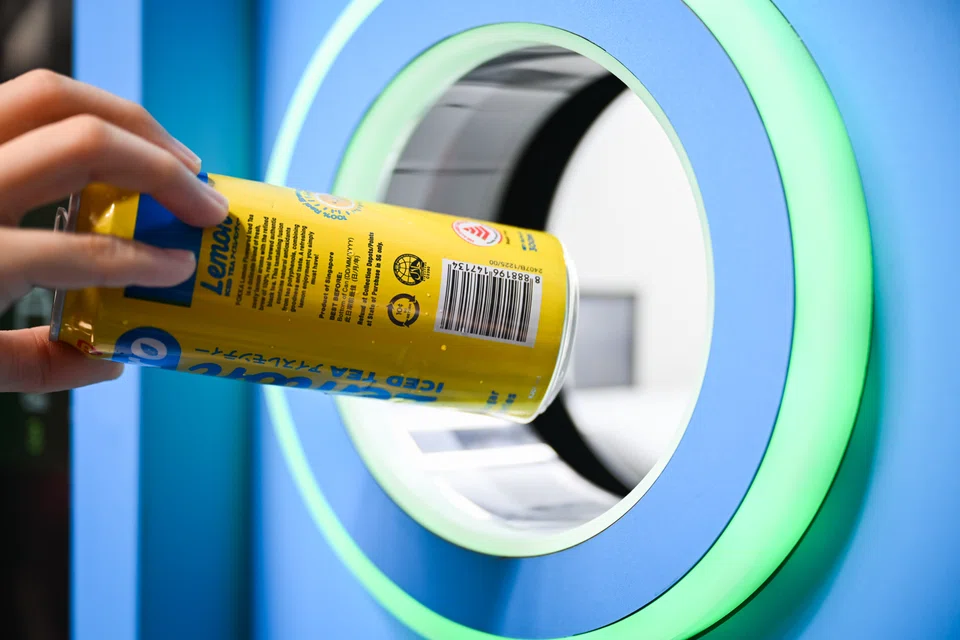
Customers pay an extra 10 cents for each drink purchased under the scheme, but get the money back when they drop the used containers into a reverse vending machine, also called a Return Right machine.
More than 1,000 machines became operational on April 1, but the National Environment Agency (NEA), which is administering the scheme, gave producers and retailers an extra six months to clear old stock.
The transition period will end on Sept 30.
From Oct 1, it will be an offence for anyone, including supermarket operators, to supply any regulated beverages if the container is not affixed with the scheme’s deposit mark and a barcode.
Under the Resource Sustainability Act, those found guilty can face fines of up to $10,000 and/or up to three months’ jail.
Japanese retail chain Don Don Donki was observed to be offering discounts on drinks labelled “non-BCRS” in at least two outlets, the 100AM Mall in Tanjong Pagar and Clarke Quay Central.
At least 25 alcoholic products were being sold at the 100AM Mall outlet during ST checks on Sept 14, with discounts ranging from 20 per cent to 34 per cent. Don Don Donki declined to comment.
K-Market’s assistant manager for Mart Team Samuel Lee said the Korean speciality grocery chain has 3,258 non-labelled beverage containers across nine outlets as at Sept 14.
He added that it will use selected markdowns, prominent displays and stock transfers between outlets based on demand to clear its remaining products.
The company has also stopped replenishing affected products.
K-Market, or Koryo Mart, has outlets across Singapore, including Bukit Timah, Compass One and Parkway Parade.
Selling the remaining quantity is manageable, said Lee. But he noted that some beverages imported from South Korea are niche products with slower or uneven demand across outlets.



He added that it is monitoring the inventory instead of applying the same clearance measure to every product.
“Our objective is to clear the affected stock during the transition period. Any regulated non-labelled products remaining after 30 September will be withdrawn from sale,” said Lee.
Meanwhile, beer distribution company Watering Hole sold 1,500 beer cans at half price over the past two weeks.
Its founder, Lim Jialiang, said he still has non-labelled products in his inventory, but he will stagger the sales to “avoid overwhelming the market”.
“Unfortunately, there are very few avenues beyond clearance sales as the product can’t be sold from Oct 1,” he said.
Lim said the transition period has also been difficult due to the technical requirements to meet the new packaging standards and coordinating with suppliers abroad.
He bought a labelling machine that cost $10,000 to apply stickers on products being imported without the BCRS-approved labels, instead of relying on manpower.
This sticker option is available for producers who are unable to print the deposit mark or new barcode directly on their product packaging.
At Cold Storage Singapore, clearance sales may be used selectively, depending on the remaining quantities, product shelf life and commercial arrangements with suppliers, said the spokesperson for Cold Storage and Giant.
Currently, there are about 5,000 non-labelled containers across Giant and Cold Storage stores, the spokesperson said.
“Our priority is to sell the remaining non-labelled stock responsibly before the deadline,” said the spokesperson, adding that some of the measures it has implemented or is considering include returning eligible stock to suppliers and re-allocating stock to stores with stronger sales demand.
There may also be operational challenges in accurately identifying and segregating labelled and non-labelled stock, particularly where both versions of the same product are present, said the spokesperson.
FairPrice Group is making good progress in its preparations for the scheme, said its spokesperson.
“We are working closely with our suppliers to transition to BCRS-compliant products and manage existing inventory, while ensuring a smooth implementation for our customers and partners,” the spokesperson added.
The Straits Times has contacted Prime Supermarket and Sheng Siong for more information.
- Additional reporting by Ang Qing and Shabana Begum

Explore more on these topics
See something interesting? Contribute your story to us.
