55% of men believe women who dress provocatively are partly to blame if harassed: Survey


In a recent survey by the Association of Women for Action and Research (AWARE) conducted by YouGov, it was reported that 55 per cent of men said women who dress provocatively are partly to blame if they are harassed.
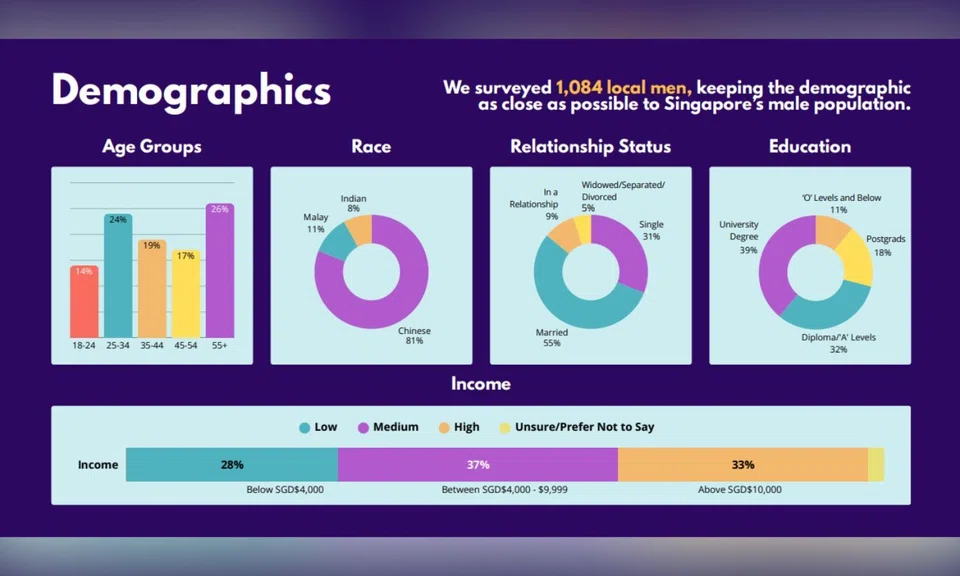
The report, published on Aug 22, was based on a sample of 1,084 male Singaporeans and permanent residents aged 18 and above, and examined their attitudes towards gender, family and society in Singapore.
Respondents’ demographics included age, race, relationship status, education and income.
Titled Survey on Men’s Attitudes to Gender, Family and Society in Singapore, the survey covered areas including sexuality and accountability, emotional expression and self-worth, family roles and decision-making, as well as attitudes toward masculinity and gender equality.
Exploring ‘victim-blaming attitudes’
On sexuality, consent and accountability, the survey revealed that 55 per cent of all respondents believe that a woman who dresses provocatively is partly to blame if she is harassed.
Meanwhile, 67 per cent of all respondents believed that a woman who flirts bears at least some responsibility for what follows — for example, if she goes back to a man’s home and is raped or harassed.
Among the victim-blaming attitudes surveyed, low-income men were more likely than middle-income men to agree with both sentiments.
Of the pool, married men had 38 per cent higher odds than single men of agreeing more strongly that a woman who flirts is partly to blame if she is harassed.
33% of men believe they cannot control themselves when sexually aroused
As for sexual entitlement beliefs, 33 per cent of respondents believe that men cannot control themselves when sexually aroused. Three in 10 men aged 18 to 54 agreed, compared with four in 10 men aged 55 and above.
Meanwhile, 37 per cent of respondents believed that men cannot be expected to stop sexual activity if their partner changes her mind. Among them, 32 per cent of men in relationships and 41 per cent of married men agreed with the statement.
When asked whether men are entitled to sex from their partners in a committed relationship, widowed, separated and divorced men held the highest and strongest agreement, followed by single men.
In marriage, most men across all age groups agreed that they are entitled to sex from their partners, with men aged 45 to 54 showing the highest level of agreement.



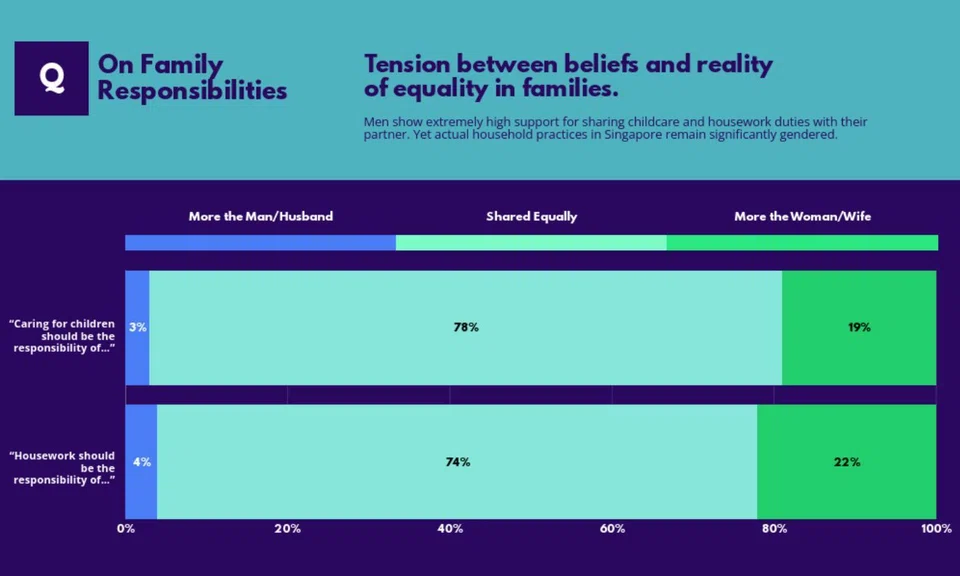
Men show high support for sharing childcare and housework duties with partner
The survey also covered family responsibilities and household roles, with most men supporting the sharing of childcare and housework duties with their spouse.
Among them, 78 per cent said childcare should be shared between men and women, while 74 per cent said the same for housework.
Among respondents, nearly three in 10 men aged 18 to 24 believed childcare was a woman’s or wife’s responsibility, compared with only one in 10 men aged 55 and above. Most men across both age groups disagree that childcare is only a woman’s responsibility.
For housework, men across age groups mostly chose “shared equally”. However, three in 10 men in the youngest age group saw it as a woman’s or wife’s responsibility.
Most men say they feel proud when they are able to provide financially for their families
When it comes to traditional masculine ideals and self-worth, 70 per cent of respondents said they felt proud when they were able to provide financially for their families.
Men across all age groups overwhelmingly agreed with this statement, with those aged 55 and above recording the highest level of agreement.
Among respondents, men with the lowest level of education were most likely to agree that a man’s worth is tied to his ability to earn and provide.
Most men suppress emotions
On emotional suppression, 70 per cent of men said they hide emotions such as sadness, fear, anxiety or stress, while 50 per cent believed that showing emotion makes them appear weak.
The youngest age group, 18 to 24, agreed the most with emotionally suppressive beliefs, while the oldest age group, 55 and above, agreed the least.
Meanwhile, men aged 18 to 24 and 45 to 54 were the most likely to agree that talking about their feelings makes them appear weak.
The report ends with calls to action and recommendations such as strengthen gender and consent education, building community-based support systems for men and reducing masculine pressure at the workplace. AWARE emphasised that the survey serves as a “jumping-off point” for more comprehensive future research around masculinities in Singapore.
“Overall, genuine gender equality requires transforming the cultural and structural norms that continue to shape how gender roles are defined, valued, and enacted in everyday life,” the report said.

Explore more on these topics
See something interesting? Contribute your story to us.
