Dad of wheelchair user writes letter to Stomp about accessibility gaps — and we visited the places he flagged
From public infrastructures to attractions and malls, accessibility barriers remain in many everyday spaces across Singapore — yet they often go unnoticed by most people.
Stomper Karunanidhi, a full-time caregiver to his daughter, who uses a wheelchair, said these are challenges that persons with mobility impairments continue to face.
By highlighting accessiblity gaps across the island, he hopes to spur improvements that would allow others like his daughter to “move around a little more comfortably”.
Karunanidhi shared a handwritten letter outlining the accessibility barriers he has encountered at various locations across Singapore.
Titled “Making Singapore the most special needs-aware country in the world”, the heartfelt letter was delivered to Stomp’s office at SPH Media.
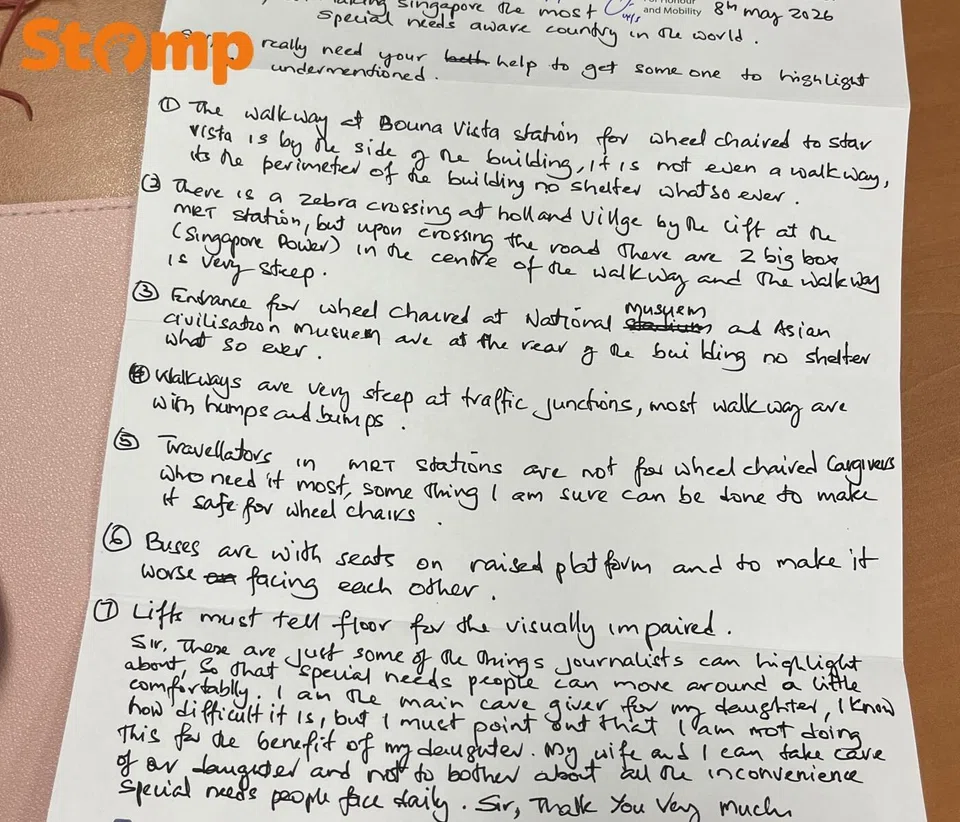
Stomp visited four of the locations listed by Karunanidhi: Holland Village, the National Museum of Singapore, the Asian Civilisations Museum and The Star Vista.
Holland Village: Steep slopes, utility box obstructions
A stroll through Holland Village — whether for a cafe visit or dog walks — may feel like part of a normal routine for those who frequent the area.
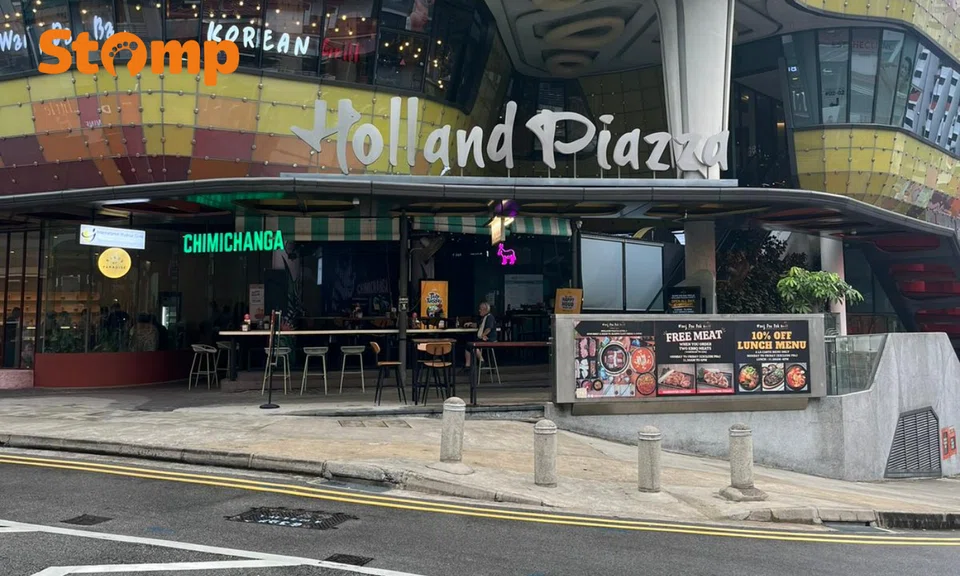
But on closer inspection, the walkway opposite Holland Piazza in Lorong Liput is far from the smoothest path for pedestrians with mobility issues.
Two Singapore Power utility boxes sit in the middle of the pavement near a zebra crossing, significantly narrowing the path. Ironically, there is a wheelchair sign at the crossing.
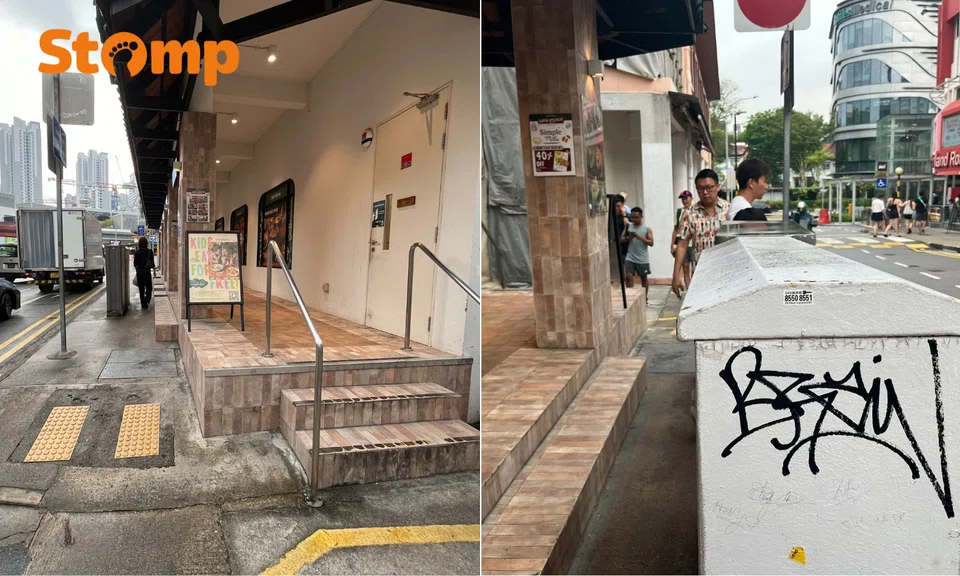
This leaves limited space for movement, particularly for wheelchair users.
Beside the walkway, a restaurant sits on an elevated platform reachable only by steps, further restricting access in the area.
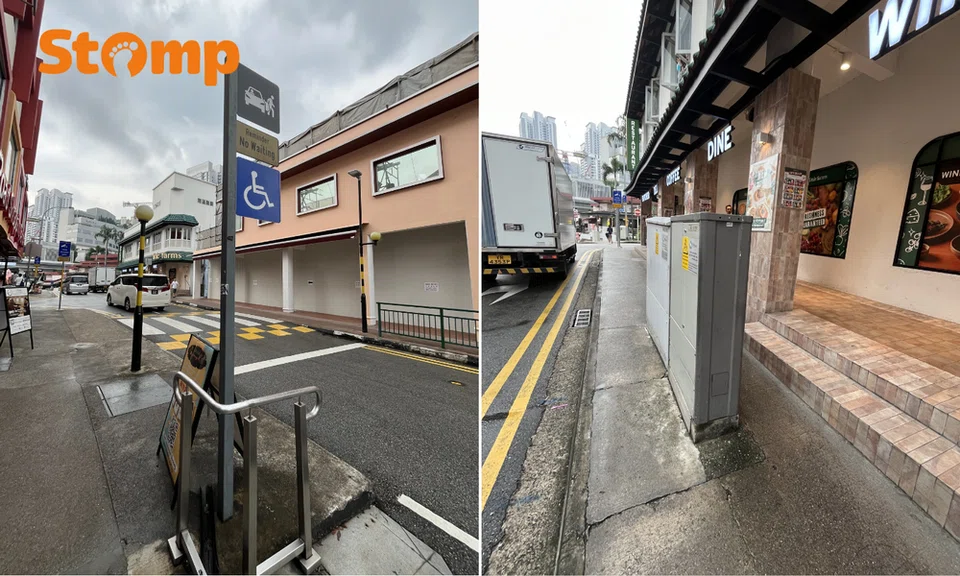
This means that wheelchair users have limited alternative routes, some of which are relatively steep.
Karunanidhi had made a similar observation in his letter, in which he said many walkways are “very steep” at traffic junctions. While he did not specify exact locations, he said these walkways “are with humps and bumps”.
In response to Stomp’s queries, a spokesperson from the Land Transport Authority (LTA) said it understands the concerns raised, and clarified that the “highlighted features are in line with prevailing design standards”.
According to LTA, the slope follows the existing road profile, while the utility boxes are positioned in accordance with standard requirements to accommodate the drain. They are also a safe distance from the road to prevent being hit by vehicles, especially during turns or if a vehicle deviates from its lane.
“Alternative barrier-free routes are also available nearby,” said the spokesperson, adding that LTA will continue to explore enhancements to barrier-free connectivity where feasible.
Museums with stairs-only main entrances
At first glance, the National Museum of Singapore and the Asian Civilisations Museum impress with their grand staircases — but accessibility for some isn’t as straightforward.
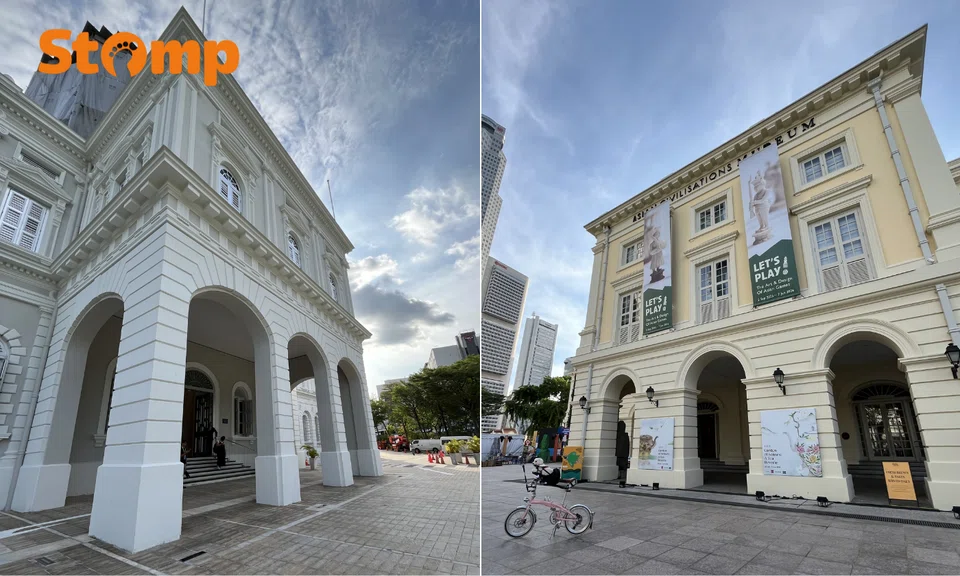
While both museums are generally recognised for their accessibility features, including special signage and designated parking spaces, small details can still affect the visitor experience for those with disabilities.
For instance, ramp entrances at both museums are located at the rear of the buildings.
At the National Museum, these are positioned closer to designated parking areas for wheelchair users. However, this may be less convenient for visitors who are dropped off at the main entrance, as they must navigate an unsheltered route to reach the step-free entrance.
Construction works were also observed near the National Museum’s ramp, which may temporarily inconvenience visitors who require step-free access.
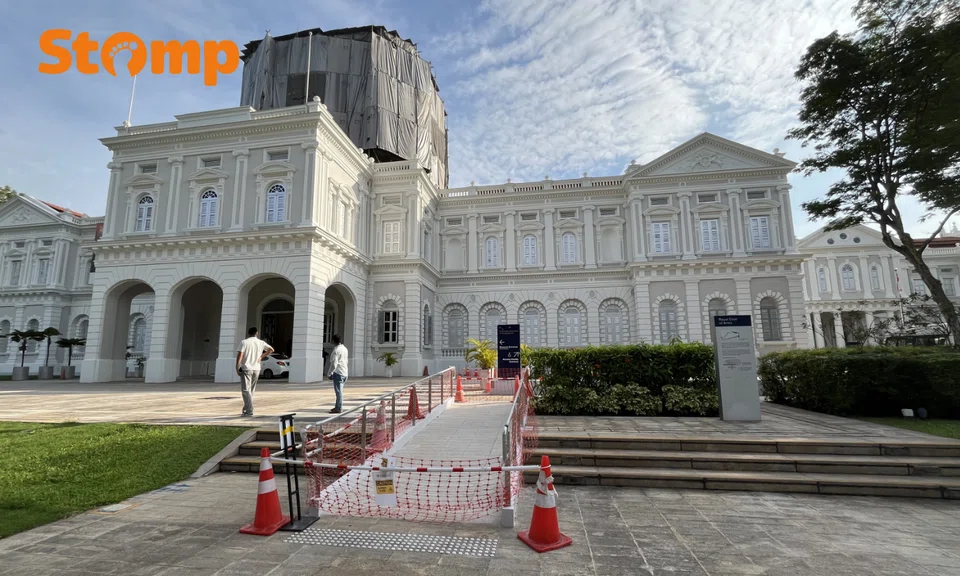
Stomp understands that the National Museum is currently undergoing works aimed at preserving the building while enhancing overall visitor experience and accessibility.
According to a spokesperson from the National Heritage Board (NHB), both the National Museum and the Asian Civilisations Museum have wheelchair-accessible facilities.
The spokesperson said security personnel are “happy to lend a hand should visitors require umbrella or help in sheltering”.
“We seek visitors’ understanding that accessibility enhancements need to be carefully integrated in a manner that is compatible with the building’s heritage architecture,” the spokesperson added.
The Star Vista: Longer route to step-free entrances
Visitors arriving at The Star Vista from Buona Vista MRT station are greeted by a direct route into the mall via its side entrance.
However, the path relies on stairs and escalators, requiring wheelchair users and anyone with mobility issues to take a longer route to the main entrance instead.
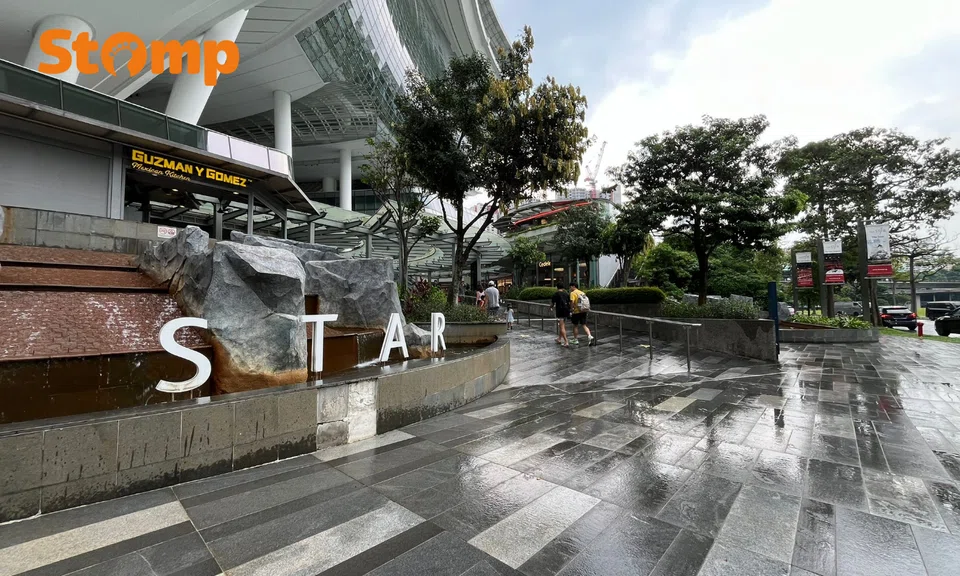
As it was raining during the time of Stomp’s visit, navigating the perimeter of the mall proved tricky.



Individuals with mobility impairments may be forced out of the sheltered route from the MRT station — onto an uncovered pathway that can be slippery in wet weather.
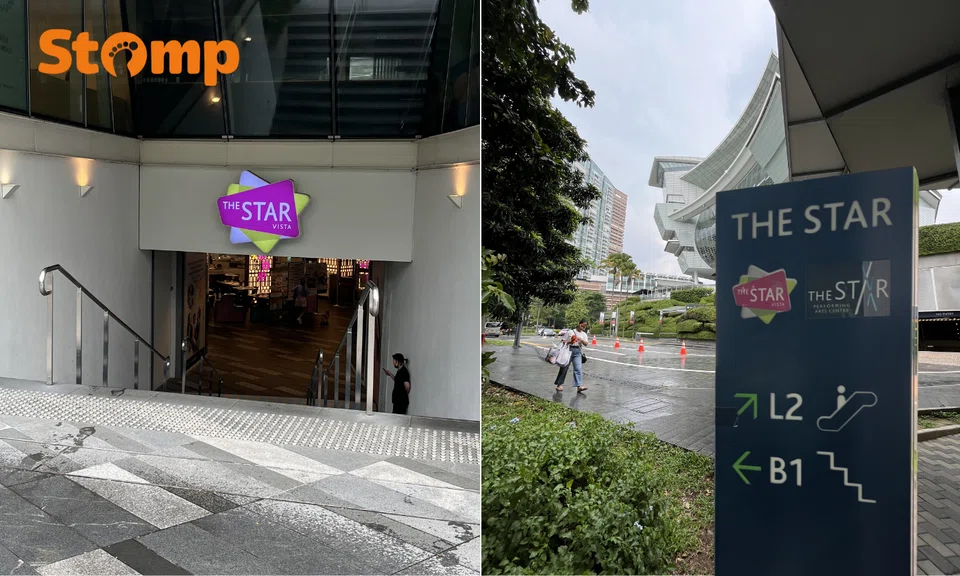
It was a route that Karunandhi described as “not even a walkway”, given the lack of a sheltered path leading to an accessible entrance.
Stomp has reached out to The Star Vista for comment.
Disability advocate speaks up
Fellow disability advocate Warren Sheldon Humphries, 57, echoed Karunanidhi’s sentiments.
Sheldon was diagnosed with Charcot-Marie-Tooth (CMT) disease in April 2020, a neurological condition that causes progressive muscle weakness and loss of sensation. He also underwent a leg amputation in 2024 due to complications from diabetes and currently uses a wheelchair.
Stomp shared our findings with Sheldon, a part-time tour guide with Ludus Lab and learning partnership manager at Blended Concept.
He said: “Based on these photographs and my personal experience at the venues, the accessibility provisions do not appear to be clearly defined or consistently implemented.”
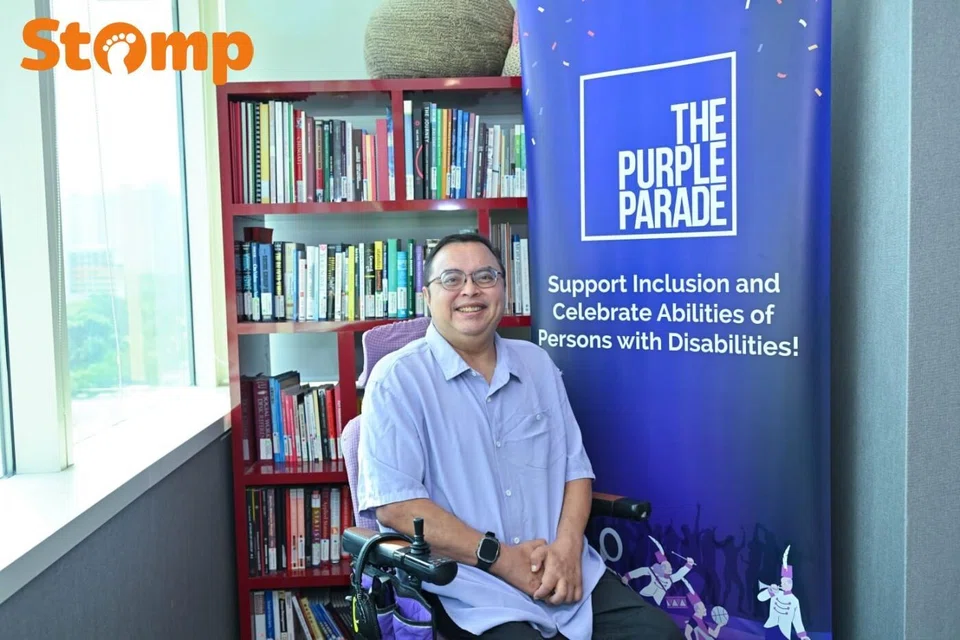
Sheldon said he frequently encounters accessibility challenges, particularly in older housing estates, bus interchanges and MRT stations.
“At times, it seems that accessibility features are introduced only after feedback or complaints are received, serving more as interim measures to address concerns rather than being incorporated as part of a comprehensive and sustainable accessibility plan,” he added.
Under regulations by the Building and Construction Authority (BCA), all public buildings, transport nodes and new developments must comply with accessibility standards.
More accessibility features were made mandatory after BCA updated its Code on Accessibility in the Built Environment last year.
This means wheelchair- and elder-friendly features — such as ramps, larger lifts and more seating areas — must be provided in new buildings.
All key building entrances linking to neighbouring buildings, transport facilities, park connectors and covered walkways must also be wheelchair-accessible. If shelters are to be provided, accessible routes must be given priority.
How accessible is Singapore?
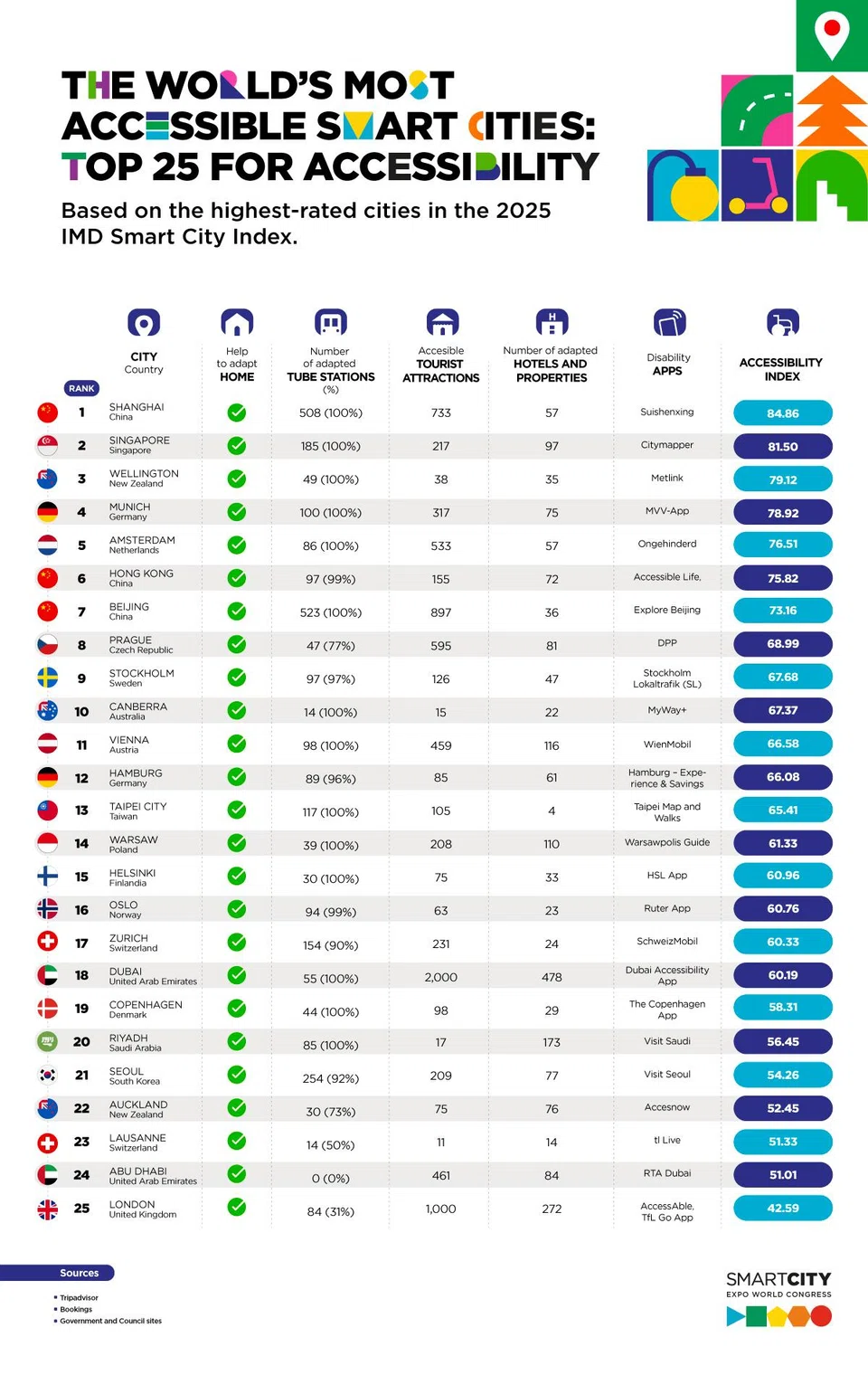
With an accessibility score of 81.5 points, Singapore ranked second on the Smart City Expo World Congress’ 2025 list of top 10 most accessible cities, just behind Shanghai.
Online portal Travel DMC gave Singapore an accessibility rating of 4.5 out of 5 stars for being “among the world’s most wheelchair-friendly cities”. It noted that:
- 100 per cent of MRT stations have lifts and barrier-free access
- All public buses are wheelchair accessible with automatic ramps since 2020
- Major attractions such as Gardens by the Bay, Marina Bay Sands and Singapore Zoo are fully accessible
- Free wheelchair loans are available at Changi Airport, most attractions and many shopping malls
The travel website, however, acknowledged limitations at older shophouses and certain historic districts.
Nonetheless, Karunanidhi feels that more can be done to address accessibility barriers in Singapore.
“Buses (have) seats on raised platforms and to make it worse, (are) facing each other,” he wrote in his letter.
Karunanidhi also hopes that travellators in MRT stations can be safer for wheelchair users.
He and Sheldon are not alone in their concerns.
A 2024 survey by the Disabled People’s Association found that transport and infrastructure accessibility was one of the top issues for 17 per cent of its respondents.
Meanwhile, the number of residents in resident households aged 65 years and over who had mobility issues grew from around 25,500 to 50,000 between 2000 and 2020. This represents 11% and 8% of the resident population aged 65 and above in 2000 and 2020 respectively.
Considering Singapore’s ageing population, the number of persons with disabilities is believed to increase significantly by 2030.
Behind the barriers — and breaking them
SG Enable, the focal agency for disability and inclusion in Singapore, said accessibility is an important aspect of creating inclusive experiences.
A spokesperson for the agency told Stomp: “SG Enable encourages organisations to regularly review their physical spaces, services, and digital platforms to identify and address potential accessibility barriers.”
SG Enable works with businesses across various sectors to strengthen accessibility and inclusion through consultation, capability-building and practical resources, said the spokesperson, adding that it welcomes organisations to get in touch to help make Singapore spaces more inclusive and accessible.
Karunanidhi said many of these challenges remain “undermentioned”, despite affecting persons with disabilities and their caregivers on a daily basis.
“I am not doing this just for the benefit of my daughter,” he told Stomp, adding that these issues are “inconveniences special needs people face daily”.
- Additional reporting by Cherlynn Ng

Explore more on these topics
See something interesting? Contribute your story to us.
