Chinese-only menus spark backlash, some eateries add English translations to reach a wider crowd


Concerns over Chinese-only menus at some eateries have sparked debate — but on the ground, several Chinese restaurants in Singapore are already adapting by adding English translations.
Visits to multiple Chinese restaurants showed that while most now offer at least basic English alongside Chinese on their menus, some only introduced translations after opening.
Of the six restaurants and stalls Stomp approached, three said they had English translations from the outset, while the others added them later. Several other establishments did not respond to queries.
Chinese hotpot and barbecue restaurant Jiu Gong Ge, for instance, opened in 2013 with a Chinese-only menu. After receiving feedback from customers who had difficulty understanding it, the restaurant added an English version in its second year.
Its manager, who wished to be known only as Carine, told Stomp the move was aimed at improving the dining experience and make ordering easier for non-Chinese customers, especially given its location at Bugis Cube, which sees many tourists.
Customer base became ‘more diverse’
In Singapore, where most people are English-educated, Carine noted that many customers are more accustomed to reading English menus, though a minority still prefer the Chinese menus.
Since introducing English translations, she said the restaurant has attracted a broader mix of customers, with its overall base becoming “more diverse”.
Carine added that the restaurant now requires staff to have basic English communication skills, though proficiency levels vary among employees.
At Xia Lao San noodles in Chinatown, owner Xia Ze Ping, 56, said the cart stall has been operating for about a month, serving Chongqing noodles.
Its menu is largely in Chinese, with only a handful of items translated into English, such as 豪华牛肉面, which is directly translated to “deluxe beef noodle”.
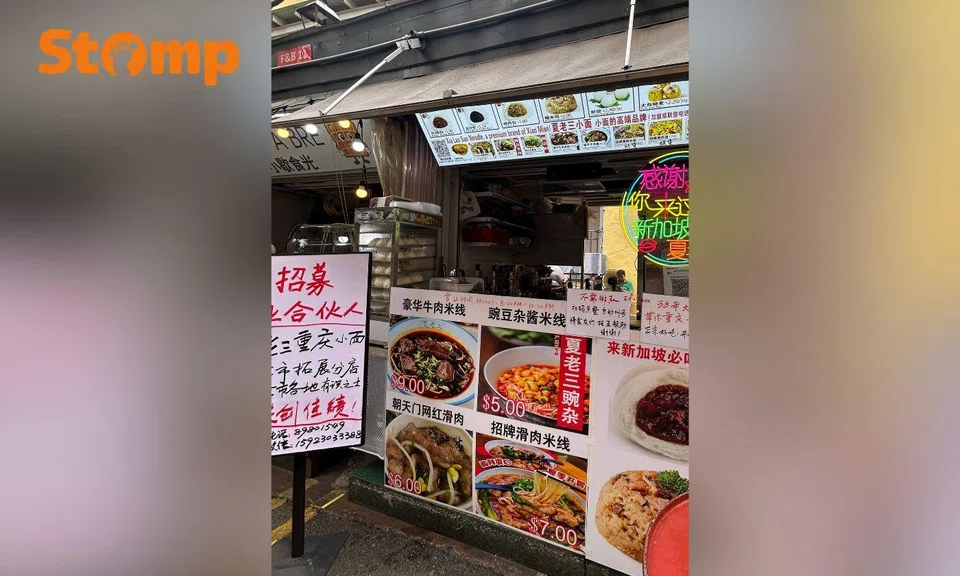
Mr Xia said that while the stall draws “all kinds of customers”, some tourists and foreigners do occasionally struggle with the menu.
He added that space constraints on the stall’s posters and boards make it difficult to include English translations, but acknowledged they are needed and said he plans to look into it in the near future.
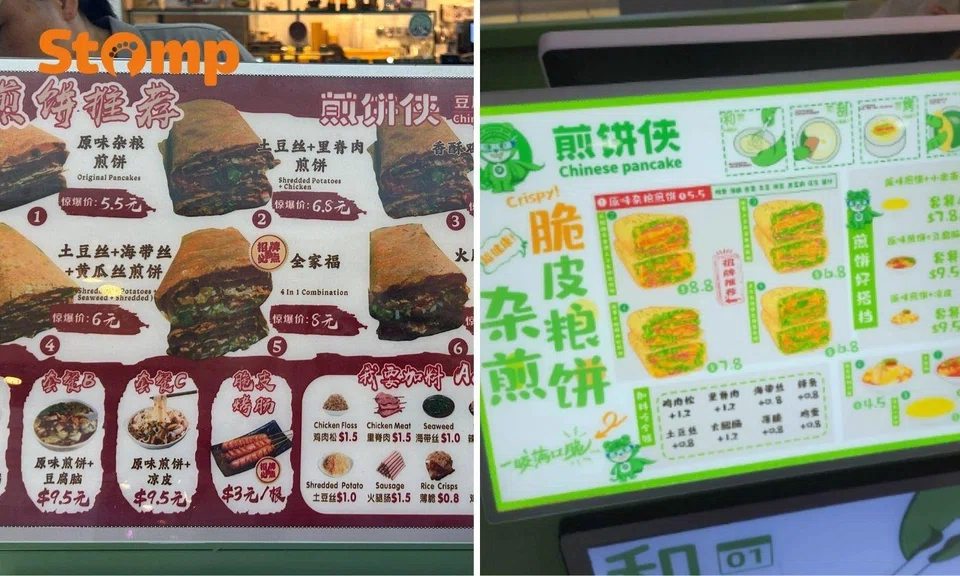
At a Chinese crispy pancake stall in Clementi’s Grantral mall, a staff member told Stomp the stall has been operating for about two years, serving Shandong-style pancakes to a mix of customers.
She added that the stall now offers both Chinese and English on its menu, after drawing earlier criticism in a 2025 article and a Reddit thread over the lack of English translations.
A photo from the Reddit thread showed a Chinese-only, which has since been replaced with a newer bilingual version. The stall did not respond to queries about the change.
Popular chain Xiang Xiang Hunan Cuisine, which has over 20 outlets islandwide, has also reportedly updated its menu to correct some English translations. The chain did not respond to Stomp’s queries.
English translations ‘very much needed’: Restaurants
Meanwhile, other Chinese eateries Stomp spoke to said they had English menus from the outset, calling them essential.
A staff member of Mian Mian Meet Noodles who wished to be known only as Marg, said the stall, which serves la mian (pulled noodles), has operated at Clementi’s Grantral mall for eight years, with additional outlets at Bras Basah and Tiong Bahru.
While its customers are mainly Chinese students, it also serves many locals.
“You cannot just have Chinese-only menus because there are a lot of foreigners, and also people who are not very familiar with Mandarin,” said Marg, calling English translations “very much needed in Singapore”.
Similarly, the manager of Qiao Lu Roasted Duck at Bugis Cube, who wished to be known only as Louis, said it is “very important” to offer both Chinese and English menus, given its mix of local and foreign customers.
“If you want to open a shop here, you should take into account not just Chinese customers, but locals and foreigners as well,” he said, adding that difficulty understanding the menu can affect the overall dining experience.
55% do not support Chinese-only menus: Poll
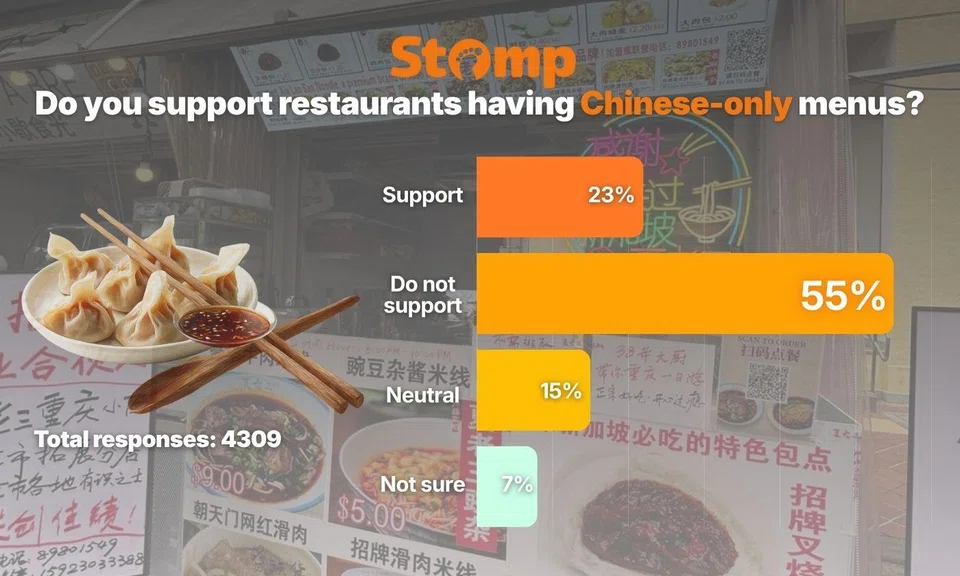
Amid the ongoing debate, a Stomp poll found that 55 per cent of 4,309 respondents do not support restaurants with Chinese-only menus.
Another 23 per cent supported them, 15 per cent were neutral, while seven per cent were unsure.
In an early April Reddit thread discussing the growing presence of Chinese brands in Singapore, users pointed out that some outlets operate primarily in Chinese across menus, ordering systems and staff communication.



The post, which drew more than 300 comments, noted that although Singapore is a multicultural country, such practices may feel “excluding” to non-Chinese speakers.
Even Scarlett Supermarket, a Singapore-based chain selling Chinese products, came under scrutiny in September 2021 for products without English labels, prompting investigations.
Under Singapore Food Agency (SFA) regulations, key information on packaged food products must be labelled in English.
However, visits to Scarlett’s Clementi branch found that most product labels were still entirely in Chinese.
In response to queries, a Scarlett spokesperson said the chain is continuously reviewing its in-store materials and customer experience to better serve a diverse customer base, adding that staff can assist customers in English where needed.
Even Chinese speakers ‘struggle’ to order
Interviews with customers found that both non-Chinese and Chinese-speaking diners sometimes struggle to order at Chinese restaurants due to the lack of, or inaccurate, English translations.
Frequent diner R Mahkeswaran told Stomp that such places often have Chinese-only menus or inaccurate English translations, along with mostly Chinese-speaking staff.
The 31-year-old engineer said usually relies on Chinese-speaking friends to help him order, or points to pictures on the menu.
He added that he also makes it a point to remember the names of his favourite dishes.
Wendy Lee, a Singaporean Chinese, echoed similar sentiments, saying she uses Google Translate or menu photos to order when she cannot understand the menu.
The 24-year-old student said she has seen others struggle to order, especially when menus lack images.
Mr Mahkeswaran also said he has seen customers leave in frustration.
A Filipino diner, who wished to be known only as Mr S, said even Chinese speakers may not recognise certain characters on the menu.
The 25-year-old civil servant said he tends to avoid such eateries for convenience, unless they are “worth the effort” due to good reviews or positive dining experiences.
“But as long as the staff are able to receive my order and deliver what I ask for, I feel like that bare minimum is enough for me,” he added.
Ms Lee, who believes in the “free market”, said restaurants can hire whoever they want, adding that she returns based on food quality and overall dining experience — not whether she can understand the menu or communicate easily with staff.
In a multilingual city like Singapore, Mr S said English, as a common language, should still act as a “bridge” to help people connect and enjoy each other’s cultures.
Chinese-only menus are ‘self-limiting’: Experts
Speaking to Stomp, business expert David Gomulya from Singapore Management University said Chinese businesses are expanding into Singapore due to its strong spending power and cultural familiarity, as well as strong competition in China’s F&B market.
However, he noted that Chinese-only menus or limited English translations may be driven by practical reasons — such as standardisation, staff training or signalling authenticity — but are ultimately “self limiting” in a diverse market.
Business expert Ang Swee Hoon from the National University of Singapore agreed, saying such practices may divide customers along racial lines and “curtail” business growth.
She added that Chinese-only menus may give the impression that non-Mandarin speaking customers are not welcome, which could harm an establishment’s reputation.
“Such exclusivity can potentially undermine the social fabric of the Singapore economy that is built on non-ethnic grounds,” she said.
Ultimately, Prof Ang said a brand’s identity is shaped more by the type of food it offers than by the type of customers it attracts.
Prof Gomulya added that the “winning formula” for success is striking a balance between a strong core identity and localising non-core aspects.

Explore more on these topics
See something interesting? Contribute your story to us.
