Young S'poreans are not selfish for not wanting kids

Young Singaporeans are not selfish for not wanting children, and I, for one, can attest to that.
I’m 26 this year and waiting for my BTO flat to be completed in 2030. When the keys arrive, I’ll be 30 and staring at a housing loan of over $500,000.
My partner and I earn a combined income of roughly $7,000 a month. After insurance, daily expenses and setting aside savings, there isn’t that much buffer left.
Yet, at every family gathering, the questions come like clockwork:
“When you BTO? When you getting married? When you having kids?”
It’s both annoying and pressurising, isn’t it?
As a young adult navigating the workforce, newfound financial independence in a high cost-of-living environment, and the elusive work-life balance, I now also face the societal pressure to settle down and start a family.
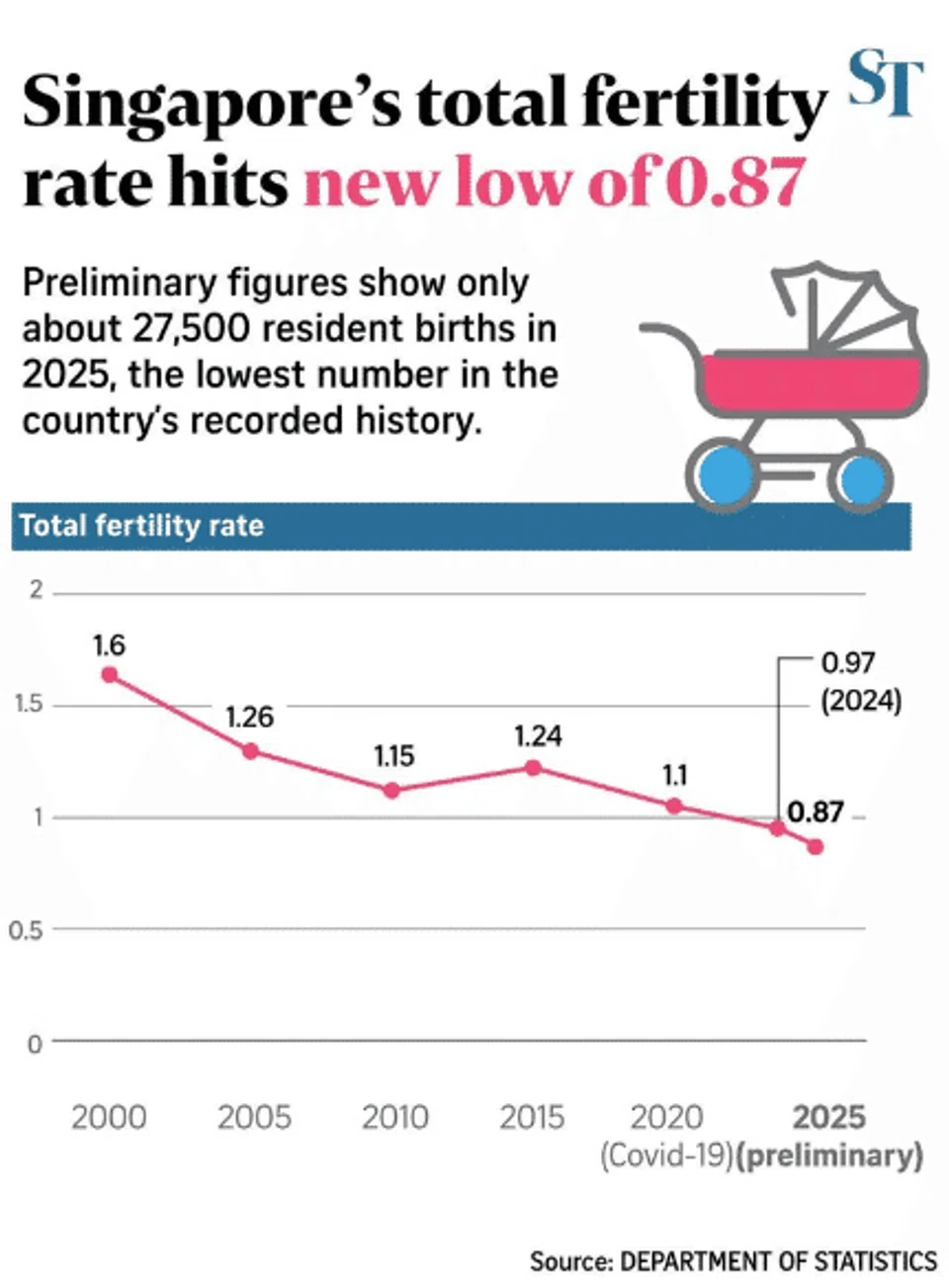
On Feb 26, it was reported that Singapore’s resident total fertility rate (TFR) has sunk to a new low of 0.87 in 2025. With birth rates falling at an unprecedented pace, the nation’s citizen population may begin to shrink by the early 2040s without new interventions, Deputy Prime Minister Gan Kim Yong said.
When Minister in the Prime Minister’s Office Indranee Rajah proposed a “marriage and parenthood reset” and the formation of a new work group to review related issues, online reactions were largely sceptical. Many pointed to broader systemic challenges such as the rising cost of living.
There is no denying that birth rates are declining. But young Singaporeans should not be blamed for what many see as a rational decision to forgo having children — at least for now.
‘How to have baby?’
I’m not anti-children. I always wondered what it'd be like having a kid of my own.
But raising a child today demands immense time, energy and money — resources many of us already lack.
Infant care alone costs about $1,300 a month. Even after basic subsidies for Singaporean citizens, most parents still pay around $700. Additional subsidies are available, but they depend on household income.
Realistically, if I focus on building my career first, my income may be higher by the time I’m ready for a child — which means I may qualify for less help.
Add diapers, formula, insurance, enrichment classes and unexpected medical bills, and that number climbs quickly. That’s before primary school tuition even enters the picture.
When I do the math in my head, parenthood shifts from an aspiration to a massive financial and emotional commitment that I’m not sure I’m ready for.
Online sentiments have reflected just that. Many have taken to social media to cite financial stability, stress, work-life balance, career prospects, and mental and physical health as reasons for delaying or avoiding parenthood.
On March 2, TikToker @leethenomad00 suggested that Singapore should “fix the stress issues” by scrapping the Primary School Leaving Examination (PSLE), arguing that it would allow children to have more fun and parents to “chill”.
He described parents in Singapore as “the most stressed in the world”, noting that many feel compelled to go through national exams alongside their children, or fork out large sums for tuition if they cannot.
He also highlighted how expensive private spaces and housing are, making it difficult for young adults to move out before the age of 30.
TikToker @benwoah shared similar views on Feb 27, pointing to the rising cost of living: “Everything increasing except our salary,” he said.
Highlighting large housing loans, the miscellaneous costs of raising a child, and the lack of work-life balance, he asked plainly: “How to have baby?”
“Right now, even surviving in Singapore is already a full-time job,” he added.
I couldn't agree more.



Raising a child today is a complex decision
A TFR of 0.87 is certainly alarming, but the reality in Singapore is stark.
I often find myself weighing the trade-offs: Can I realistically raise a child while pursuing my career, maintaining my health, nurturing personal passions, or simply feeling financially stable? Often, the answer is no.
Yet society continues to frame this choice as selfish or short-sighted.
As my grandmother tells me: “Just because you have no money doesn’t mean you don’t have children. You cannot think like that, if not the world won’t have children.”
While it’s a sentiment rooted in tradition and optimism, it misses a crucial point: raising a child today is a complex, high-stakes decision.
I’m already following the so-called Singaporean dream. But when my BTO keys arrive, I’ll be knee-deep in debt, managing a long-term loan. Having a child soon after that would not be ideal — it would be financially reckless.
Parenthood in modern Singapore is not simply about love or willingness. It’s about time, resources and structural support.
To be fair, the government has introduced various policies and subsidies aimed at easing the burden. Baby bonuses, enhanced parental leave, housing grants and childcare subsidies exist.
In the recent Budget, it was announced that families with Singaporean children aged 12 and below will receive $500 in Child LifeSG credits per child, which can be used to pay for groceries, utilities, and more.
Shared parental leave will increase from six to 10 weeks from April 1, 2026.
These measures help, but they cannot fully counterbalance broader and longer-term economic pressures.
Instead, we should consider the thoughtful and pragmatic suggestions raised by several Members of Parliament during the recent parliamentary sitting.
Jalan Besar MP Shawn Loh proposed that any “unexpected fiscal surpluses” be shared with citizens. Acknowledging that parenthood is a “deeply personal decision”, he argued that the government can promise Singaporeans that the “basic cost of child raising should never be a barrier to having children”.
He described LifeSG credits as a “small move in the right direction”, but stressed that more could be done — including making basic childcare, infant care and student care free.
Nadia Samdin, MP for Ang Mo Kio, proposed adjusting childcare leave “proportionately” to the number of children a couple has, enhancing flexible working arrangements further, normalising career pauses and supporting workforce re-entry for both men and women.
She described such measures as “crucial” for modern dual-income households, calling them the “invisible infrastructure of fertility”.
Financial and structural support can make a difference
Declining birth rates are not unique to Singapore. Hong Kong and South Korea have also seen sustained drops.
South Korea, which recorded the world’s lowest TFR at 0.72, offers some lessons.
According to CNA, the government injected 366.7 trillion won (S$316.7 billion) over more than a decade into childcare subsidies, cash grants and housing incentives, and has managed to nudge its birth rate up in recent years.
The lesson is clear: financial and structural support can make a difference. Fertility responds to the environment in which young adults live, work and raise families.
Viewed through this lens, young Singaporeans are not rejecting parenthood out of indifference or sheer rebellion.
Many of us, myself included, are simply navigating high costs, long work hours, and structural hurdles — and making rational decisions about whether to have kids.
Instead of chiding us and piling immense pressure on our shoulders, perhaps it’s time to ask deeper questions.
And perhaps the real selfishness lies in expecting people to have children at the expense of their livelihoods, well-being, and ability to provide properly for the next generation.
Hot Takes are opinion pieces written by Stomp journalists, based on their personal experiences and viewpoints. They reflect the writer's perspective and do not necessarily reflect the views of SPH Media.

See something interesting? Contribute your story to us.
