Dog beneath ‘No Pets’ sign at Hougang coffee shop makes Stomper ponder ‘funny contradiction’


A dog sitting quietly at a Hougang coffee shop has prompted one woman to question whether Singapore’s strict no-pets rule at food establishments matches how the rule is actually enforced — and she’s not complaining.
Stomper Carol was having a meal with her family at a coffee shop along Hougang Avenue 5 at around 1pm on Aug 8 when she noticed the dog.
What caught her attention was not just the animal, but the fact that it was seated under a laminated “No Pets Allowed” sign mounted on a pillar.
“My first reaction wasn’t annoyance — it was more curiosity,” she said.
“It felt like a funny little contradiction rather than something that upset me.”
The dog, she said, remained calm throughout the family’s meal, only occasionally reacting to noises from nearby tables.
“It wasn’t begging, wandering, or bothering anyone,” Carol said.
“Not causing trouble. Not begging for scraps. Just... there, patiently waiting while its owners ate their chicken rice and sipped their Kopi-O,” the Stomper recounted.
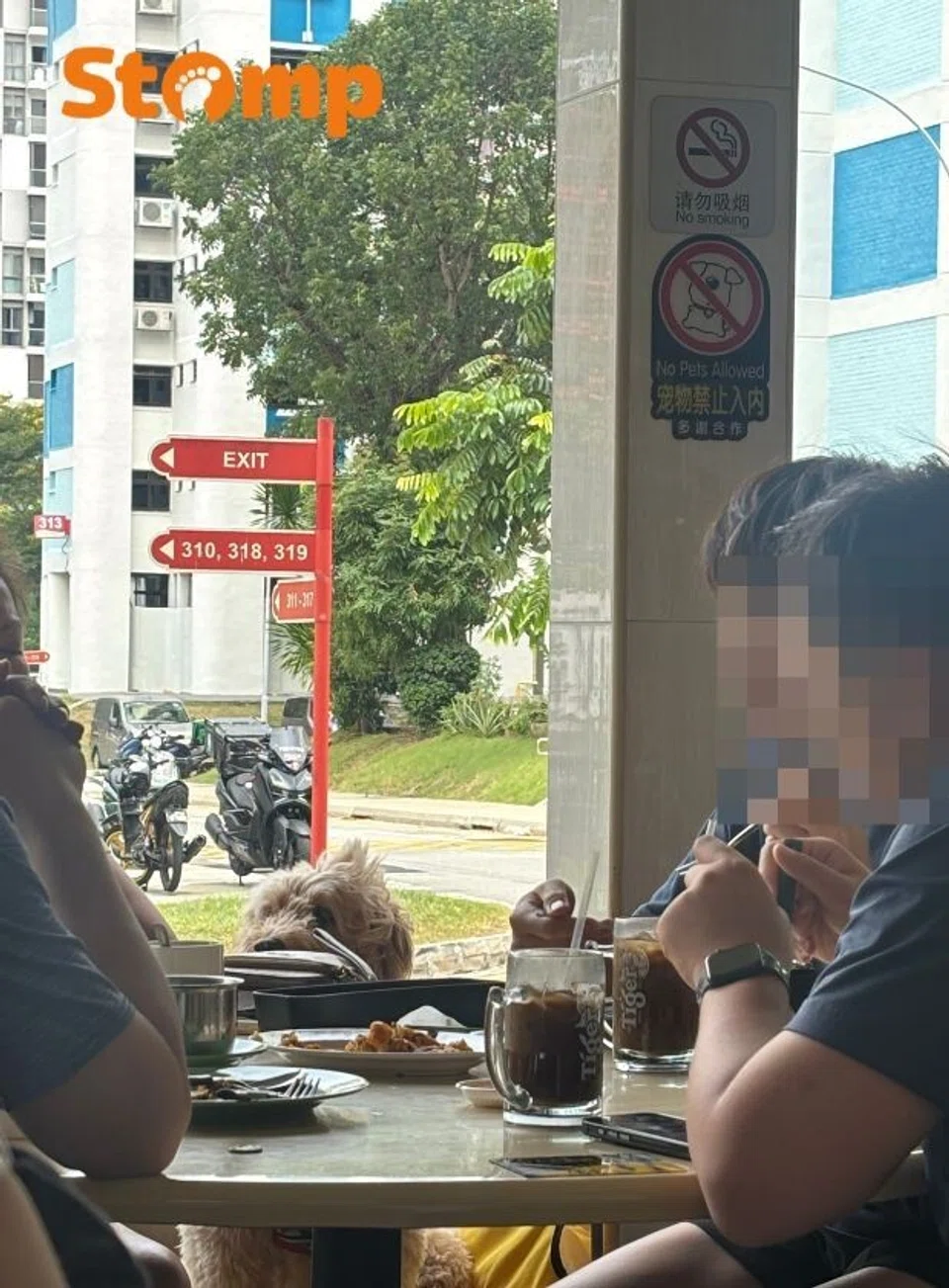
She did not approach the owners or report the incident to the coffee shop or authorities, as she did not consider it a hygiene concern.
Instead, the encounter got her thinking about the gap between Singapore’s written rules and how they are enforced in everyday life.
Are rules just guidelines?
Carol said the "No Pets” sign was unambiguous, but seeing the dog seated near it made her wonder whether such rules are sometimes being treated more as guidelines than hard-and-fast restrictions.
“We’ve all seen this pattern before — rules that are unambiguous in wording but soft in enforcement,” she said, citing the example of uncles who smoke at coffee shops near “No Smoking” signs.
She added: “Nobody stops them. Nobody’s called over. Life continues, coffee gets refilled, and the sign just becomes part of the wallpaper.”
To Carol, the issue is not about "getting” one dog owner who seems to have bent the rules, but something more integral to Singapore’s culture.
“I think it’s a small window into how Singapore actually functions day to day: a country famous for its precision and enforcement, but which also runs, quietly, on a huge amount of discretionary tolerance.”
She believes the rules serve as a backstop should something go wrong, such as a complaint, health concern or a dog biting someone.



“Until then, everyone just sort of looks the other way, as long as the dog behaves and nobody’s bothered,” she said.
Should we be more flexible?
Carol understands why pets are not usually allowed in food establishments.
“Hygiene rules in food environments exist for real reasons — shedding fur, allergens, the general unpredictability of animals around strangers eating with their hands,” she said.
She also acknowledged that a blanket ban is perhaps easier to understand and enforce than requiring staff to decide whether individual pets are sufficiently well behaved.
Still, watching the dog at the coffee shop, she found it difficult to see it as a threat to public health.
“It was better behaved than some of the people at the table,” she quipped.
Carol said she is neither advocating for a blanket removal of the no-pets rule at coffee shops and hawker centres nor is she asking for a complete ban of pets.
Instead, she thinks there could be value in authorities exploring whether there is room for greater flexibility, such as allowing small, leashed and well-behaved pets in certain circumstances.
“Maybe the more honest conversation is about whether the rule as written still matches how people actually want to live,” she said.
“Because right now, there’s a real mismatch between the laminated sign on the pillar and the dog curled up two feet beneath it, and neither the sign nor the dog seems to be going anywhere.”
According to the Singapore Food Agency (SFA), food businesses are not required to seek additional approval from the agency to allow diners to bring pets along when dining at Outdoor Refreshment Areas (ORAs).
ORAs are defined by SFA as “refreshment areas outside the main structure of buildings or the food premises that are not enclosed, even if under shelter”. These areas must also be accessible without needing to go through food premises.
The Stomper hopes the incident will prompt readers to think about whether rules should be consistently enforced or reconsidered if they no longer reflect how people use shared spaces.
“Next time you’re at a coffee shop, look around,” she said.
“You might spot the same quiet contradiction I did.”

Explore more on these topics
See something interesting? Contribute your story to us.
