Slow-travel blueprint: Singapore retirees stayed in eight cities so far in 2026 on $4,000 a month
Stephanie Yeo
The Straits Times
Nov 14, 2026
With just a large suitcase and backpack each, Alan Wah, 56, and Wendy Tay, 54, have made their home in eight destinations overseas so far in 2026.
The Singaporean couple kicked off their post-retirement slow-travel journey in January with a 27-day stay in Bali. The plan was to set up a base in a different place every month.
In February, they moved to Granada in southern Spain, after which they lived in Portugal’s capital, Lisbon, in March.
They next moved to Porto in Portugal’s north-west in April, before joining friends for a tour of Morocco in mid-May.
Tirana, capital of Albania in the Balkans, became their home later in May. They returned to Asia in late June, staying mostly in Johor Bahru, before flying to Tokyo in September.
They have dwelt in Bangkok since October, although they returned to Singapore briefly in the same month, during which The Straits Times interviewed them.
Theirs is a second act in more ways than one.
The couple were colleagues in a shipping firm in their 20s and later lost touch. They reconnected about two decades later on social media platform Facebook in 2011, by which time both were divorced.
They married two years later in 2013. Wah has a child from his previous marriage who is now a young adult, and Tay has no children.
Both had travelled frequently for work – Wah as a senior leader in the technology industry here, and Tay in Hong Kong as cabin crew with Cathay Pacific for two decades. She later worked in customer service roles in different industries.
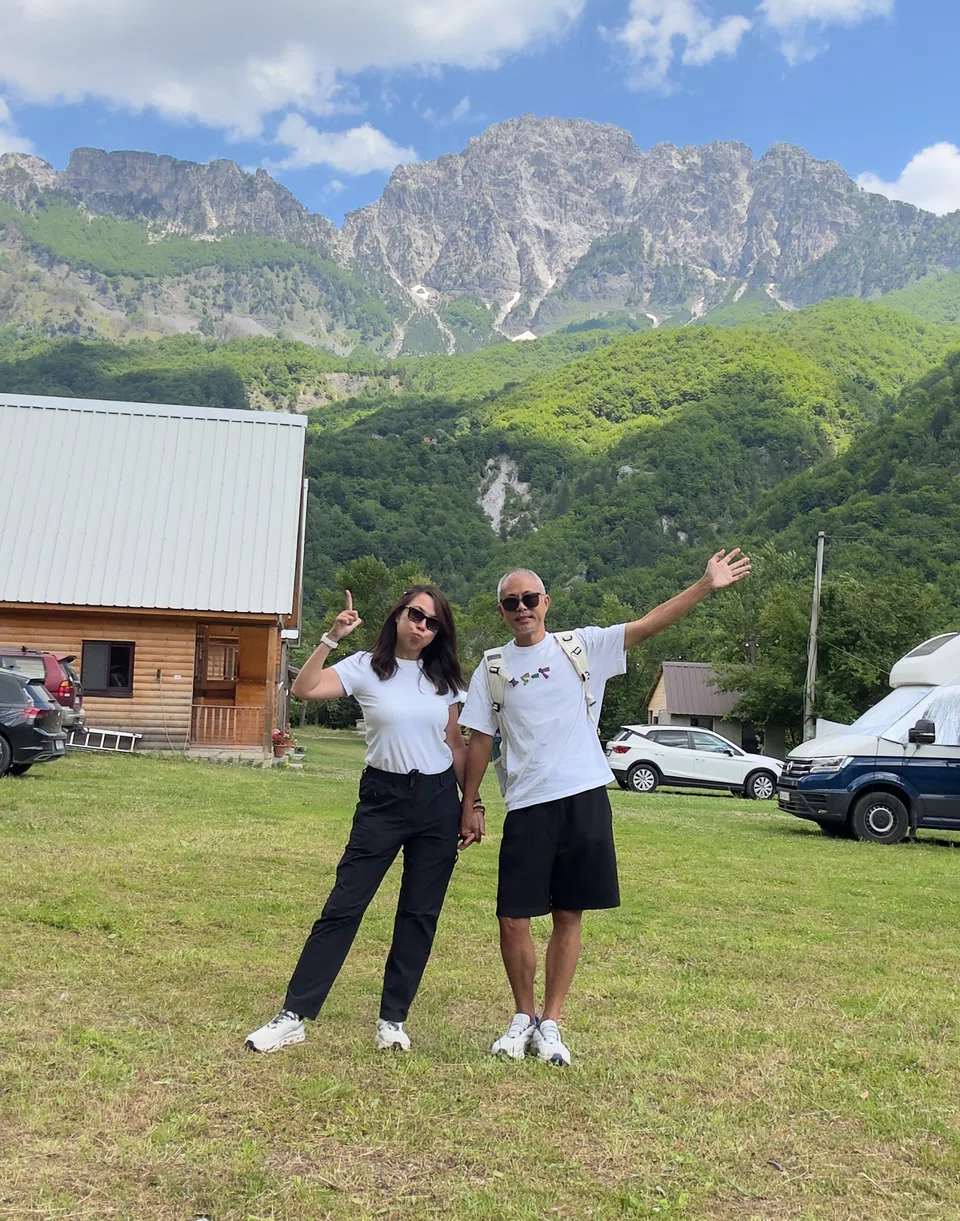
The idea of slow travel appealed to them as they wanted to experience a different retirement-focused lifestyle, stretch their dollar and avoid flying in and out of Singapore frequently, which would be costly.
“Our initial plan was to find a cheaper place to retire in, like Bali or Thailand, but that meant we wouldn’t have the budget to travel. So we thought that we would travel around before we embarked on a fixed retirement location,” says Tay.
Wah, who retired in July 2025, adds: “We have been working very hard and I didn’t want to have to set my alarm for 8am every day. We wanted to take it slow.”
Before starting their global adventure, they did a month-long trial stay in Bali in October 2025, during which they learnt to ride scooters, the most convenient mode of transport there. The Island of the Gods holds special meaning since they tied the knot there.
Emboldened by the ease with which they settled into everyday rituals like going to the market, cooking at home and watching TV, Tay quit her job and they flew back to Bali in January to start their new nomadic lifestyle.
They said goodbye to their Porsche 987 Cayman and found a tenant for their one-bedroom apartment in the Central Business District. Everything else was housed in a storage unit.
Tay started a public Facebook page called Soluna Days to document their journey, including sharing tips and living costs. It has more than 2,500 followers. They also have an Instagram page (@solunadays) and an account on Lemon8 (@blackiejackcorner).
Logistics of slow travel
The couple decided on a budget of $4,000 for monthly expenses such as apartment rental, food, on-ground transport and incidentals. The rent from their Singapore apartment and passive income from investments cover this.
This figure excludes airfare, travel insurance and mobile phone data plans. Tay’s former cabin crew status allows her to buy standby tickets for both of them at a discount for certain destinations.
Such a budget works comfortably within Asia, but they had to find alternatives to the more popular and pricier cities in Europe.
They also had to be mindful of the Schengen 90-day rule, which allows non-European Union nationals to stay in the Schengen area for up to 90 days in any 180-day period. The Schengen area covers 29 countries and excludes Morocco and Albania.

Spain was on their bucket list, but instead of Madrid, the capital, or Barcelona, they chose to live in lower-cost Granada, a place they had admired in the 2018 K-drama Memories Of The Alhambra.
Airbnb rentals typically took up half their budget as they opted for accommodation at least 600 sq ft in size with a kitchen and balcony. For instance, their pool villa in Bali cost $2,000 for 27 nights, while a one-bedroom apartment in central Granada cost $2,200 for 30 nights.
The couple also picked up some costly lessons along the way.
In Tokyo and Bali, they had to jettison their accommodation bookings for hygiene reasons.
In Tokyo, for instance, the apartment’s musty smell made Tay’s eyes water and they were not allowed to open the windows. They forfeited the $1,700 fee after three days and found better accommodation, but ended up busting their $4,000 budget.
The couple also assumed that accommodation with a kitchen came with a stove or hob, but some apartments had just an air fryer or microwave, making cooking Asian food difficult.
In Europe, meals were mostly home-cooked as produce was fresh and affordable, while eating out was expensive.
Their Singaporean palates missed local favourites, so Tay whipped up dishes like lor bak and bak kut teh using pre-mixes. Wah even packed 2kg of jasmine rice because he was unsure if he could find it in Europe.


They ate out about three lunches a week in places where restaurants cost a pretty penny. Conversely, they cooked less when dining out was cheaper, like in JB and Bangkok.
While some of their Facebook followers exhort them to live it up overseas, Wah sees the value of financial longevity.
“When you’re doing slow travel after retirement, it’s not only about tomorrow, but also about 10 or 20 years down the road. We can splurge now, but what about later on? We have to have the discipline,” he says.
Since they have the means to travel, he says they are doing it now, when they are still relatively healthy, rather than wait until they are older.
He says: “If you can do it, then do it because you never know what will happen tomorrow.”
Be prepared for anything
The couple credit their ability to go with the flow as the reason they have been successful in slow travel.
“We are very flexible in our travel arrangements; we don’t have fixed itineraries. If we feel like going to this place, then we plan. That is part of the excitement,” Wah says.
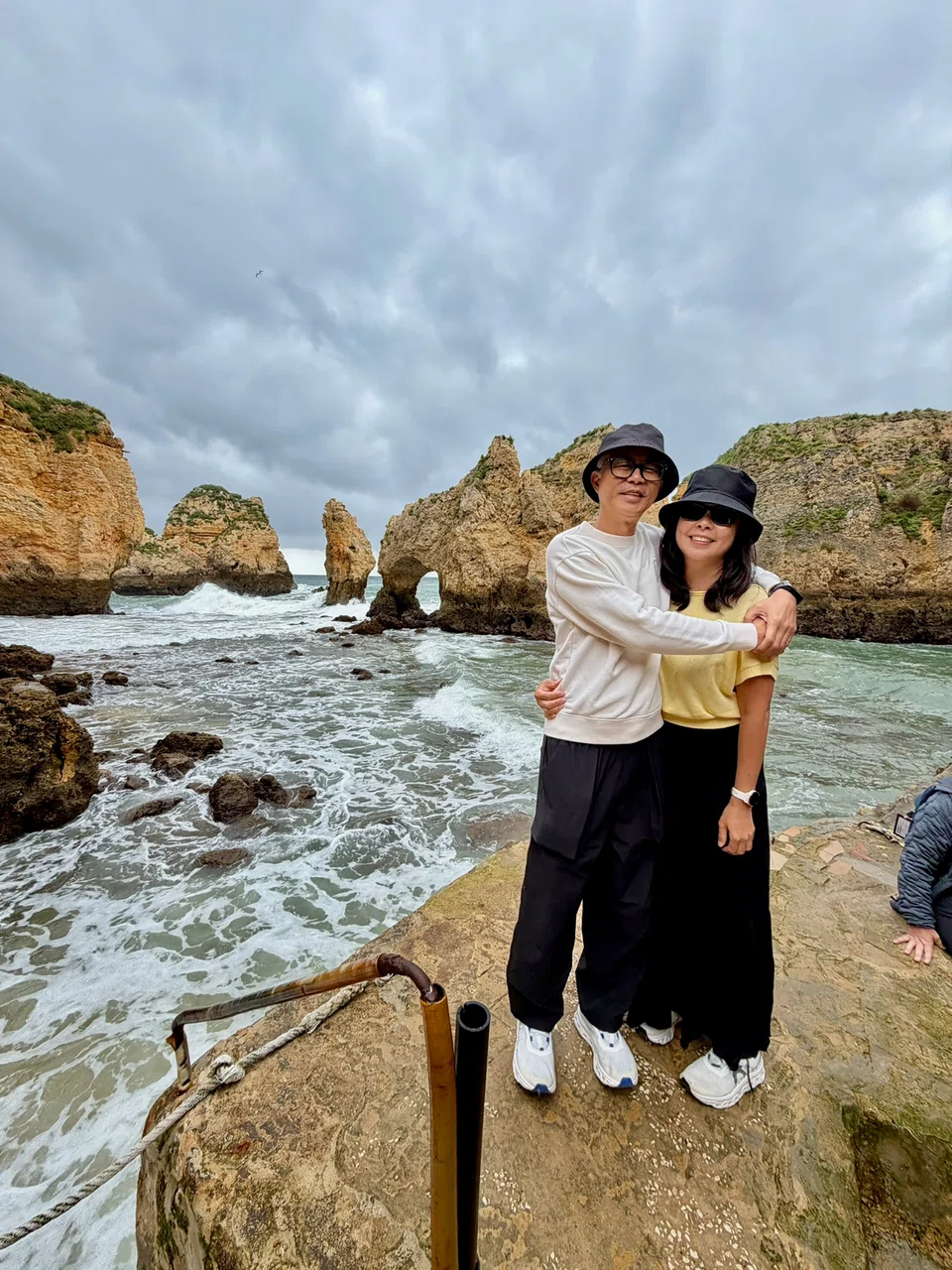
While in Lisbon, they spontaneously decided on a four-day road trip to the Algarve region in southern Portugal, famed for its coastal scenery and beaches.
During their stay in Porto, friends from Singapore invited them on an 11-day tour of Morocco in May, so they postponed the Albanian leg of their journey.
Morocco was a base they had considered for slow travel, but found unsuitable because of the lack of Chinese grocery items.
Over the year, the couple have pared down their lean belongings as they grow more accustomed to living out of a suitcase.
Their initial three 23kg suitcases became two so they could save on extra baggage costs on intra-Europe flights. Tay gave up lugging along her buckwheat neck roll pillow after a while, and both she and Wah travel with just one pair of shoes and slippers each.
“These things are just extra and unnecessary. Why do you need to take along 10 T-shirts? You just need three,” Tay quips.
Still, unforeseen challenges tested their adaptability.
They cancelled their plan to move to North Macedonia when their tenant in Singapore was retrenched in late June and had to leave Singapore within a month if he could not find another job in time.
They flew back to Asia and rented an apartment in JB, which was cheaper than one in Singapore.
At one point, they moved back into their Singapore home for about two weeks while searching for another tenant. Once that was settled, they resumed their travels in September.

In October, Tay came down with a high fever of 39.6 deg C in Bangkok, which necessitated a visit to the hospital emergency department. The $650 bill was reimbursed by their travel insurance plan.
Tay’s back issues have also delayed their next trip to Yunnan in China, now slated for December.
“I don’t think we really have had very low moments. They’re more like inconveniences,” Wah says.
After China, they are considering Chiang Mai, which both have heard is a good retirement hub. They hope to move to Europe in late 2027 to experience winter there.
Looking back, Wah says: “The year has gone by so fast. I was initially quite sceptical about this. We would have to pack and unpack, and maybe it would be hard to find an Asian supermarket. But it’s actually not so bad.
“We also realised that people are quite nice. Even in small towns, they will come up and say: ‘Hey, where are you from?’
“Now, we are thinking, can we stay longer in each place, like two months?”
Breaking down the costs
Wah and Tay broke down how much they spent in four cities on everyday living expenses:
Tirana, Albania
- One-bedroom apartment: $1,600
- Groceries and dining out: $1,130
- Four-day trip to Theth: $640
- Two-day trip to Berat: $230
- Total expenses: $3,600
Bangkok, Thailand
- Detached house: $1,530
- Dining out: $790
- Groceries: $237
- Transport: $324
- Total expenses: $2,881
Granada, Spain
- One-bedroom apartment: $2,200
- Dining out: $800
- Groceries and miscellaneous: $1,000
- Total expenses: $4,000
Tokyo, Japan
- Forfeited rent for first apartment: $1,700
- Two-bedroom apartment: $2,100
- Groceries: $406
- Dining out: $1,271
- Transport: $328
- Total expenses: $5,805
Note: In Bangkok, the couple incurred extra expenses for a visa extension, a one-night stay in a hotel and a $650 emergency hospital visit. The medical cost was reimbursed by their travel insurer. Expenses listed do not include airfare, mobile phone plans, streaming service subscriptions and annual travel insurance, as well as some airport transport.

Explore more on these topics
See something interesting? Contribute your story to us.
