‘He planned our anniversary 2 days before he died’: Wife, 36, recalls late husband’s heartbreaking battle with ALS

On Aug 18, Nur Aisyah Gersali was enjoying the 13th anniversary dinner that her husband, Mark Adam Collins, had planned for them at home.
Little did she know it would be their last celebration together.
“Before (he fell ill), planning may not be his favourite activity but on that day, he planned everything,” the 36-year-old school teacher shared.
With the help of his children, Collins managed to put the celebration together despite his limited mobility. He ordered a feast for the whole family, planned an activity for their two children and surprised his wife with a cake that evening.
“I asked him, ‘Did you plan all this?’,” Aisyah said, smiling at the memory.
“He just laughed and said, ‘Yeah, I did.’ Like as if (to ask), ‘Are you proud of me?’”
Two days later, on Aug 20, Collins died peacefully at home after a two-year battle with amyotrophic lateral sclerosis (ALS).
Seeing him take his last breaths
Speaking to Stomp at her Woodlands home, Aisyah said her husband “passed away quietly in his chair”.
She was at work when she received a call from her domestic helper, who was at home with Collins.
Aisyah immediately called an ambulance and watched the chaos unfold through her home CCTV as she rushed home. She saw paramedics rushing in, trying to revive him.
“I knew he was gone. He was not moving. His skin had turned rather gray.”
Looking back at the footage from the minutes before her helper’s frantic phone call, Aisyah saw Collins fall to his side, jerk twice and take his last breaths.
To this day, she does not know the real cause of his death.
“We only know that it was his time,” she said.
The first signs of ALS and diagnosis
Aisyah shared that her husband’s ALS first made itself known through “several random symptoms”.
Also known as Lou Gehrig’s disease, ALS is a progressive nervous system disease that destroys nerve cells in the brain and spinal cord. Those with the illness eventually lose control of voluntary muscle movements such as walking, talking and, eventually, breathing.
Once a “very active” person and typically a good speaker, Collins first began showing signs of the illness in 2023 when he had trouble speaking.
During a string of Zoom meetings, Collins, a software and content professional, suddenly realised he was unable to say the word “opportunities”.
He kept stumbling over the word, and did the same with other words that were “too long”.
Later, he suffered a fall and injured his arm. Instead of recovering, his arm gradually became weaker and eventually “much skinnier than the other”.
Friends and loved ones began to notice and commented that he “just didn’t look very well”, pointing out how different he seemed compared to before.
In 2024, Collins was hospitalised at National University Hospital, where he was considered a fall risk.
After undergoing a magnetic resonance imaging (MRI) scan and ruling out other possible conditions, doctors deduced that he was suffering from ALS.
“They did not dare to diagnose ALS immediately, because there is no particular test where you can confirm that,” Aisyah recalled.
Doctors then told him there was currently no cure and that he could have only two to five years to live.
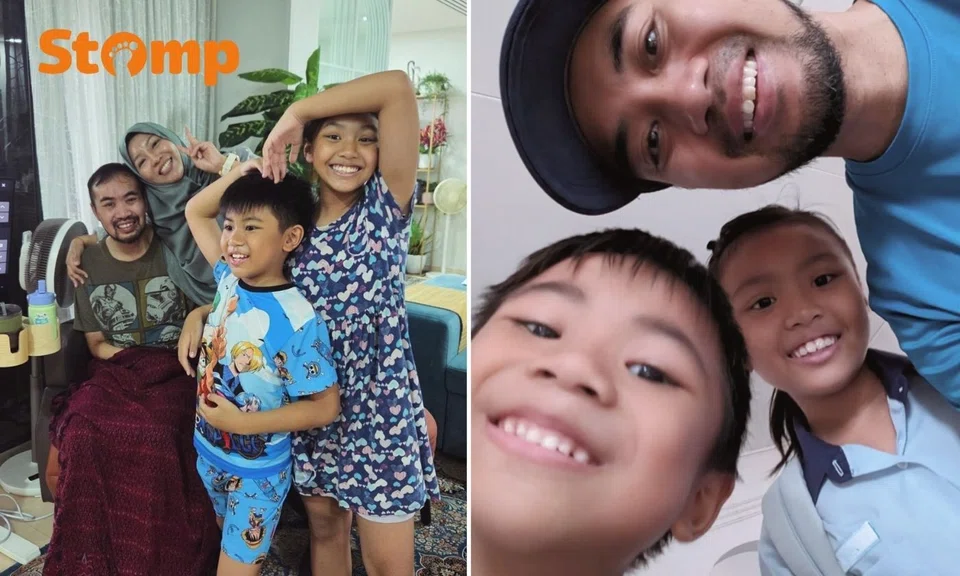
Acceptance and adjustment
Looking back, Aisyah said the news initially left Collins feeling defeated.
He was filled with fear and despair as life was “turning out great” for the family at the time, and he had expectations of what their future would look like with two young children.
The only consolation, she said, was that the illness was progressive.
As the symptoms did not appear all at once, she took comfort in the fact that they had time to adjust as a family, finding new ways to accommodate and help Collins as he gradually lost the ability to do everyday things.
To Aisyah’s surprise, life went on — but with adjustments.
“For example, he couldn’t put on a T-shirt anymore. He (switched to) button-up shirts and when he couldn’t button, he had to get our children to help.”


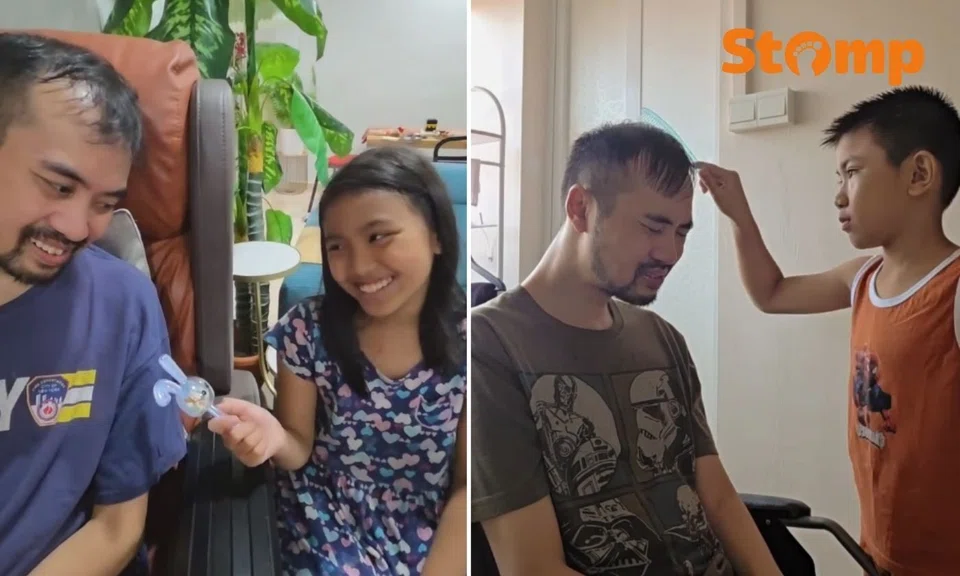
Their son Ryan, 8, made a game out of helping his father with his shirt buttons, while daughter Rayna, 11, took pride in occasionally feeding him ice cream.
While Aisyah was proud to see the children stepping up to help their father whenever they could, she could also tell that her husband ached to be there for them as a dad.
“He couldn’t love his children the way he wanted to,” Aisyah said quietly. “He wasn’t able to teach (our son) how to cycle, or send them to school.”
“For him to have to consciously say ‘goodbye’ to that phase of fatherhood... that was difficult for me. I saw disappointment, I saw love, and I saw him wonder, will the kids know that he loves them?”
As the family adjusted to their new normal, the children continued going to school while Collins switched to a work-from-home job.
Eventually, as his mobility worsened, he had to stop working altogether.
Despite the setback, Aisyah said he still “found different ways to stay purposeful”.
Turning his diagnosis into a way to help others
Collins made it his mission to raise awareness about ALS in his own way, and started an Instagram account called @theunremarkablebrain.
The idea for the name came from the results of an MRI scan, which stated: “No acute intracranial abnormality detected. MRI brain is unremarkable.”
At the time, the couple joked about the choice of words.
Later, they saw it differently: although the scan had been described as “unremarkable”, they hoped their experience could still make a difference to others going through the same journey.
“He continued on his social media platform all by himself. It was all his ideas. Only when he couldn’t use his hands anymore that I realised this was a struggle.”
When Collins eventually lost control of his hands, Aisyah took over the Instagram account and began sharing awareness posts from her perspective as his caregiver and wife.
Through the two years she spent caring for her ailing husband, Aisyah said she never once saw it as a burden. Instead, she described being his caregiver as “an absolute honour”.
“It was the best thing,” Aisyah said, her voice wavering as she wiped away tears.
“I won’t say it was difficult because we have always had this mindset of taking on adventures together. This was a new (kind of) adventure — it was ALS, it was discovery, it was still about loving each other, caring for each other.”
Watching her husband lose his everyday abilities also made her see him more clearly for the person he had always been — humble, caring and patient.
Remembering him as ‘energetic, free and willing to try’
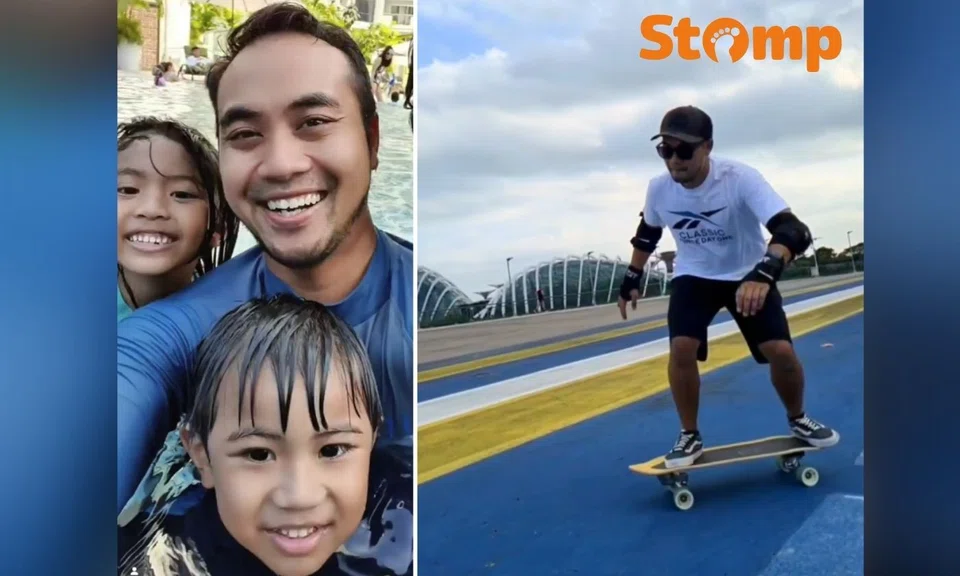
Before his symptoms began in 2023, Collins enjoyed cycling, scooting and surf skating.
Together with a group of friends, he even set up Just Skate Lah, a community bringing together surf skate enthusiasts from across Singapore.
“He was just such an energetic and free man. He was very willing to try new things,” Aisyah recalled fondly.
One memory that stood out was an event where organisers asked for a volunteer to join a Zumba performance.
Despite having no experience with the dance workout, Collins volunteered, went on stage and had the crowd laughing and cheering.
“He had no idea what he was doing, but he just heard the music and went with it. That was the kind of person that he was.”
Asked what she hopes others would know about ALS, Aisyah said the illness can look “very different” at every stage, and caregiving can become “very complicated” due to its progressive nature.
“I went from supporting him with a walking stick to a four-legged walking stick, then to a wheelchair, and then (safe) transfers.”
Towards his final days, Collins had grown so weak that he relied entirely on his wife to help him move to different places around the house.
Remembering the last conversation she had with him, Aisyah admitted it was a “practical” one.
They were discussing an upcoming speech therapy appointment when Collins wondered aloud if there was any point attending, as he knew he was growing weaker.
Aisyah suggested postponing the appointment until he felt more comfortable attending.
Even then, his determination remained unwavering.
“His last words (to me) were, ‘Okay, I will try.’”

See something interesting? Contribute your story to us.
