Accident on the job left him with metal pins in his leg: S’pore’s only stunt driver on risking it all for ‘fulfilment’


Think Singapore is just a nation of people working typical corporate jobs? Introducing Stomp’s new original series, Don’t Try This At Work, where we spotlight individuals with risky, exciting, unconventional and even downright terrifying jobs.
From cleaning up after death to exploring kink, the series offers a behind-the-scenes look at occupations most people would never dare to try — and the people who do them every single day.
Nearly a decade ago, Jason Tan traded a stable five-figure salary for a career in drifting, where drivers intentionally slide their cars sideways at high speeds with precise steering and throttle control.
The journey began with a movie that sparked an unlikely dream, followed by months of contemplation, a leap of faith and a dream he couldn’t ignore.
Since then, the 49-year-old has made a living crashing, drifting and flipping cars and motorbikes for the camera. But behind the adrenaline-fuelled action lies a reality few see: months without work, financial uncertainty and sacrifices that extend far beyond the driver’s seat.
Midnight trainings in Malaysia
It all started with the action-packed film Tokyo Drift, which introduced audiences to the world of drift racing. When it hit Singapore theaters in 2006, it left a lasting impression on Tan.
Fascinated by the art of drifting, he told Stomp he watched Tokyo Drift more than 10 times over the next two years. Eventually, he could no longer ignore the urge to get behind the wheel himself.
In 2008, he bought a second-hand drift car, travelling to Malaysia regularly to hone his skills. He later competed in Singapore’s largest drifting competition, Formula DRIFT, the following year.
Over the next nine years, Tan honed his drifting skills by juggling stunt-driving gigs alongside a full-time career in marketing.
With no suitable facilities for drift training in Singapore, he travelled regularly to Malacca where he practised on drifting tracks.
After a full day of work at his full-time job, Tan would set off for Malacca at around midnight. He would train until about 4 or 5am, head back to Singapore to catch a few hours of sleep, then wake up at around 10am to continue his day.
He kept up this gruelling routine two to three times a week.
Left five-figure salary for stunt driving
Things began looking up for Tan in 2016 when he landed a stunt-driving role for a SingTel television commercial, marking his first major commercial opportunity.
The commercial featured Tan, a fencer and a child wearing virtual reality headsets while carrying out their respective activities. Filmed on an empty road and inside a container port, Tan performed a series of precision drifts and high-speed navigation through narrow lanes of shipping containers. The commercial later went on to become one of SingTel’s most viewed pieces of content ever.
Reminiscing about his first big break, Tan said it was his first real stunt-driving job and the one that convinced him he wanted to pursue the profession full-time. “I’m very grateful for that job,” he said.
Encouraged by the breakthrough, he took a leap of faith the following year. After spending six to seven years in a stable marketing job earning a five-figure monthly salary, he walked away to pursue stunt driving full-time.
When asked how much he had in savings, Tan said he would have been able to “survive” for two years without working.
He added that being unmarried and without children gave him the freedom to pursue such a niche career.
From there, Tan went on to land more commercial projects. He was hired to take part in corporate shows such as the Singapore Airlines F1 show, as well as stunt-driving roles in local productions, including Medicorp’s Crimewatch and a number of Channel 8 dramas.
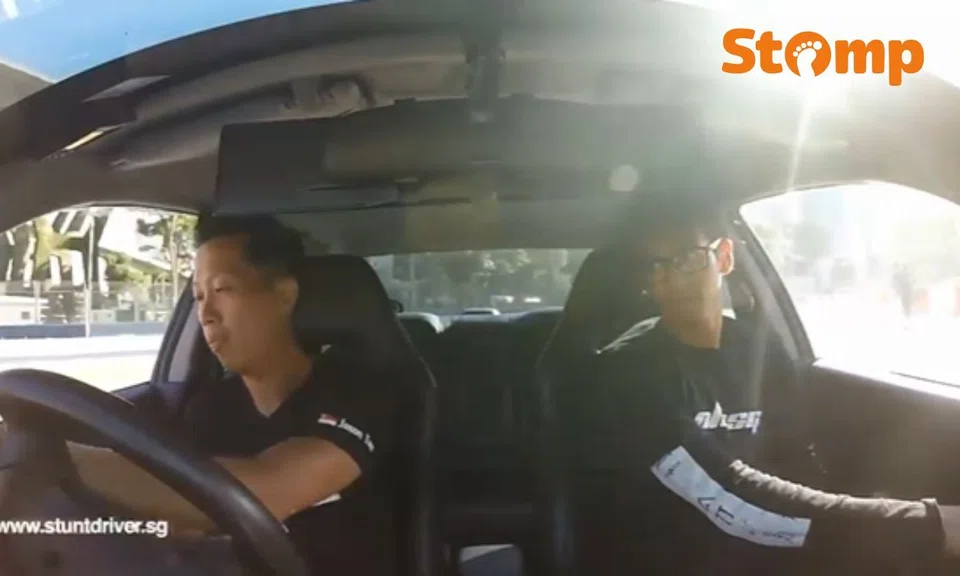
Sacrifices, financial uncertainty
Looking back on the years he spent honing his craft, Tan said he placed immense pressure on himself to make a name in the industry.
The countless hours of training, he said, came with their own sacrifices. Instead of spending time with family and friends, he often travelled to Malaysia to train — a routine he described as “very boring and dry”, but one he knew was necessary to improve.
Drifting, Tan explained, demands a high level of precision behind the wheel. Depending on the director’s vision, he may be required to execute complex manoeuvres such as precision parking, stopping at exact angles or controlled skids.
On top of that, the years immediately after leaving his stable job proved to be the most difficult, Tan recalled.
“I was very scared,” he admitted, explaining that at the time, few people even knew what drifting was, let alone that it could be pursued as a career. He also said he anticipated a drastic drop in income, which made him worry too.
Tan said the first three to four years after going full-time were financially challenging. There were months when he struggled to secure projects, and even when he did, some clients failed to pay him for his work.
“Yes, drifting is my passion, but that doesn’t mean you don’t have to pay,” Tan said.
He added that it took years for people to recognise stunt drivers and drifters as skilled professionals whose expertise and years of training deserve to be fairly compensated.
Even nearly a decade later, Tan said he still faces financial uncertainty. While 2025 was his strongest year yet, he described this year as “quiet”, with work seemingly scarce.



Tan said he has not had any stunt-driving gigs in the first half of this year. However, he is set to work on an upcoming Channel 8 drama series in the coming months.
Without any side hustles to fall back on, Tan said he relies on his savings and investments to tide him over during quieter periods.
Fractured leg doing a motorcycle stunt, concussions are ‘quite common’
Despite his years of experience, Tan said the possibility of an accident or injury never leaves him whenever he gets behind the wheel for a stunt.
More than anything else, he fears getting injured. “If I get injured, then I cannot do my job,” he said.
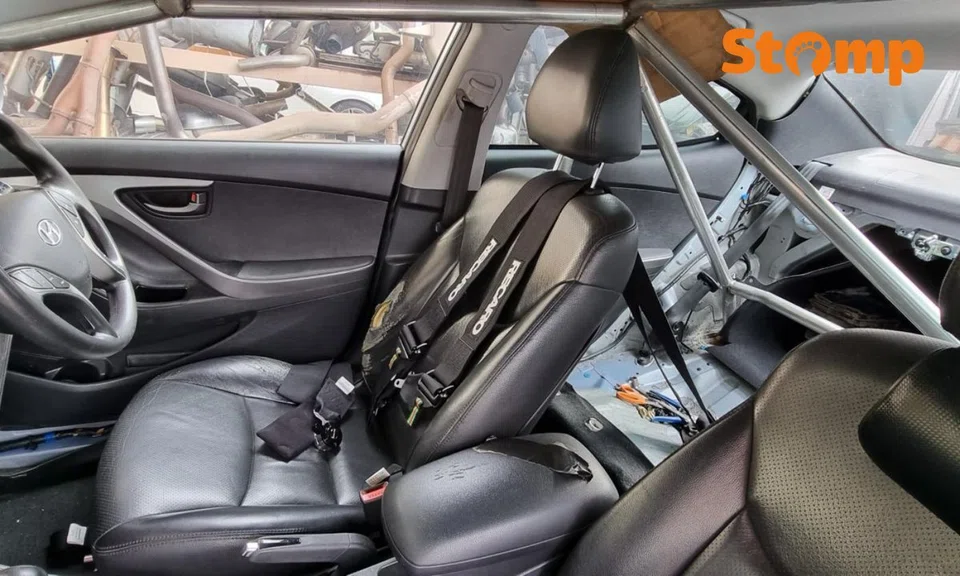
For crash scenes, he explained that the vehicle is fitted with a roll cage — a reinforced steel frame installed inside the car to protect the driver. The structure helps prevent the car from collapsing if it rolls over, reducing the risk of serious injury during a stunt.
He also wears a neck brace and four-point harness for safety precautions.
While Tan has never suffered a serious injury in a stunt car, he said concussions are “quite common”, regardless of how experienced or well-trained a driver is.
Motorbike stunts, however, are a different story.
He said they are far riskier than car stunts and recalled his worst accident, in which he fractured his shin while training on a motorbike in 2013.
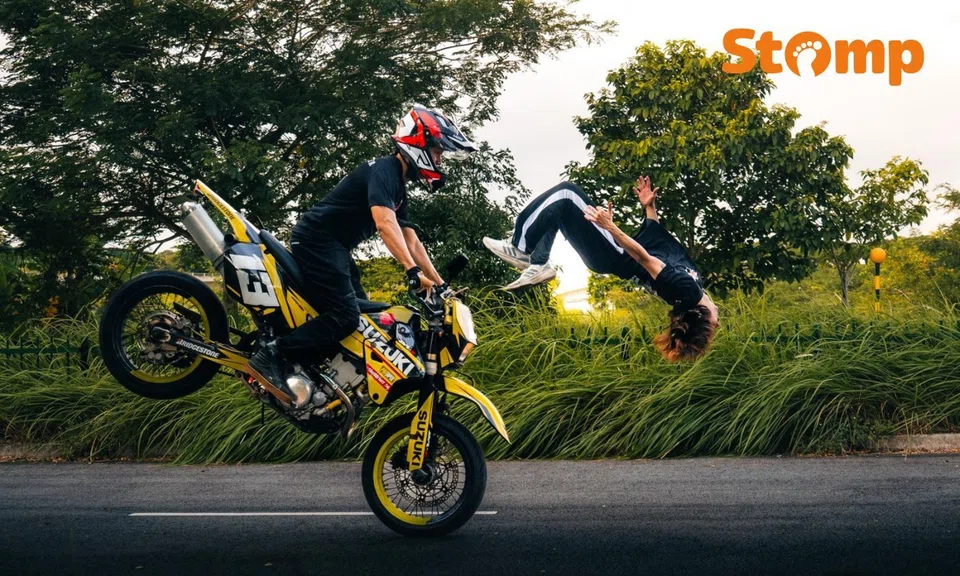
At the time, he had been practising wheelies — a motorcycle stunt in which the rider lifts and balances the front wheel off the ground while carefully controlling the throttle.
After successfully completing a few runs, he admitted he became “too greedy” and tried to lift the front wheel even higher.
It was, in hindsight, a “bad judgment call”, he said. Without the experience and composure to recover from the manoeuvre, the bike flipped backwards, throwing him off. His right leg slammed into the tarmac, fracturing his tibia.
The accident left Tan with metal pins in his shin, where they remain today.
After undergoing surgery, he spent six to seven months in rehabilitation, learning to walk again. Even today, he said, his injured leg is not the same as it was before.
With the risks that come with stunt driving, he said physical preparation is essential. He keeps himself relatively fit to ensure he has the stamina to perform repeated stunts and cope with long hours on set, including overnight shoots.
Age has also begun to catch with him. He said his body no longer recovers as quickly from repeated impacts that come with performing stunts.
Stunt driving gives him a sense of fulfilment money never could
Today, nearly two decades after he first discovered drifting, Tan said he has no regrets about taking the unconventional path in his 30s.
Driven by an unwavering passion, Tan said stunt driving gives him a sense of fulfilment that money never could.
When viewers enjoy the show or even go, “Wah, this one confirm CGI,” he said, is a compliment for him.
When asked whether he regretted not settling down like many of his peers, Tan said he did not feel he had missed out on having children, explaining that parenthood was never something he prioritised.
However, he mentioned he has been in a relationship for the past decade, adding that he and his partner are happy with where they are in life.
“She has stood by me since my early drifting days. She’s also earning more than me and we’re okay with it,” he said.
Tan also lives with his mother and grandmother, whom he helps care for.
These days, he no longer makes regular trips to Malaysia to train, having spent years mastering the techniques required for the sport. Instead, he devotes much of his time to training aspiring drivers, choreographing stunt sequences and taking on stunt-driving projects.
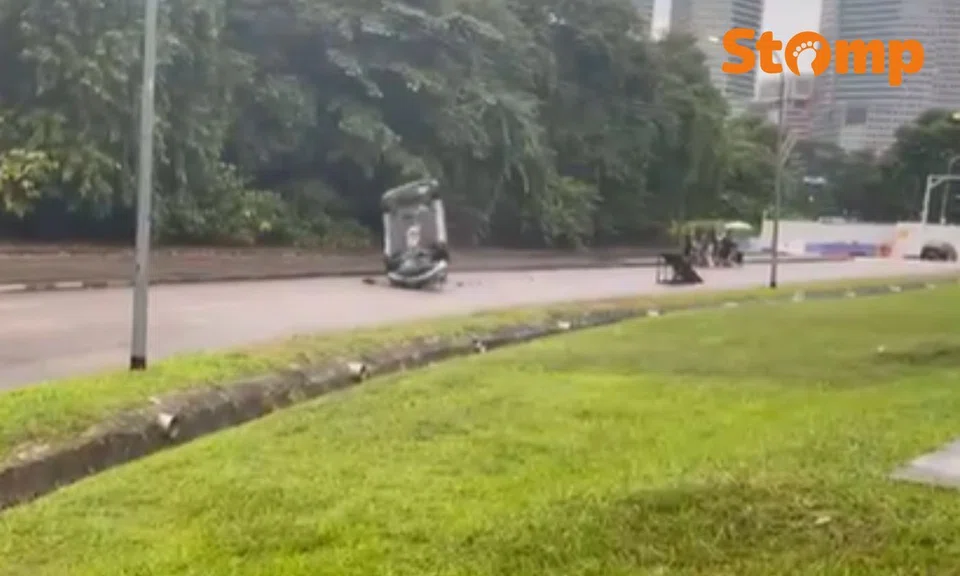
He has also ventured into content creation on social media, where he breaks down the mechanics behind real-life traffic accidents. In one video for instance, he explained how a car ended up flipping over in a multi-storey car park, using his expertise to help viewers understand what likely happened.
Despite the financial uncertainty, physical risks and sacrifices, Tan has no intention of slowing down anytime soon. When asked about retirement, his answer was immediate.
“No,” he said, pointing out that a 76-year-old stunt driver in the UK is still active in the industry.
“I will do it for as long as I can,” he said.

Explore more on these topics
See something interesting? Contribute your story to us.
