Dutch woman, 42, on becoming a Taoist priest in S’pore: 'This is what I’ve been looking for’


As a child, Sann Carrière was fascinated by spirituality and the vivid things she saw in her dreams. Now, at 42, the Dutch national is a fully ordained Taoist priest in Singapore.
Long before she discovered Taoism, however, Carrière said she had already been experiencing lucid dreams and seeing things she could not always explain — including people who had already died.
When Stomp visited her at the Buddhaguna Buddhist Temple in Kembangan, she shared how she pursued her spiritual interests while navigating her unconventional 14-year journey to discovering her faith.
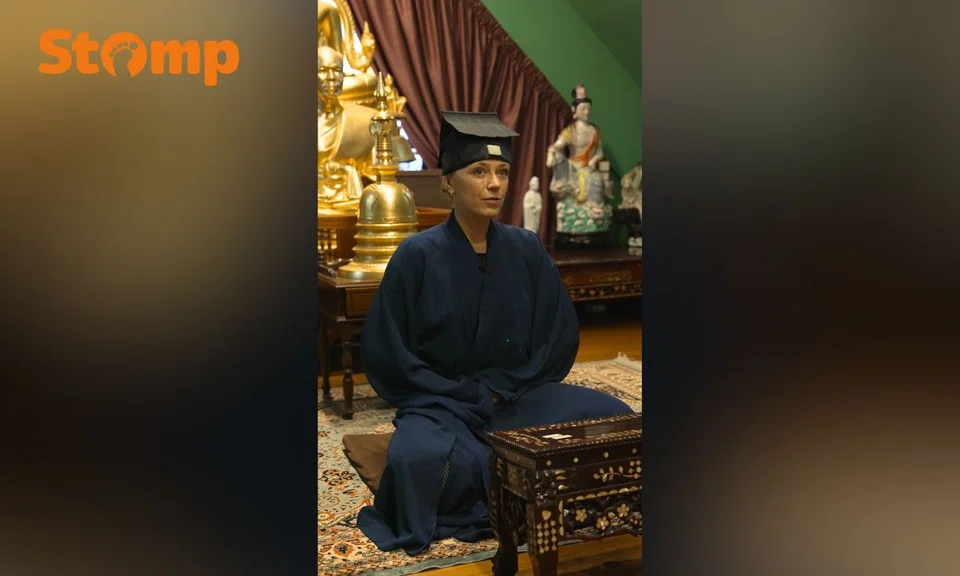
She sees dead people in her dreams
Growing up, Carrière said she was always interested in spirituality, particularly consciousness, dreams and nature.
As a child, she also experienced what she later came to recognise as lucid dreams, though she did not have a name for them at the time.
A lucid dream is one in which a person is aware that they are dreaming while the dream is happening. In some cases, the dreamer may also be able to control what happens, with the experience often feeling particularly vivid.
“I had these experiences from a very young age, so for a long time I didn’t realise there was anything unusual about them,” said Carrière.
On some occasions, she said she would describe people she had seen in her dreams — including, for instance, a close friend’s grandmother, whom she could describe in detail, such as her appearance and clothing — before learning that the woman had already passed away.
As such dreams had always been part of her life, she said it was only as she grew older that she realised not everyone experienced dreaming the same way she did.
“Growing up with those experiences made me curious about consciousness very early. If you can be inside a dream and simultaneously know what you are dreaming, it naturally raises questions about perception, awareness and what we consider to be reality,” she said.
She also recalled telling people about things she had seen in her dreams, only to find that they would happen a week later — realising that they weren’t just dreams, but visions of what would happen in the future.
Carrière added that she often dreamt about future disasters such as climate change, resource depletion and the extraction of natural resources from the earth.
Spurred by these relentless dreams about the world’s future and her innate passion for sustainability, she was inspired to start Orobo, a Singapore-based sustainability technology company. Established in 2020, the company acts as a trusted digital bridge for global trade, ensuring that businesses can easily showcase their eco-friendly initiatives.
While her dreams did not directly lead her to Taoism, she said it “opened a door very early in life”, sparking her interest in consciousness and traditions that “explore the mind through direct experience rather than purely intellectually.”
“When I eventually encountered Taoist practices, that experiential aspect felt very natural to me,” she said, referring to the many physical rituals performed in the faith.
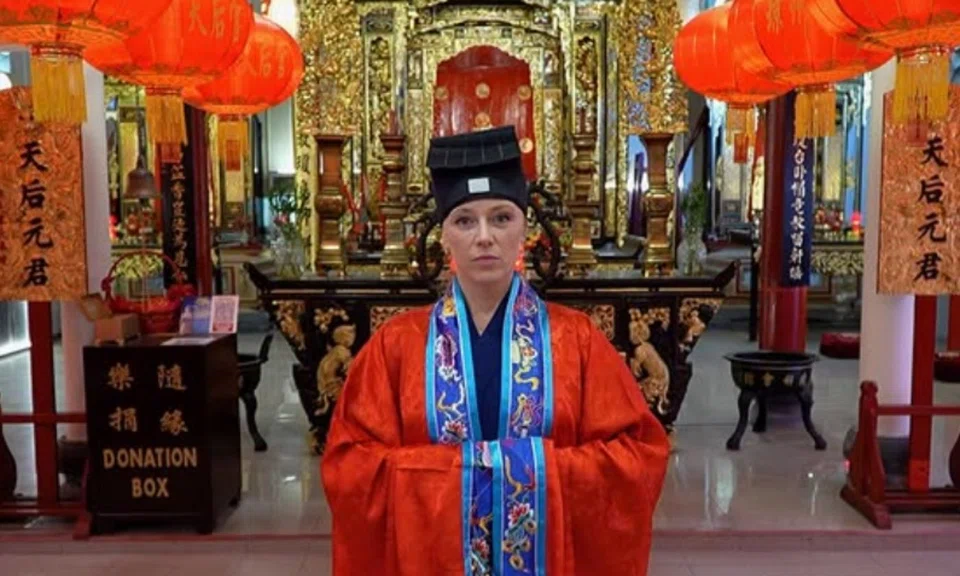
Her 14-year journey as a Taoist
Even before moving from the Netherlands to Singapore eight years ago, Carrière had already discovered Taoism and began practising the religion in 2012.
She said she first encountered Taoism while praying for a way to “integrate” her worldly and spiritual selves. She found that her “social persona” and “deeply spiritual self” were at odds, making it difficult for her to be understood by society.
After saying that prayer on a beach in the Netherlands, she came across a Nei Dan course commencing at three different locations within the country. Nei Dan is an ancient Taoist system of spiritual, mental and physical practices.
One of the course locations, she said, turned out to be at a studio right on her street — a coincidence she couldn’t ignore.
After her first guided session, Carrière thought: “I knew, this is what I have been looking for.”
What attracted her to Taoism, she added, were the practices that allowed her to explore and investigate things for herself.
Even as she moved between countries, Taoism and her spiritual practice remained a constant in her life.
“Taoism became less connected to a particular place and much more connected to how I lived,” she said.
Presented herself to deities to become a priest
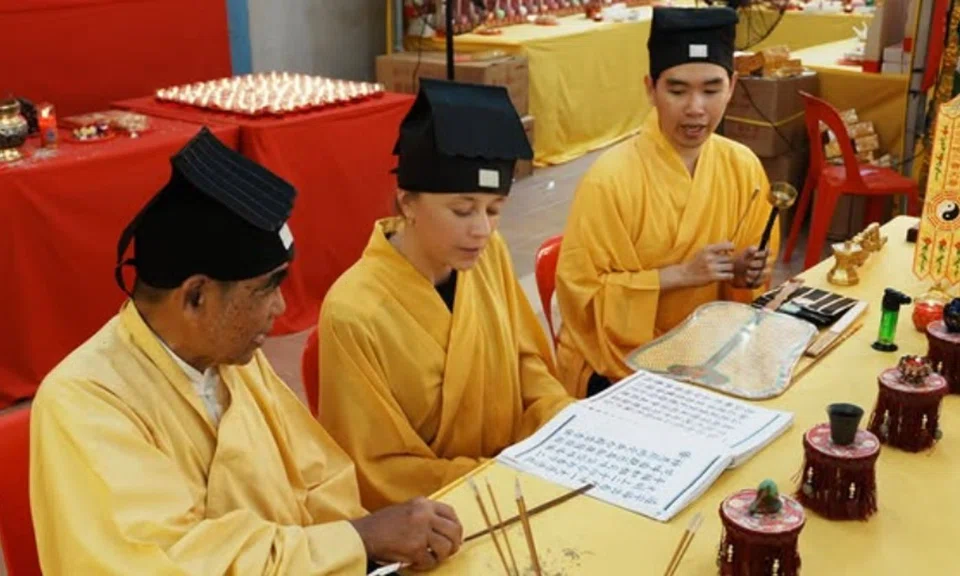
After moving to Singapore, Carrière joined the Quan Zhen Cultural Society, a Taoist organisation, three years ago.
The group, which has about 70 members, gathers at Balestier Point to study and practise Taoist traditions.



A key milestone in her religious journey, she shared, came shortly after joining, when she became a fully ordained Taoist priest.
Recalling the moments leading up to the ordination, Carrière said she underwent a particular ritual that she described as “special”.
The ritual involved “presenting herself” to the deities, who would, through divination, determine whether becoming a priest was part of her spiritual path, she said.
She explained that an altar is prepared for the ritual, with members of the ordained community present. Divination tools are then used to “ask” whether becoming a priest is the right path for the individual, with the answer confirmed three times for consistency — usually through dropping the tools and observing how they fall.
“It was quite a joyful occasion, but I was also a little tense and excited because you don’t know what the answer will be,” Carrière said.
At one point, she recalled thinking that the deities could see through her anyway, and that there was no point in trying to control the outcome.
When the outcome of the ritual turned out “very positive”, Carrière said she was genuinely surprised and happy.
“Everyone around me started congratulating me, and I remember my heart just overflowing. It was a very special moment,” she said.
Since then, Carrière has been allowed to perform certain rituals and blessings, depending on her level of initiation and ordination, as there is a hierarchy within the tradition.
When asked if temple goers had ever doubted her abilities as a Taoist priest due to her race, Carrière preferred not to comment.
Becoming a priest, she said, involves more than studying Taoist philosophy, chanting and meditating. It also includes learning how to conduct herself within the tradition, and understanding that she is becoming part of a lineage and community.
“Being ordained doesn’t mean that the learning stops — I’m both practising actively and continuing to learn,” said Carrière.
Learning Chinese has been her greatest challenge
For Carrière, one of the greatest challenges throughout her Taoist journey has been the language barrier.
She is also conscious of the fact that, as a Dutch woman entering a tradition deeply rooted in Chinese culture and religious practices, she still has much to learn.
“I don’t think it would be appropriate to pretend that difference doesn’t exist,” she said. Instead, she said she does not approach Taoism as something she is “entitled to”, but as a tradition she can learn from and respect.
Carrière described the language barrier as the area where she feels the most vulnerable.
While she can learn a chant and understand its meaning, she noted that it’s still not the same as the instinctive relationship with the language that someone who grew up speaking Chinese would have.
A turning point came last year, when she realised she could not progress to further examinations without learning Mandarin more seriously. The scriptures she needed to study and analyse were also in Chinese.
She said she was left with no choice but to keep learning, by practising the chants, studying the texts more deeply and asking questions.
‘A lifelong process’
One misconception Carrière has encountered, she added, is the assumption that she could never truly understand Taoism because she was not born in Singapore.
“I may have been born as a white woman in the Netherlands, but how do we know why this practice aligns with me so well?” she said.
However, she said the acceptance she has experienced within the Taoist community has been “very meaningful” to her.
“Ultimately, I was given the opportunity to become part of the lineage. I take that trust seriously,” she said.
Today, she visits the temple once a week and spends the rest of the week meditating at home.
14 years since the start of her spiritual journey, even as a fully ordained Taoist priest, Carrière said she remains a student — accepting that her Taoist journey is a “lifelong process”.

See something interesting? Contribute your story to us.
