‘Too good to be true’: Bait-style listings being used by some property agents to lure buyers
Joyce Lim
The Straits Times
Jan 26, 2026
A new four-bedroom freehold condominium unit in Bedok’s Bagnall Haus was advertised on the PropertyGuru website for $2.988 million, about $100,000 less than the actual price of the unit.
In another listing, a three-bedroom condo unit at the freehold Arcady in Boon Keng was priced at $2.33 million, even though the agent, when contacted, said the price was in fact above $2.4 million.
Such glossy listings, featuring stylishly decorated show-flat images and promises of “genuine best price” or “direct from developer” price, urge buyers to act quickly before such coveted units are snapped up.
Industry players said this sort of tactic is becoming more common in a crowded and highly competitive property market.
The Straits Times reviewed more than 100 listings across major portals, uncovering a pattern of similar practices that suggests the issue extends beyond a single agency.
Follow-up calls to six property agents showed that they did not have the properties available at the advertised prices. Instead, they tried to steer the buyer to other units, at higher prices.
The review was prompted after a Council for Estate Agencies (CEA) post on Jan 8 revealed that ERA Realty Network had been issued a letter of censure for supervisory lapses involving one of its agents.
It was the first time a property agency that is ranked among the top five in terms of headcount has been censured.
Between December 2021 and February 2022, ERA agent Abel Ang Pei Xiong posted three online advertisements for three new developments, with prices significantly lower than the developers’ asking prices. The price difference ranged from $260,000 to over $1 million.
A CEA disciplinary committee later ruled that Mr Ang had breached the Code of Ethics and Professional Client Care by publishing advertisements that were inaccurate and misleading.
The committee said the advertisements were not the result of carelessness, but were deliberate and “grossly misleading”, designed to act as bait to attract inquiries.
Mr Ang was fined $14,000 and suspended for five months in 2023. In October 2025, he was fined a further $28,000 and suspended for six months – the heaviest penalty to date – for similar offences before resigning from ERA in January.
CEA told ST that between 2023 and 2025, it took enforcement action on 324 complaint cases related to inaccurate or misleading advertisements. To date, no agents have had their registration revoked for this, it added.
ST’s own checks showed that similar pricing discrepancies persist across agencies.
When contacted, an agent from Huttons Asia, who advertised the 1,249 sq ft four-bedder unit at Bagnall Haus for $2.988 million, said he had no intention of misleading consumers and that he would amend his advertisement immediately.
The agent, who asked not to be named, said he had received the lower price quote from the developer in January 2025, and explained that “the developer will keep adjusting the price upwards”.
“My ad is outdated, so I will adjust the price accordingly to current price... If the price is not like $200,000 to $300,000 different, I don’t think we have the intention to mislead anyone,” said the agent.
However, CEA records showed that the same agent had previously been fined $3,000 in 2023 for advertising a property at lower than its actual price. ST also found several of his current listings – most of which were for new launches – were similarly priced lower.
Data from the Urban Redevelopment Authority showed a 1,249 sq ft four-bedder unit at Bagnall Haus was transacted at $3.012 million on Jan 18, 2025. Subsequent units of the same size were sold for between $3.019 million and $3.273 million.
There was no unit sold at $2.988 million, the price the agent claimed was given by the developer.
In response to queries from ST, Huttons Asia chief executive Mark Yip acknowledged that “accurate and transparent advertising is essential to consumer trust and confidence in the property market”.
“An advisory has been issued to the salesperson concerned to review and rectify the advertisement where necessary. We have also sent compliance reminders to our salespersons to reinforce the importance of ensuring that advertised prices and information are accurate and promptly updated,” said Mr Yip.



In another misleading advertisement, a PropNex agent had listed a three-bedroom unit at the freehold Arcady condominium for $2.33 million. After ST contacted her, she changed the price to $2.48 million.
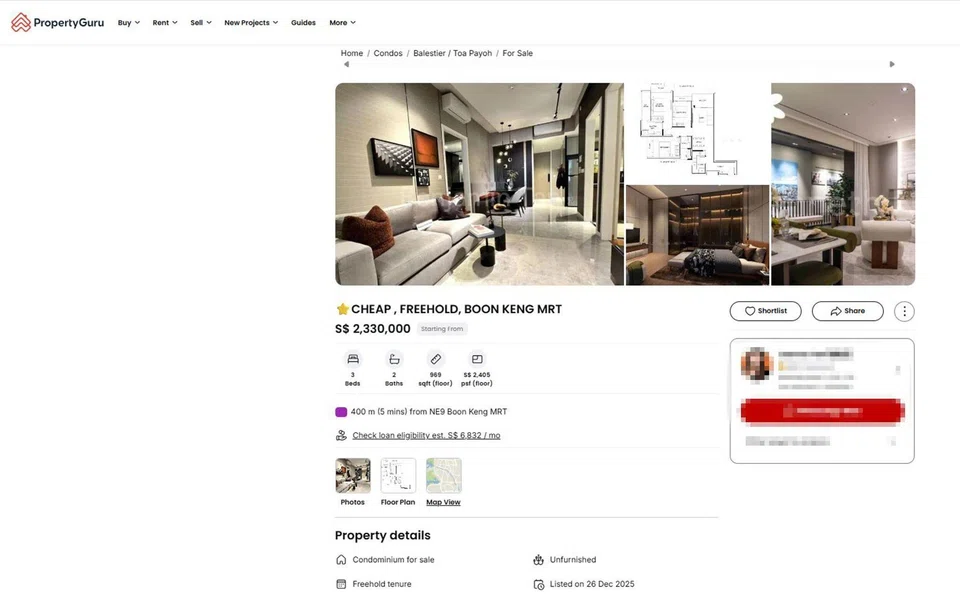
When asked about the $150,000 difference in price, the agent, who asked not to be named, pointed out that a unit was indeed sold at $2.335 million in January 2024.
When asked why she would list a price from two years ago in her listing on Dec 26, 2025, she said: “When we advertise, we obviously choose the lowest price to advertise. It’s not about being dishonest... It’s not like we are out to deceive consumers.”
PropNex Realty chief agency officer Eddie Lim said the agency does not condone misleading or bait-style listings, adding that salespersons involved had been followed up with to reiterate the importance of accurate and responsible advertising.
ST also found many listings with vague details, featuring generic street images, instead of photos of the actual units.
Industry practitioners said such “template-style” listings are a clear signal that the agents do not have the property available for viewing, and are using an artificially low price to bait potential buyers.
A 29-year-old buyer, who declined to be named, said: “As a buyer with limited experience in the property market, I find it hard to distinguish between genuine and fake ads. The confusion that results from it makes me sceptical of property listings and adds stress to my property-buying experience.
“It also makes me feel like I have to depend on the advice of trusted agents to help me.”
CEA advises consumers to verify advertisement details by viewing properties in person with agents registered with the council. It is also reviewing the use of artificial intelligence in property advertising and will issue further guidance when ready.
Several agents told ST that the tactics distort the market and disrupt their own operations, as genuine buyers increasingly challenge them over unrealistically low prices seen online, even when those listings are clearly bait or do not exist.
One agent, who declined to be named, said: “Bait listings can be extremely disruptive to our work when we serve buyers. They give the illusion that there are more and better options out there. When buyers see these listings on the market, they will want to view them before making a decision.
“Yet when we reach out to these agents, they either do not respond or say it’s already sold. But as long as their ad stays up, it creates unnecessary dissonance in the buyers’ minds.”
Property agencies acknowledged that supervising listings has become increasingly challenging in a high-volume, fast-moving market. Training, monitoring and disciplinary action remain ongoing efforts, even as industry-wide solutions are explored.
Mr Eugene Lim, key executive officer of ERA Singapore, said “the sheer volume of advertisements across multiple external portals” makes monitoring an industry-wide challenge.
Mr Lim of PropNex said the growing use of third-party vendors to assist salespersons with listing creation and marketing has added further complexity to supervision.
Mr Justin Quek, deputy group chief executive of Realion (OrangeTee & ETC) Group, said salespersons are required to submit their property advertisements through the company’s internal online portal before publication.
A spokesman for property portal 99.co said: “Fake or misleading listings are problematic and 99.co actively removes such listings when they are identified or brought to our attention.”
How to spot a bait property listing
Industry players in Singapore told The Straits Times that bait listing for properties is becoming more common in a highly competitive market. Here is how to spot such listings.
1. Prices are far below prevailing launch prices
Most listings of this kind are for new launches. Buyers can cross-check prices by comparing multiple listings for the project, consulting the developer’s official sales channels or show-flats, or checking recent transaction data on major property portals.
2. Vague description
Listings that do not name the project, or use generic facade images or street photos instead of actual unit images, should raise red flags.
3. Price changes upon inquiry
If the price jumps once you call, ask for proof of availability.
4. Agents offer alternative units upon inquiry
If an agent quickly steers you to alternatives, it often signals that the unit was not available to begin with.

Explore more on these topics
See something interesting? Contribute your story to us.
