Talking too much while live-streaming caused her voice to change

Venessa Lee
The Straits Times
May 23, 2026
Ms Elaine Heng sounds hoarse.
She has been “talking too much”, she says, while live-streaming for the past few days for TikTok’s 5.5 campaign, a huge retail sale on the platform in early May.
“Before I started doing live-streaming, my voice was not like this. It was higher-pitched,” she says.
During the Covid-19 pandemic, which started in 2020, Ms Heng, the founder of an image consultancy firm, found that she could not work as effectively when she had to switch from meeting clients in person to working via video calls. She used to hold consultations and training sessions in professional grooming, colour analysis and social etiquette.
She caught the livestreaming bug in 2023 when she gave it a go.
“I was surprised that people bought from me during my first live stream, when I sold a Yakult-like drink from a China brand. I was happy with my low three-digit commission.
“Live-streaming was something different and I was curious to know more about it. It was exciting as well, once you’re able to hit a certain milestone in sales,” says Ms Heng, who is divorced with two sons, aged 15 and 12.
Three years on, using the “mselaineheng” nickname, she has worked with more than 50 brands as a live streamer, selling products as diverse as health supplements, skincare devices, hair care, cleansers, serums and creams, collagen drinks, fashion, fengshui crystals and ornaments, household cleaning products and moissanite, a lab-grown gemstone that looks like a diamond.
She focuses almost exclusively on live-streaming now, which has been more profitable than her previous work. She has more than 38,000 followers on TikTok.
She has her livestreaming set-up down pat, with her ring light and other lighting positioned optimally. When a viewer buys an item, she taps a golden bell on a table in her living room, signalling a sale. She waves a pink calculator at the screen of her mobile phone, showing the extent of a discount.
Her domestic helper takes behind-the-scenes photos and videos, which may be disseminated on other social media platforms like Instagram and Telegram.



Ms Heng sometimes mans a live stream with a co-host and is proficient in both English and Mandarin.
She live-streams almost every day, for up to 10 hours in total, on platforms like TikTok and Shopee, earning an income from commission on products sold and, sometimes, brand sponsorship fees.
Sales are dopamine hits. She was excited when she once made $30,000 in gross merchandise value (GMV) during a live stream that lasted more than four hours. GMV is the monetary value of all goods and services sold on an e-commerce platform over a particular period.
But it is not all fun and games. When she was starting out in 2023, someone scolded her for calling her viewers “sister” and “brother”.
“It’s very common on live streams to say ‘bro’ and ‘sis’, like ‘eh bro, come and support me’. I cannot call them ‘uncle’ and ‘auntie’,” says Ms Heng.
“I started crying, but you know what? Traffic went up, from around 50 to more than 300 people watching me, with some voicing their support.”
She was used to working from home even before the pandemic, as her image consultancy business was home-based. But her long hours now mean she does not get that much flexibility as a parent.
She says: “You’re present but not present. You can’t really spend much time with the boys. They’re used to it and they understand that, as a single mum, I need to work. They’re happy that I don’t go and disturb them like a tiger mum.”
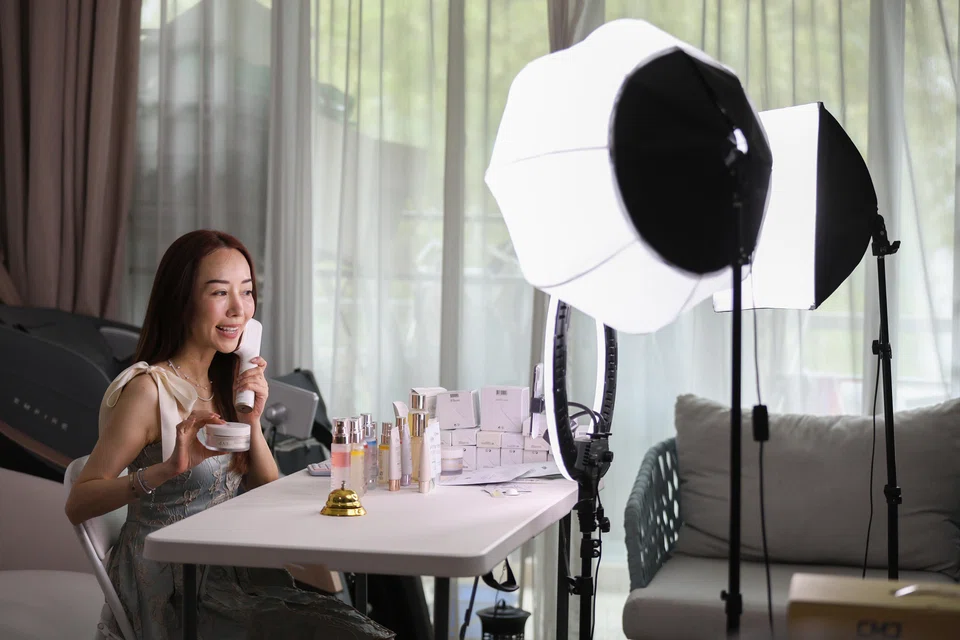
The job has its peculiarities.
“You keep repeating things, over and over, because people drop in and out of your streams. You need to be able to talk without facing a physical person. You’re talking to your phone,” says Ms Heng.
“I’m an introvert so I have a great time when I stay at home to live-stream.”

Explore more on these topics
See something interesting? Contribute your story to us.
