Bird netting to prevent pigeons on air-con ledges to be trialled at 2 HDB blocks
Isabelle Liew
The Straits Times
Dec 17, 2025
Two HDB blocks in Punggol and Toa Payoh will have their air-conditioner ledges covered in netting to stop pigeons from landing and building nests there.
This is part of a trial to prevent pigeons from affecting residents and study how different air-con ledge layouts and configurations affect bird nesting behaviour, HDB told The Straits Times.
The Housing Board on Dec 1 called a tender for the design, supply and installation of the netting, which will be installed at 35 units – one stack of 15 flats in Punggol and another stack of 20 in Toa Payoh. The exact blocks have yet to be finalised.
Tender documents on government procurement portal GeBIZ stated that this netting should be fire-resistant and have top covers and sides that can be opened for maintenance.
It should also have enough ventilation to prevent hot air build-up from the air-con condenser unit, and not obstruct clothes drying racks.
HDB said Punggol and Toa Payoh were selected for the study after consulting town councils, which typically receive reports of pigeons nesting at air-con ledges from residents.
The study is expected to start in the first half of 2026 and be carried out over 13 months.
First, the netting will be tested at a mock-up unit at HDB’s Centre of Building Research.
It will then be installed at certain units chosen by HDB. The air-con ledges will be cleaned and any bird nests, chicks or eggs removed in a humane manner. Netting will be installed for the remaining units after a year of observation.
HDB said it will review the findings before assessing whether to implement bird nettings on a larger scale.



The tender closed on Dec 15, with one bid from wildlife consultant Mastermark.
As part of the tender, the contractor will also have to study the number of birds and species at the site, document food sources – such as residents feeding them – and the location of the birds before and after netting is installed.
The contractor is also expected to capture up to 10 pigeons identified by HDB before the air-con ledges are cleaned. The birds will then be transferred to a third-party research team for tagging.
Finally, it must minimise inconvenience to residents and prevent damage to their homes throughout the installation and monitoring period.
HDB will get feedback from residents and town councils before and after the study.
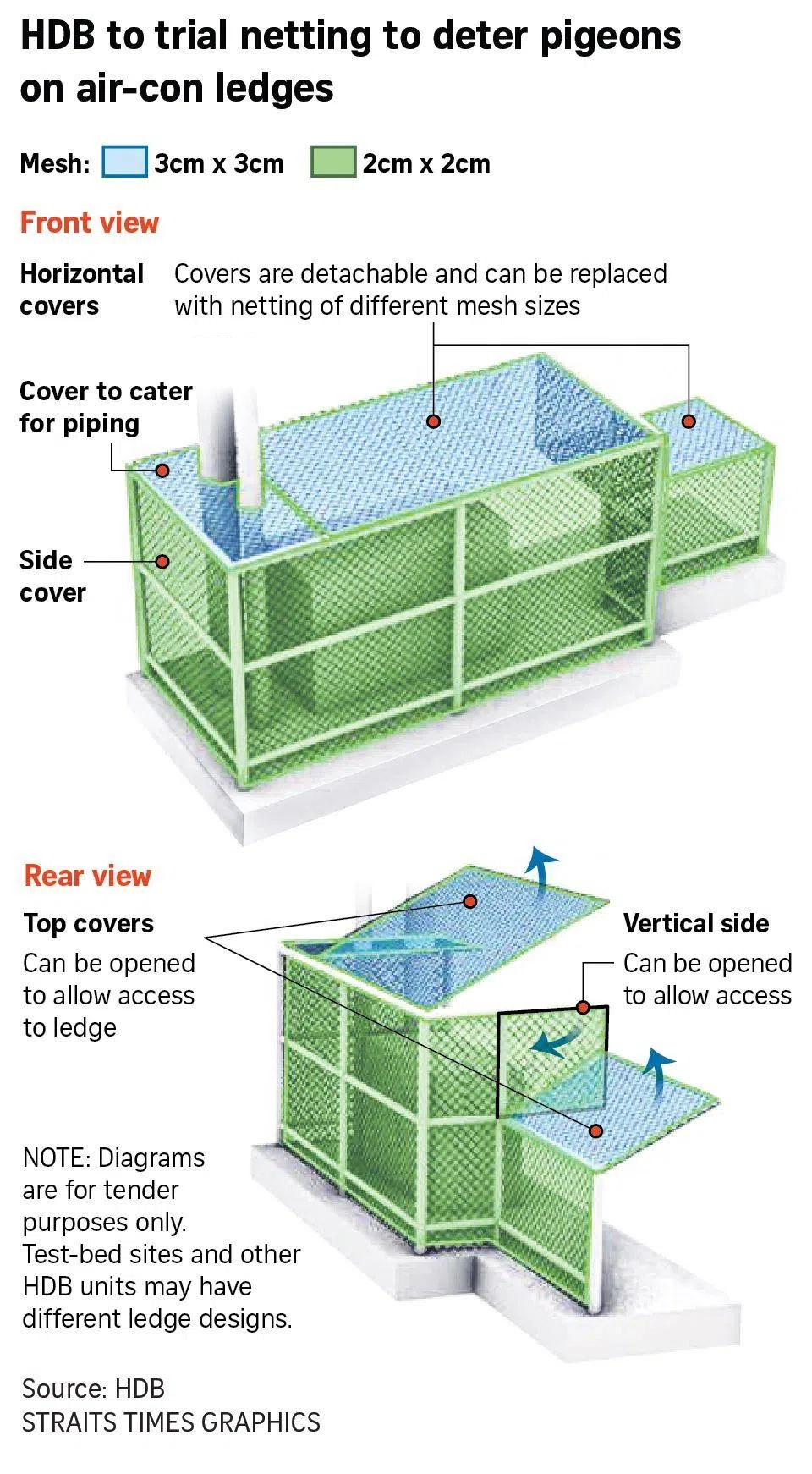
HDB said its study complements the National Parks Board’s (NParks) islandwide pigeon management efforts, and aims to better understand pigeon behaviour, such as flight and relocation patterns, after interventions such as netting are introduced.
In February 2024, Chinese-language news outlet Shin Min Daily News reported that a Punggol resident had been dealing with pigeons nesting on his air-con ledge for several years. The resident said the birds had left droppings on the ledge, causing a stench and attracting insects into his home.
In 2024 and 2025, NParks also embarked on pigeon control efforts, which led to a 50 per cent decrease in the bird population in Ang Mo Kio, Bishan-Toa Payoh and Tanjong Pagar.
These efforts included improving refuse and food waste management at bin centres and food establishments, and distributing educational materials to food stall operators.
In May, then Senior Minister of State for National Development Tan Kiat How said this pilot pigeon management plan will be rolled out in three more areas: Jalan Besar, Marsiling-Yew Tee and Nee Soon.

See something interesting? Contribute your story to us.
