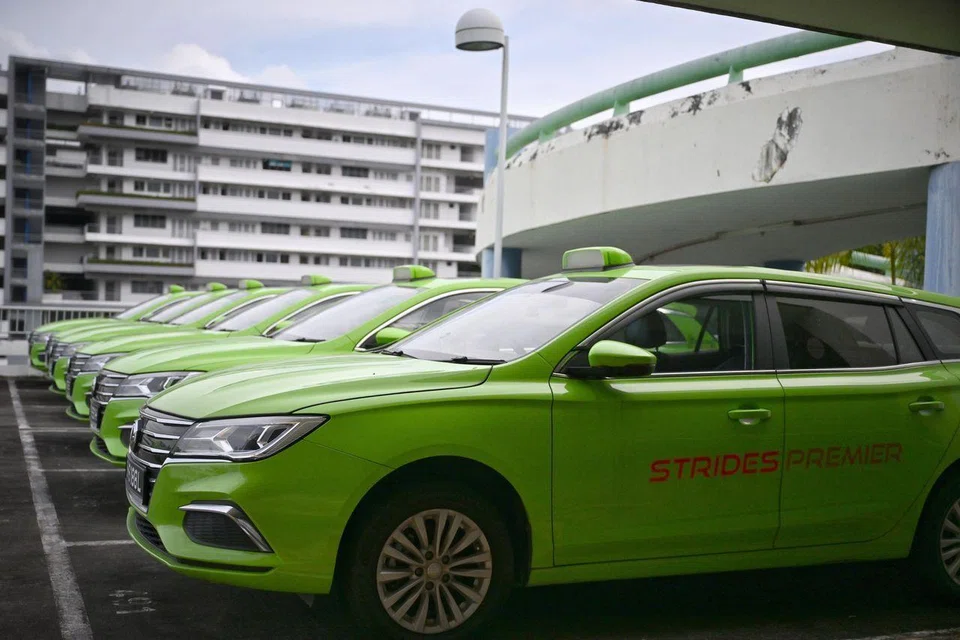
Strides Premier electric taxis collecting dust at Tampines industrial carpark

A large fleet of around 100 Strides Premier electric taxis is sitting idle in a multi-storey carpark in Tampines Street 92.
The dust covering the cabs’ windscreens suggests they have been parked there for some time.
These taxis comprise about one-fifth of all electric cabs in Singapore.
They are still road-registered and have valid road tax, according to checks conducted by The Straits Times using a sample of 48 vehicle registration numbers taken from the taxis in the carpark in Tampines.
ST first spotted the taxis in the carpark at the start of February. They were still there when ST made three more visits to the carpark that month, most recently on the evening of Feb 28.
Strides Premier did not respond to queries on why the taxis are parked there, or how many of its electric taxis are in use.
There are 502 electric taxis registered in Singapore as at Jan 31, based on statistics from the Land Transport Authority (LTA). On its website, Strides Premier offers six taxi models. Besides the electric MG5, the other five are petrol-hybrid taxis from Hyundai, Kia and Toyota.
While Mr Charles Ban is happy with his MG5 electric taxi, which he has been driving since August 2021, he said that the need to charge an electric taxi in the middle of a shift may not suit the driving habits of other taxi drivers.
“Typically, cabbies like to drive until they are hungry before they take a break. But with an EV, the driver has to stop to charge when the taxi is ‘hungry’,” Mr Ban told ST.
The MG5 is said to be able to cover 316km on a single charge, based on a standardised test used by the motor industry.
In contrast, a petrol-hybrid model can travel up to 1,000km before needing a refuel, which takes a few minutes.
The first MG5 taxi was delivered to Strides, the taxi arm of public transport operator SMRT, in 2021. Before its merger with Premier Taxis and Premier Automotive Services in 2023, the operator ordered 300 units of the electric station wagon in a deal said to be valued at $30 million.
According to Eurokars EV, the distributor of MG cars in Singapore, all 300 vehicles have been delivered.
Mr Ban, 53, said he can travel approximately 230km before the MG5 needs to be charged. On average, he covers about 300km daily, six days a week.
Mr Ban pays $95 a day in rent, adding that a petrol-hybrid model would cost about $120 a day to rent.
He is the sole hirer for the taxi and normally uses his lunch break to charge it up.
This gives his taxi enough range to last him to the end of the work day, when he plugs in at the multi-storey carpark near his home for an overnight charge to prepare for the next day’s work.
Previously, operators had to ensure all registered taxis clocked a daily mileage of at least 250km.
LTA dropped the minimum daily mileage requirement in 2017, citing the rise of taxi booking apps, which have enabled better matching between taxis and commuters.
Mr Ban said that with the expanding EV charging network, it is getting easier to use an EV today than in 2021, when he first got the electric taxi. Usually, he is able to find charging stations near his lunch spots.
When asked if he had concerns about the reliability and longevity of the EV, Mr Ban said the electric taxi’s warranty includes a battery replacement if the operating range falls below a certain threshold.
Other than Strides Premier, ComfortDelGro is the other taxi operator with electric taxis in its fleet.
It did not respond to ST’s request for comment on how many electric taxis it has in its fleet or how many of them are hired by cabbies.
In January 2022, the operator said in an ST report that it would have up to 400 electric taxis by the end of 2022, depending on how the charging network developed. This has not been borne out in the latest electric taxi population figures.
Prime and Trans-Cab, the other two taxi operators, confirmed they do not have any electric taxis in their fleets.
The total population of taxis has been falling. There were 13,000 taxis as at Jan 31, 2025, less than half of the 2014 peak of 28,736 taxis.
Based on LTA data, fully electric vehicles formed 3.9 per cent of the total taxi population, as at Jan 31, 2025.
Petrol-hybrid vehicles dominate, at 11,360 units, while the number of taxis that run on diesel fuel stands at 1,134 units.
The population of diesel-powered taxis is expected to continue shrinking after a ban on registering new diesel taxis kicked in on Jan 1, 2025.

See something interesting? Contribute your story to us.
Explore more on these topics
