I tried living on $10 a day for a week in Singapore — and it was impossible

Spending $10 a day for a week sounded manageable, until I was quickly humbled when two meals and a bus ride brought me well over budget.
Rising costs feel like a permanent fixture in society, from higher energy prices driven by global conflicts to daily necessities hit by “shrinkflation”.
Online, Singaporeans have been vocal about these pressures. One Redditor, for instance, lamented that affordability feels increasingly out of reach, especially for students and interns.
To see how far $10 a day could go, I took on the challenge for a week — how hard could it be, right?
Trying hard to stay within budget
Day 1 began promisingly: a 30-minute walk to save on transport, followed by a $2.20 plate of cai fan (economy rice) for lunch comprising two vegetable dishes, earning me pitiful looks from my colleagues as they tried to slip me food.
By mid-afternoon, a mixture of hunger and fatigue had set in, as I struggled to string together coherent sentences at work.
Somehow, I made it home after another long, slightly delirious 30-minute walk. Dinner was thankfully provided by my parents — along with a lecture on why this self-inflicted Sisyphean task might be doomed from the start.
For the next two days, I skipped breakfast, determined to prove that my $10 budget was entirely possible.
Hawker meals became small comforts: $4.50 Ipoh hor fun, $5 char kway teow, $4 chee cheong fun. Though carb-heavy and light on protein, they provided just enough nourishment to tide me over until dinner.
Despite sticking to low-cost meals, it only took one social activity to blow my budget. Catching up with a friend over dinner cost $8 in a mall food court, before I caved and took a bus ride home.
Together with lunch, the day’s expenditure shot up to $15 — not my proudest moment.
Days 4 and 5 coincided with the weekend. I followed my mother to the wet market, where she doubled as a self-appointed tour guide, and watched with admiration as customers haggled with astute precision, pride thrown aside in pursuit of a better deal.
We emerged with five types of vegetables for $7, enough to last us for a week. Factoring in the cost of other ingredients, I worked out that each home-cooked meal would cost roughly $2 to $3 per person — a fraction of eating out.
Buoyed by this small victory, I embraced another cost-free activity — swapping an $8 drink at a cafe for a bottle of water and a picnic mat laid over a grubby spot at Bishan-Ang Mo Kio Park. But my triumph was short-lived as the skies opened up, leaving me thoroughly soaked.
As much as I tried to romanticise a frugal lifestyle, I spent the final two days of the challenge fending off a cold and quietly counting down to freedom.
I had gotten used to the hunger, but the brain fog that descended in the afternoons persisted.
Thinking felt like wading through cotton wool, and I found my writing severely hindered, much to my supervisor’s frustration.
(Don’t worry — my supervisor knew about the experiment. I still have a job.)
Stumbling out of that eventful week, I finally conceded — $10 a day was, for me, impossible.
Social gatherings, transport costs add to expenditure: Students
According to a Stomp poll, 44 per cent of 2,555 respondents said they could “almost never” keep their daily spending under $10.
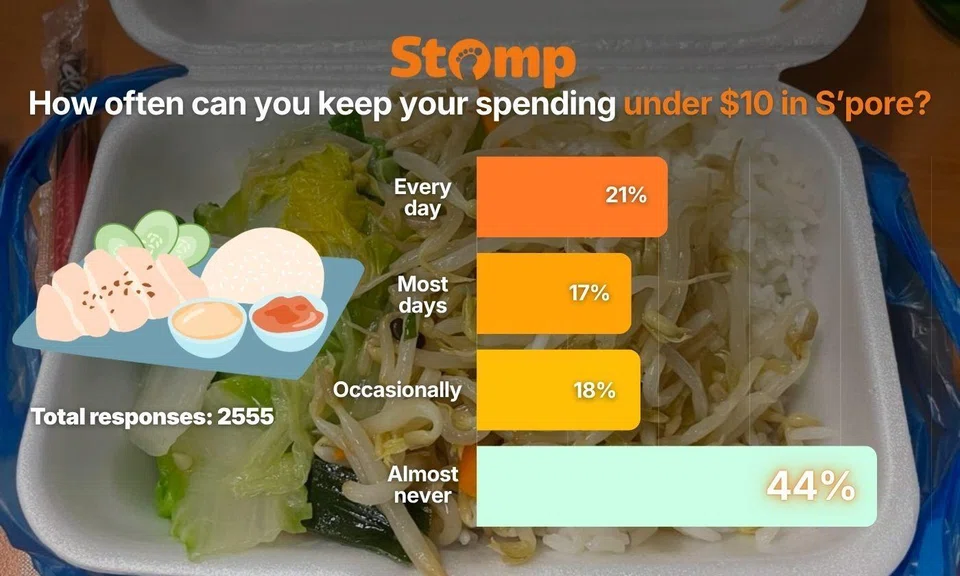
Several students echoed this view.



Nathaniel, a 24-year-old student at Nanyang Technological University, said he spends about $20 a day on two meals. During his internship, he earns $1,000 a month and saves about half.
“It is hard to keep expenditure below $10 when going out for social reasons,” he explained, adding that it was only possible to lower expenditure by frequenting food courts offering meals below $10, or eating at home.
Rachel Lee, a business major at the Singapore University of Social Sciences, agreed that a $10 budget would be a stretch, especially with an $800 internship allowance.
“I never stick to below $10 expenditure unless I’m at home and my parents are cooking for me. Transport is also expensive, even if you take bus and MRT,” the 23-year-old said.
Skipping meals, cramming work to cut rising costs
Ernest Chua, a 20-year-old student at Nanyang Polytechnic, spends between $5 and $20 a day on food. During his three-month-long internship, he earns about $700 a month while working in an office in MacPherson.
To save money, he would choose to eat at his school canteens, visit affordable coffee shops near the office, and occasionally forgo meals entirely.
“If I needed to keep my expenditure low, I would normally just skip meals. Coincidentally those periods were also cramming periods for work, so often the ‘work high’ would keep me sufficiently nourished,” he added.
While he acknowledged that food prices were rising, he noted that coffee shops and canteens still offer relatively affordable options.
F&B operators struggle to keep prices low
Students aren’t the only ones feeling the pinch. Hawkers and business owners I spoke to said they are feeling it too.
Abaf, a 49-year-old hawker who has worked at an ayam penyet stall in Toa Payoh for two years, said rent and utilities take up a large chunk of costs.
Despite rising costs, prices at the stall have remained unchanged — for now.
“But I’ve heard rumours that my boss say want to increase (prices), by 20 cents, or 50 cents,” Abaf added.
When asked if the stall would consider offering discounted prices for students, he explained that prices were already considered “reasonable” and on the lower end.
For some businesses, however, price increases have been unavoidable.
At Pazonia Italian Street Food, a casual eatery along Amoy Street, owner Daniel Pazonia said the business sees 200 to 300 customers daily but operates on “very marginal profit”.
Prices have risen about 10 per cent, due to cost increases of 10 to 15 per cent.
Increasing prices might drive customers away: F&B consultant
Khoo Keat Hwee, a former F&B operator turned consultant, said many businesses are seeing sales fall by 10 to 20 per cent — a trend he described as “common” in the industry — while logistical costs continue to climb.
Newer businesses are facing rents ranging from $4,000 to $10,000, even in coffee shops, he added.
But raising prices isn’t a straightforward solution either.
“It can actually reduce overall revenue if customers feel the value is no longer there,” Mr Khoo said, noting that many value convenience and price over quality.
$20 a day might be more realistic
If price hikes are inevitable for both businesses and consumers, a $10-a-day budget can pretty much be thrown out of the window, as my feeble attempt at the experiment showed.
And that’s without factoring in regular social gatherings, gifts or hobbies. Healthier meals can easily cost $8 to $10, and I’ve occasionally found $9 transport charges buried in my bank statement — not to mention the constant pull to spend with every ad that pops up on social media.
While surviving on $10 a day might be possible with extreme self-discipline, $20 a day would be more realistic — and far less miserable.

Explore more on these topics
See something interesting? Contribute your story to us.
