‘Hybrid can consider, full EV will not’: S’poreans remain wary of EVs even as petrol prices spike amid Iran war

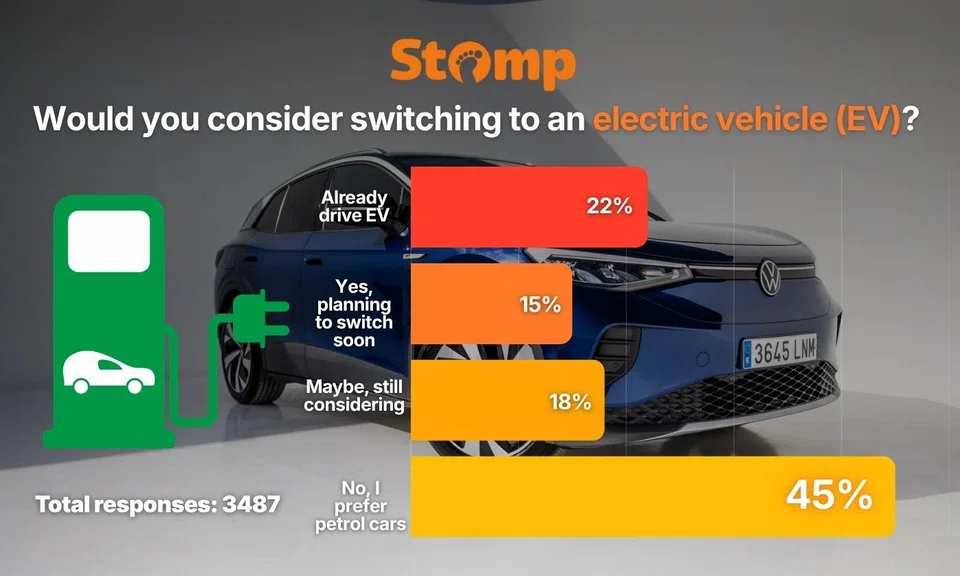
Singapore drivers remain hesitant to switch to electric vehicles (EVs), even as petrol prices climb amid escalating tensions in the Middle East, according to a new Stomp online poll.
Out of 3,487 responses, a majority of motorists said that they still prefer petrol cars, with only 22 per cent currently owning an EV and 15 per cent indicating that they plan to switch soon.
Oil prices have skyrocketed on the back of the Middle East conflict, which started on Feb 28 when the US and Israel attacked Iran, hitting a recent high of US$114.03 per barrel. The Islamic Republic retaliated with its own strikes and closed the Strait of Hormuz, a critical shipping lane for crude oil and gas globally.
As a result, motorists are feeling the pinch at the pump. Today, fuel prices cost anywhere between $3.43 to $4.68 per litre at Esso, Shell, SPC, Sinopec and Caltex stations, according to data from Motorist, as compared to $2.84 to $3.62 in early January.
On April 7, the Government unveiled new support measures to help Singaporeans cope with the impact of the conflict, even as Prime Minister Lawrence Wong warned of rising prices and a possible global energy crunch.
Rising oil prices and potential issues with fuel supply have also led some pundits to predict an acceleration in electric vehicle (EV) uptake. However, not all drivers Stomp spoke to were convinced.
Dealers Stomp spoke to — EV Direct, Electric Vehicle Singapore and Hin Lung Auto Pte Ltd — also affirmed that there has not been a significant increase in EV demand at this point.
EV charging ‘not as simple’
Property executive Patrick Tan, 58, is among those who will not be adding to the approximately 46,029 EVs in the Republic any time soon. He has changed cars four times over the years, most recently purchasing a Mercedes C180 — a mild hybrid — in March 2023.
The main consideration for him is not short-term fluctuations in oil prices caused by the conflict — his company pays for his fuel costs as his job requires him to meet tenants frequently across the island — but convenience and reliability.
“You take one or two hours to charge an EV, whereas I can pump petrol in three to five minutes,” Mr Tan told Stomp, adding that the charging infrastructure was not comprehensive when he switched to his latest car in 2023.
Earlier this month, authorities announced plans for every HDB town to have at least one fast-charging hub by end-2027, in addition to generous incentives for EV buyers.
But all things considered, even if he had to pay for fuel himself, Mr Tan would not consider switching to an EV, given his concerns about battery safety, range and reports of vehicle fires.
“Hybrid can still consider, full EV will not,” he quipped.
Early adopters feel EV concerns are overstated
Roger Tan, 43, who works in healthcare, recently switched to an EV after first trying one while travelling in South Korea several years ago. He now drives an Xpeng G6, a midsize crossover SUV.
“The main difference is acceleration. It’s better than a normal petrol car,” he said.



The healthcare professional is aware of rising oil prices, but maintained that fuel costs were never the primary motivation for his EV transition. Instead, he cited lower maintenance costs and a comparable purchase price to petrol cars due to government subsidies.
Charging has also not been an issue, given that he installed a charging point at home and charges his EV every three or four days. “There’s not a lot of anxiety about (depleting) battery life,” he said.
In fact, the driver of more than 20 years believes that charging infrastructure is currently underutilised — he has noticed empty EV charging stations in public housing car parks on many occasions. “Availability of charging is more than demand for EVs at this point.”
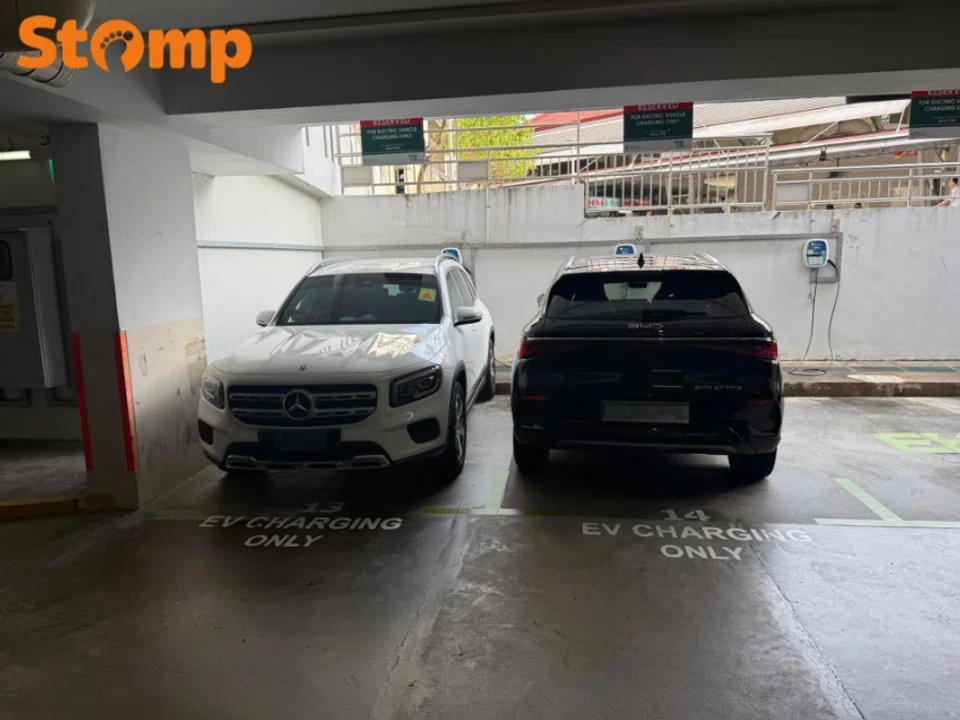
Melvin, an EV driver who wrote to Stomp, also observed on April 6 that there have been instances of cars occupying EV lots without being plugged in.
Experts: Fuel costs not main driver
Associate Professor Walter Theseira from the Singapore University of Social Sciences noted that fuel costs make up only a small portion of overall car ownership expenses in Singapore.
“Car purchases are made considering overall costs, and in Singapore, fuel operating costs are actually quite a small part of the overall cost,” he said.
Instead, larger factors such as the Certificate of Entitlement (COE) and Additional Registration Fee (ARF) play a more significant role. “The more important factor recently has been government EV rebates and the falling price of China-made EVs,” he added.
Assoc Prof Theseira, who himself has driven an EV since 2021, estimated that the operating cost of his EV is half that of his previous car, even though he does not have access to home charging.
While his personal experience of owning an EV has been positive, he acknowledged that uncertainty over long-term repair costs and battery replacement continues to give some drivers pause.
Beyond China-made EV brands that are on Assoc Prof Theseira and Roger Tan’s radar, other automotive companies are fast rolling out their suite of EVs. For example, Volkswagen Group Singapore launched its first batch of eight EV models in 2024.
A spokesperson from the automotive company told Stomp that since then, EVs have comprised 42.5 per cent of its current sales, signifying strong customer interest.
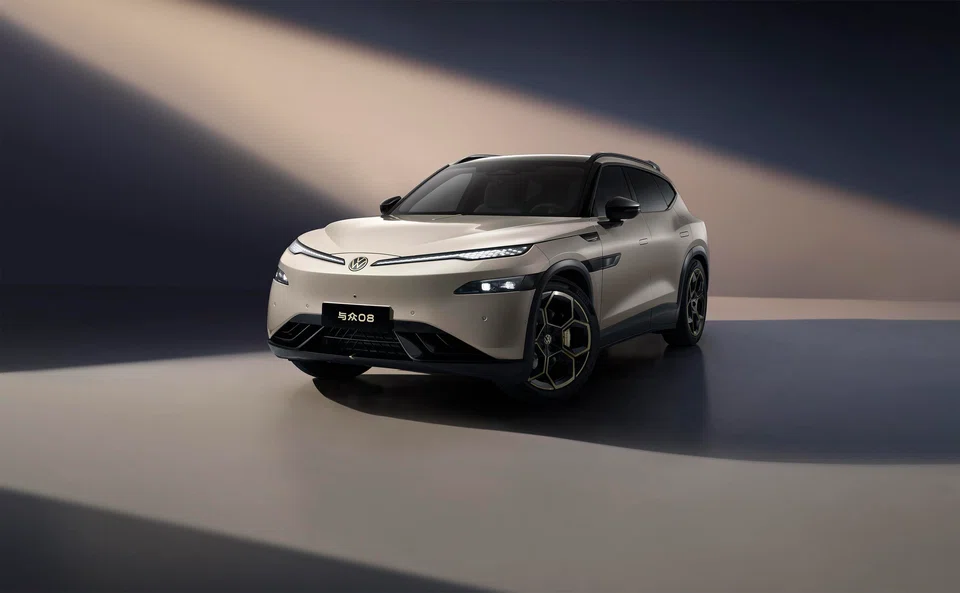
They added that Volkswagen has been able to reassure customers with concerns about EV range and battery servicing. “Our electric models offer strong range figures for journeys within Singapore and beyond, as well as a 10 year battery warranty for peace of mind.”
By 2030, authorities will scrap registration of new petrol cars, but the shift to EVs is likely to be gradual. For now, factors such as COE prices, government incentives, and evolving technology matter more than what drivers pay at the pump.
“These are likely still more important than short-term run up in petrol prices,” said Assoc Prof Theseira.

Explore more on these topics
See something interesting? Contribute your story to us.
