If S’pore is ‘somewhat safe’ for most women, why are we always on guard?

A few years ago, a friend and I visited a private dance studio located in an industrial building in Tai Seng on a weekday night to practice for a dance performance.
As we were walking back to the bus stop post-rehearsal, a seemingly male voice called out from a dark corner. “Hello, you’re beautiful. Can I have your number?”
I felt a chilling discomfort race down my spine. Without turning to see who it was, my friend and I quickened our steps towards the main road.
Afterwards, I tried to reflect on the possible reasons for the cat-calling.
Neither of us was dressed in anything remotely revealing — though that shouldn’t matter. Women are not objects to be leered at no matter what we’re wearing.
We were in a dimly lit area, but we had booked the Tai Seng studio as it was within our limited budget. A plausible reason perhaps, but poor lighting doesn’t naturally lead to cat-calling.
Who was I kidding? Cat-calling is unnecessary and inappropriate in any context.
That said, I was reminded that while most women, myself included, generally feel safe in Singapore, creepy interactions can still make us feel like we’re in danger.
This is not just the view of one opinionated “woke” strawberry, the numbers support it.
According to a recent Milieu Insight survey, 84 per cent of women in Singapore feel very or somewhat safe. Yet 40 per cent adjust their behaviour due to safety concerns, and almost half view personal safety and security as their top concern.
That most women feel at least “somewhat” safe in Singapore is cause for celebration, but there’s an obvious paradox in feeling safe while constantly policing one’s own behaviour.
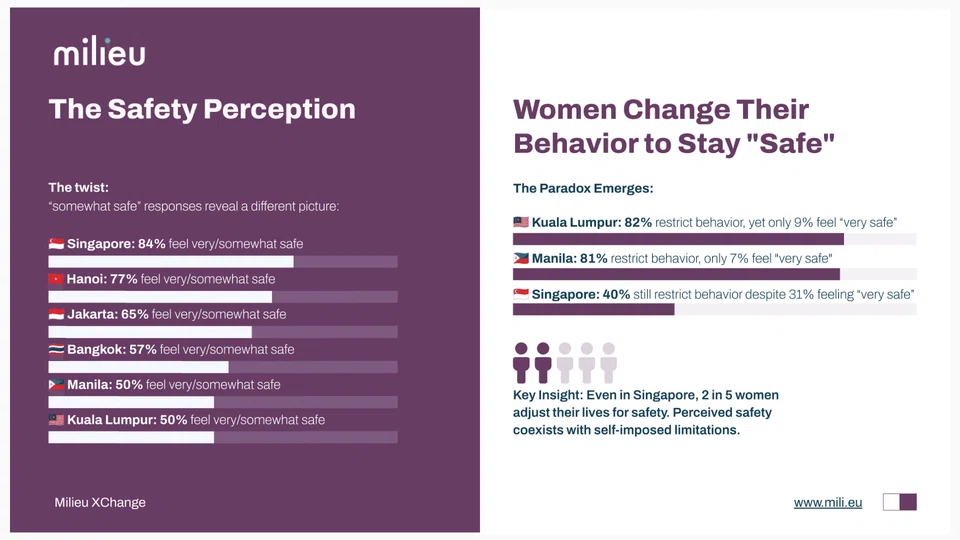
Here’s the unvarnished reality: For many women in Singapore, safety is not the total absence of danger, but the presence of constant self-protection and caution, often at the cost of our convenience and peace of mind.
What does it mean to restrict behaviour?
Some of these "adjustments" concern how we get around at night. Choosing brightly lit areas with steady human traffic, even if it increases travel time, is an obvious one.
Another is deciding whether it’s safe to go for a run in the park on a cool evening — and whether I should do so with or without my earbuds plugged in. I remember a time I was irrationally afraid that someone would grab my ponytail while I was jogging.
Sometimes, I also second-guess the outfits I wear.
Is my skirt too short? Should I wear this sleeveless top? Should I wear a jacket on the way and just remove it at my destination? But that’s going to make me sweat, not to mention take up space in my bag.



These may sound minor, but I’d much rather decide where I want to go and what I want to wear without having to worry about how strangers might behave.
Women not only feel the need to protect themselves in strange environments, but familiar ones too.
At a monthly social mixer I attended regularly four years ago, surrounded by people I considered friends and acquaintances, I was groped on the bottom while engaged in lively banter with a man I had just been introduced to.
The incident lasted less than a minute, but the disgust lingered long after. Most of the attendees I confided in believed me, but many continued being friendly with the man. It took me some time — and many emotional ups and downs — for me to move past the betrayal I felt.
I also remember being yelled at by a drunk man I had looked up to as a child while catching up over drinks. He had been ranting about my close friends and about women in general. I have not spoken to him since I snuck out of the bar that night.
Then there was the time I inspected the shower door knobs in my residential college for hidden cameras.
This was shortly after the 2019 peeping tom incident involving a male National University of Singapore student who filmed his female friend in the shower. By then, I had already lived in the residential college for two years and proudly called it my second home. Yet a single incident was enough to throw me off completely.
To be clear, I share my experiences not to indict men — far from it. Nor is it to suggest that danger exists only for women.
The takeaway here is simply this: While 84 per cent of women in Singapore feel at least “somewhat safe”, “somewhat safe” is not good enough, especially if the cost is having to over-analyse our relationships and over-prepare for every social situation.
Although women here are experiencing dating app fatigue, as reported by CNA Women, nightmare dating stories are still common.
Take Stomper Lilia, whose dating app match supposedly could not accept rejection. There’s also the man who allegedly told Stomper CA that he was “good in bed” and “had money” in an attempt to win her over, even after she had declined his advances.
Crimes such as molestation, upskirting and revenge porn continue to be part of the landscape. Meanwhile, artificial intelligence is introducing new dangers, including the creation of deepfake sexual images involving women and underaged girls.
As the world commemorates International Women’s Day on March 8, I celebrate the fact that so many women feel secure in Singapore, but also hope that we can all one day live as we wish.
Freely, fearlessly, and safely.
Hot Takes are opinion pieces written by Stomp journalists, based on their personal experiences and viewpoints. They reflect the writer's perspective and do not necessarily reflect the views of SPH Media.

Explore more on these topics
See something interesting? Contribute your story to us.
