Stomper flags financial and operational challenges for canteen stallholders in Beverage Container Return Scheme

Welcome to Stomping Ground — a space where Stompers share reflections, personal essays and social commentaries that spark conversation and insight.
Will school canteen stallholders end up bearing the cost of Singapore’s latest recycling scheme?
That’s the question on Stomper Ho’s mind ahead of the implementation of the Beverage Container Return Scheme (BCRS) on April 1.
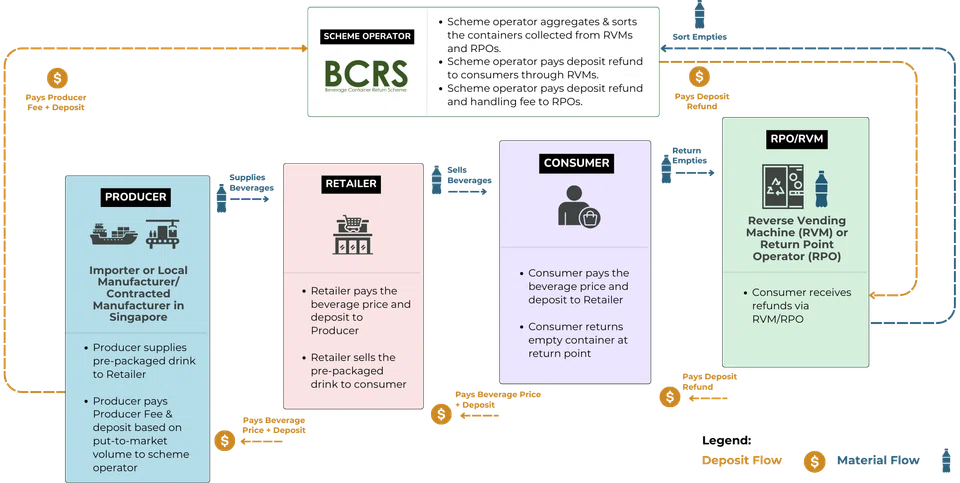
The BCRS scheme will require a 10-cent deposit to be applied to beverage containers, with consumers able to get a refund when they return empty bottles and cans at designated points such as reverse vending machines.
Ho feels that the scheme could place additional financial and operational strain on canteen stall owners who have space constraints.
However, under the “Return Right F&B” model for dine-in settings, food and beverage (F&B) operators are not allowed to charge customers the 10-cent deposit if they retain the containers. Instead, operators are expected to collect and return the empty containers themselves to reclaim the deposit.
The Stomper questioned how this would work in a school environment. She said her concerns are based on a close relative who has been operating a drinks stall in a secondary school for over 10 years.
“Stallholders still have to pay the 10-cent deposit upfront to suppliers, but they cannot charge students for it,” she said.
“If containers are not returned, the stallholder ends up absorbing the cost.”
Ho pointed out that without proper guidance, students may not consistently return their bottles and cans, which could lead to recurring losses.



Beyond the financial impact, she also highlighted operational challenges.
“Stallholders may be required to manage the collection, sorting, storage and return of large volumes of used bottles and cans,” Ho claimed.
She noted that her relative’s stall is run mainly by one person, and uses part-time help only during peak periods such as recess and dismissal. There are also space constraints and hygiene concerns to consider in collecting beverage containers.
While the scheme allows operators to return containers at reverse vending machines or arrange for collection after accumulating larger quantities, the Stomper questioned whether this would be practical for small stallholders managing daily operations.
She further pointed out that there appears to be a lack of clarity on how the scheme will be implemented at the school where her relative is operating a stall.
“The approach seems reactive, pending further direction,” she said.
While Ho appreciated the importance of improving recycling rates, she said more support may be needed on the ground so that the scheme is fair and workable for canteen stallholders.
“A centralised collection and return system at the school level, together with safeguards to address unrecovered deposits and clear operational guidelines, would help reduce both the operational burden and financial risk faced by stallholders, while still supporting recycling outcomes,” the Stomper suggested.
The Return Right website was recently launched ahead of the BCRS rollout to help the public locate their nearest return points from among the over 1,000 available islandwide.
Have your say on Stomping Ground! Write to us at stomp@sph.com.sg or WhatsApp 9384 3761.

Explore more on these topics
See something interesting? Contribute your story to us.
