Mother's biggest regret is not staying up on night her daughter was raped: 'Why did I sleep?'

Reema Dudekula Tabla March 13, 2025
I first heard about Mrs Sujata Tiwari two days before meeting her. I knew only one thing about her – she is a mother who fought a long battle to bring her daughter’s rapist to justice. As a woman who could sympathise with the weight of her burden, I knew I had to meet her.
A quick search informed me of the many hats Mrs Tiwari wore. Entrepreneur, journalist and an activist, to name a few. But none held a candle to her role as a mother, as I would soon find out.
I arrived early for the interview and settled into a corner booth in Wild Honey at Mandarin Gallery, a cafe of Mrs Tiwari’s choice.
My head was buried in my phone, scrolling through the document of questions I had prepared, when I heard a faint “Hi!”.
I looked up and there she was, a petite woman with a crown of wise greys, carrying a bag nearly as big as her. She sat down, I introduced myself and she replied: “First, order something. Get yourself some food and a drink, it’s on me.”
Once the pleasantries were out of the way, Mrs Tiwari, an Indian based in Singapore, pulled a book titled “Against All Odds” out of her bag. This was the book she wrote documenting the gruelling six years she spent in courtrooms fighting her daughter’s rapist.
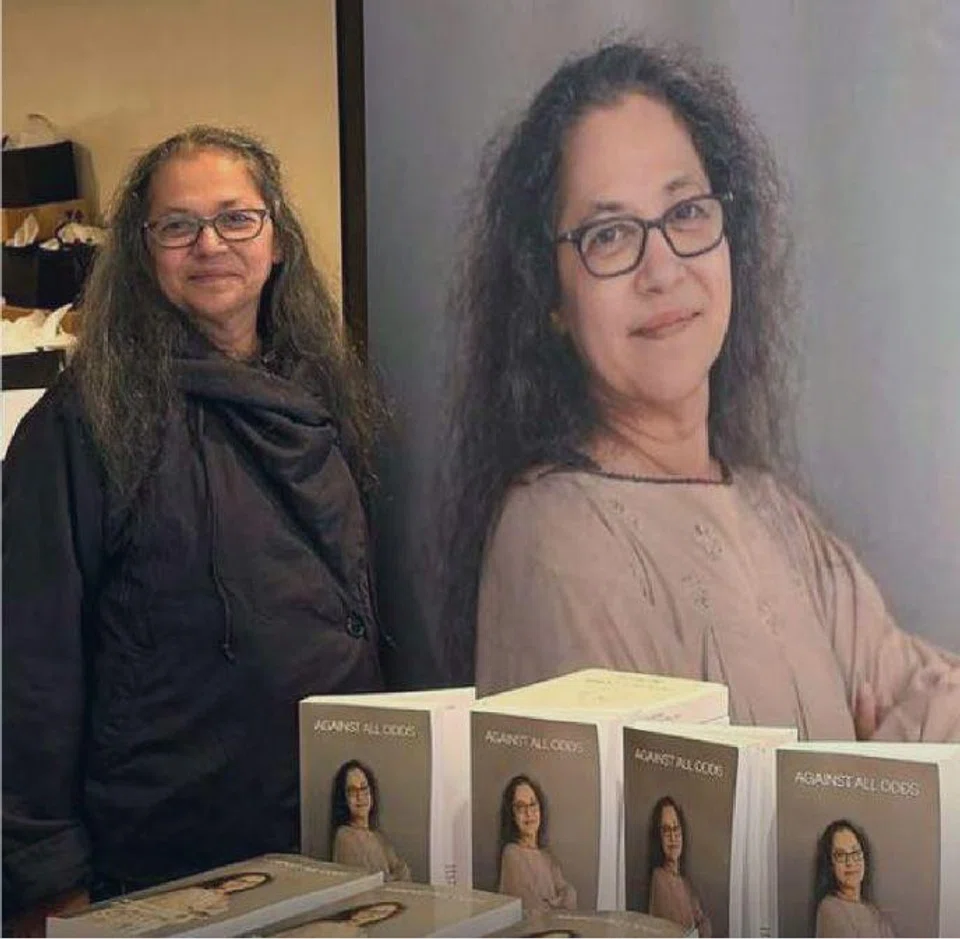
Justice systems often fail to protect women, subjecting them to arduous processes to fight for justice. In Mrs Tiwari’s case, the severity of her pursuit only served to embolden her. “Not many are willing to publicly admit that their child has been raped because they think it is humiliating,” she said.
To her, “not fighting was not an option. If you don’t report, you are stuck with it. It is already something the victim is forced to live with, but if you don’t speak up, life becomes harder,” she said.
The family’s ordeal began almost 15 years ago after Mrs Tiwari, who was abroad, chatted with her daughter, the youngest of her three children, in Mumbai on a video call. After the call, her daughter left for a party in town.
“The call ended and I went to bed. Usually, I stay awake until my children come home, but this day I did not. It remains my biggest regret. Why did I sleep?” she said.
“I remember she was fully clothed when I had called her the night before. But when we found her, she was not,” Mrs Tiwari added. Her daughter was found in the lobby of her apartment in Mumbai the next morning by her elder sister. Mrs Tiwari also has a son.
She took the next flight to Mumbai and reached her distraught daughter. “Ever wonder what a mother, a sister and a brother have to go through when they see the aftermath of a violent and brutal act?”
She said the family made a pact to only ask her questions about the incident when she was ready to talk about it.
Mrs Tiwari reported the case the next day and soon began a court battle that would usurp her life. “I had to get my answers,” she said.
Her days and nights were filled with liaising with the Mumbai police to gather all the evidence she could to put her daughter’s rapist behind bars. Mrs Tiwari was shown a glimpse of the video clip where her daughter staggers into the lobby and collapses.
“It was enough to scar me for life,” she said in her book, which is available for purchase on Amazon.
The rapist had dismantled her daughter’s phone by removing its sim-card and battery, hiding it in different places. The rape was pre-meditated.
Based on the recovered CCTV footage, the Mumbai police were able to trace the victim’s last steps and find the crime scene, less than 100m away from the gate of her building, where they found her leggings, boots, panties and a cigarette butt.
Through the years, Mrs Tiwari shared that she not only faced criticism but was also ostracised by her extended family because of the shame.
While her husband remained in Singapore to maintain a steady flow of income, Mrs Tiwari dealt with court appearances on her own.
“It is not cheap to fight for justice,” she said. “Someone had to keep earning for the family while I flew to Mumbai to fight the case.”
She also learnt that fighting for justice is a lonely process and rape conviction rates in India were dismal. From 2018 to 2022, conviction rates were roughly one in four according to the National Crime Records Bureau.
Then came the ordeal of facing her daughter’s rapist during every court appearance.
“Can you imagine having to sit there in front of him?” she asked me.
Six long years later, the case concluded, and the rapist was sentenced to 10 years in jail.
But the truth is, when you are a victim of such a brazen crime, justice does not always feel like a ‘win’. Mrs Tiwari’s journey of resilience did not end with the courtroom victory. In fact, it marked the beginning of a new chapter in her life.
Today, she is a life mentor for women, a mental health and well-being counsellor and a podcaster.
“I want to be that voice,” Mrs Tiwari said, “the one that reminds people, especially women, that they are not defined by what happens to them. We are defined by how we rise after it.”
The story of her daughter’s rape is interspersed through the book, which does not only discuss her tribulations, but also those that women around the world experience daily.
“A woman’s struggle has not lessened,” she said, as she quotes cases such as Nirbhaya – the brutal gang-rape and murder in 2012 that left India shaken and reverberated throughout the world.
The mention of Nirbhaya took me back to when I first learned about the details of the rape. I was all of 14, freshly returned to Singapore from a school trip to the very city where the rape had occurred – New Delhi. I would later find out that the bus we travelled on had taken a route similar to the bus where the gang rape had happened – a sobering revelation for a 14 year old.
From harassment at workplaces to marital rape, Mrs Tiwari told me that so much needs to be done – starting with being loud about the injustices imposed on women. “With all the bureaucracy, internalised misogyny, regressive thinking, where does one even begin to fix the problem?”
As the conversation drew to a close, I found myself momentarily lost for words, riddled with hopelessness. I felt the weight of everything she had shared – the pain, the perseverance, and the unrelenting courage that shaped her into the activist she is today.
My first impression of Mrs Tiwari proved right – her spirit was indeed so much bigger than her frame.

See something interesting? Contribute your story to us.
Explore more on these topics
