Fashion designer made dream dress for teen with rare nervous disorder: 'We all want the same things'

Ms Elisa Lim, founder of the inclusive fashion label Will & Well, remembers the day she delivered Amelia Ng’s dream dress to her family back in 2022 — a moment that has stayed with her.
“(Amelia) was so excited that she held her breath,” Ms Lim tells Stomp over Zoom. That tiny act of anticipation set off an alert for Amelia’s family, who were viewing the dress just outside her room. The signal told them her air supply had been cut off.
“She did that intentionally because she wanted to see her dress, and she wanted to be part of the conversation,” Ms Lim says, calling Amelia’s gesture “cheeky”.
In 2021, the late Amelia Ng became the first person in Singapore to be diagnosed with Infantile Neuroaxonal Dystrophy (INAD), an extremely rare disorder that attacks the nervous system. There is no known treatment, and most children with the condition do not live past the age of ten.
Because of INAD, Amelia was non-verbal, ate through a feeding tube and relied on a bilevel positive airway pressure (BiPAP) machine to breathe. She also slept close to 20 hours a day.
Still, none of that stopped Ms Lim from “co-designing” a dress with her. She would toss out ideas, and Amelia would blink in agreement. The result: a light-up dream dress with thoughtful adaptations tailored to Amelia’s needs.
For many, the idea of designing clothes for differently-abled bodies may feel daunting. For Ms Lim, however, it’s the heart of her calling — a mix of joy, challenge and deep purpose.
Building up her mission
She traces the beginnings of Will & Well to her final year at Lasalle College of the Arts, when a doctor approached her to create clothing for his disabled and bedridden patients. She had never designed for such clients before, yet something about it felt “intuitive”.
“If you don't know something, you’ve just got to observe it, you've got to learn it, and you've got to hear it from people,” she says — an approach that designers now recognise as "design thinking".
Was there one pivotal moment that made her start Will & Well? She doesn’t think so.
“Frankly, I don't think that there is one specific moment. I think it's every moment with the different clients that I meet with that I see how challenging dressing really can be for them,” Ms Lim shares.
Her clients today span a wide range of needs. Beyond patients with complex medical conditions like Amelia, who died in February 2024 at age 18, a significant portion of her clientele are elderly.
With a soft, affectionate smile, she tells Stomp about one such client: Madam Tiah — and her boyfriend-slash-caregiver.
Ms Lim first met Madam Tiah through a social worker who regularly checked in on the elderly woman at her rental flat.
When she stepped into the home, the scene struck her: the old lady, then in her 80s, sitting on the floor dressed only in a diaper and shirt.
Years of being confined indoors, smoking and watching television had caused her muscle mass to deteriorate drastically. And while her boyfriend was younger and in his 60s, he was still an elderly man himself — his age and asthma making the task of caring for her “almost impossible”.
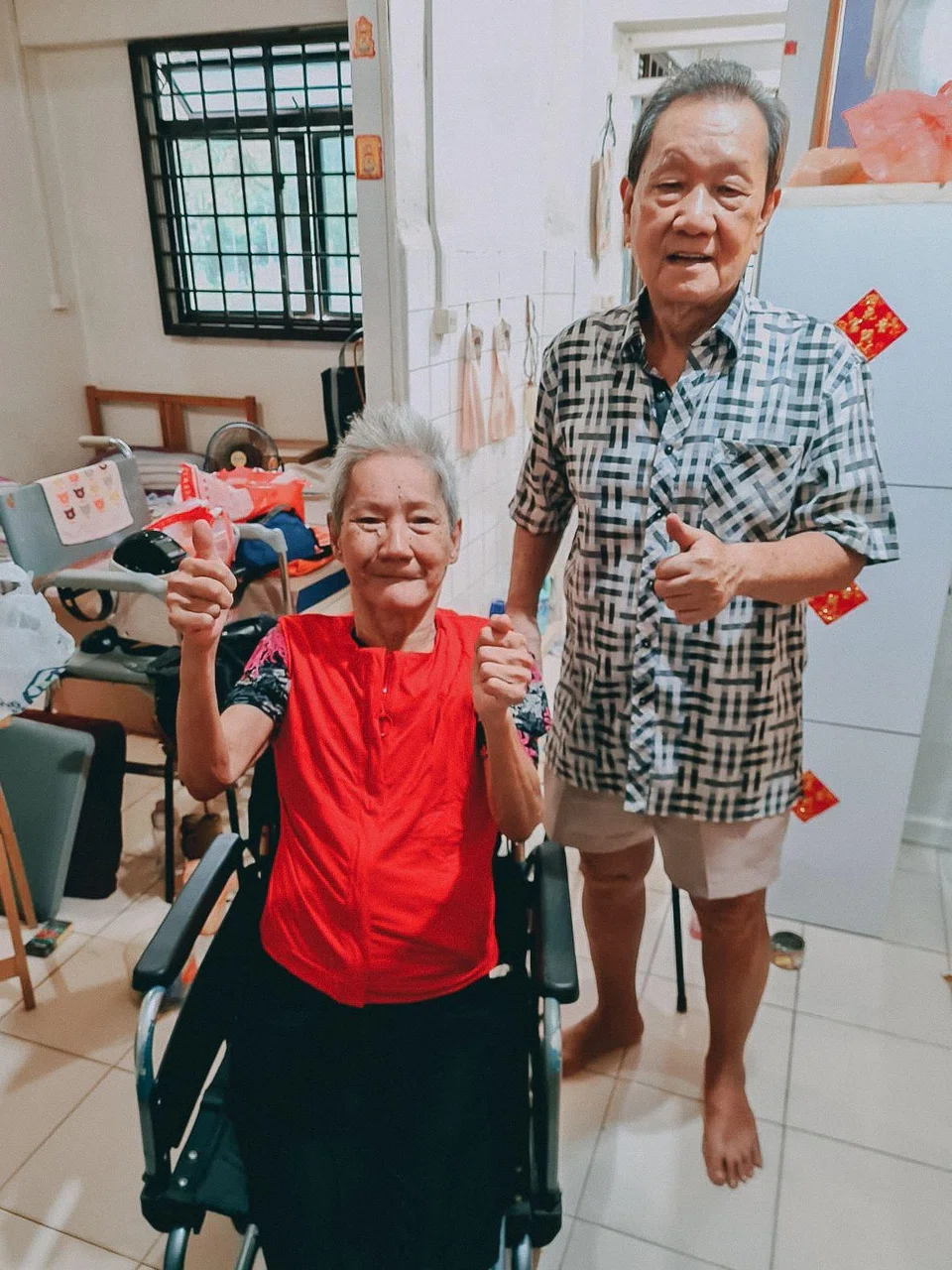
Ms Lim and her team at Will & Well made Madam Tiah a sleeveless blouse, a pair of short pants, a pair of long pants and an altered Cropped Cape.
The pieces didn’t just look vibrant — they also lightened the load for her boyfriend, who could now dress her without getting breathless.
Building clothes around real bodies
When designing clothes that work for both clients and caregivers, she is constantly navigating the balance between aesthetics and practicality.
She describes Will & Well’s pieces as “visually comfortable” and versatile — garments that can move across everyday life, special occasions, and the client’s own style preferences.


The 31-year-old designer adds that the biggest principle guiding her work is subtlety. She is intentional about ensuring her designs never “scream ‘I'm disabled, therefore I'm wearing this’”.
That philosophy also guides Will & Well’s process: they design around bodies exactly as they are. If a client is bedridden, measurements are taken right on the bed, with caregivers helping to gently manoeuvre the person’s body.
“If someone has super severe scoliosis, what I would do is I would drape a fabric on them, and I would follow their body contour,” she says.
And time and again, Ms Lim returns to the assignment that pushed her creativity and compassion the furthest — Amelia’s dream dress.
There were layers of complexity to consider: Amelia’s chest was developing as she entered puberty; she relied on a feeding tube; and she used a BiPAP machine to breathe.
The dress she eventually designed incorporated a training bra and featured a water-resistant panel along the path of the feeding tube to prevent stains. It also opened from the side, allowing caregivers to dress and feed her without disruption.
“Imagine if she had to put on a training bra and a regular shirt or a regular dress. (Her caregivers) would have to take off her oxygen supply to put on clothes. Crazy, right?”
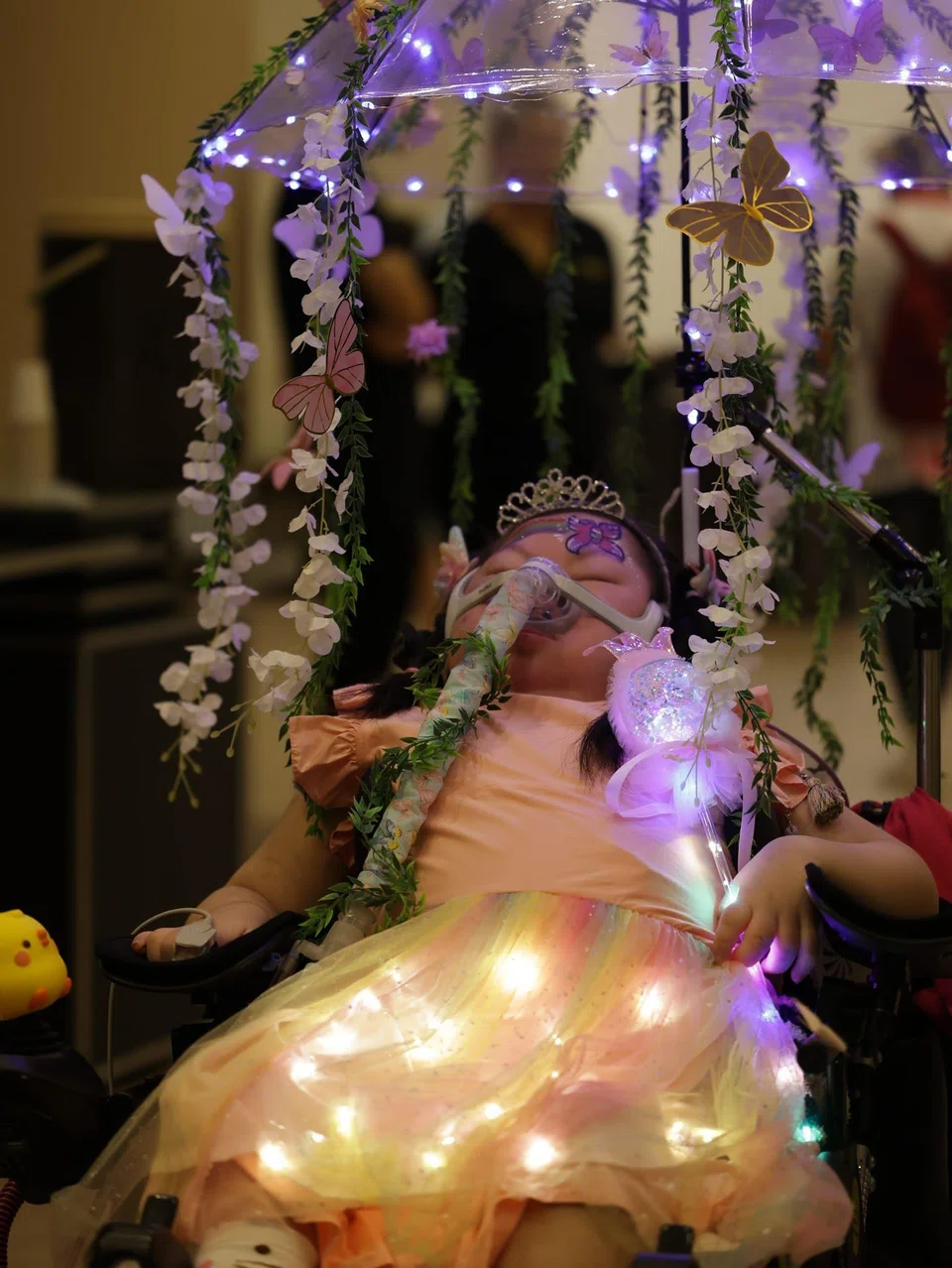
Ms Lim tells Stomp that Amelia adored the dress so much that she refused to take it off after trying it on for the first time. Her parents had to come up with all sorts of excuses before the teen finally relented.
Emotional lessons on belonging
When Ms Lim is asked about what she has learned from her clients — and whether this work has shifted the way she sees the world — she says her biggest realisation is that the able-bodied and persons with disabilities “aren't all that different”.
“We all want the same thing. We want comfort, we want ease, that's just very natural human tendencies. We want to be accepted, we want to be heard. We want to belong. We want to… we want to be considered for.”
She stops here. Tilting her head slightly upward, she pauses, her eyes welling with tears.
Perhaps it’s easy to assume that working with the differently-abled naturally comes with textbook lessons about gratitude. Or to imagine that eight years in this field would make someone more stoic about the work.
On the Zoom call, heart-shaped reactions from others in the session appear on screen as a small gesture of solidarity, giving her space to take a breath and wipe her tears.
Once she collects herself, she explains that her clients often open up about other aspects of their lives during consultations. Through these conversations, she realised how many systems are not designed for persons with disabilities. Some of her clients are fully bedridden and rely on special transport that can cost up to $100 per ride.
“They always have to find ways to fit in with the masses.”
Throughout the conversation, an undercurrent of empathy, indignation and determination to improve her clients’ lives is unmistakable.
Her commitment extends beyond clothing; she also raises how payment methods need to be more accessible so her clients can experience a degree of freedom and independence.
So what can those without her technical expertise do to embody her inclusive spirit?
“Keep telling their stories,” Ms Lim says. “Give them a platform for their voice to be heard.”
Whether through TikTok or traditional news, she believes greater visibility helps the public become more comfortable interacting with the differently-abled.
Her hope is simple: that by hearing her clients' stories, people will learn to see them as they are — and include them as they deserve.

Explore more on these topics
See something interesting? Contribute your story to us.
