'I'll never bid for that BTO': Residents worry about lift waits, fire safety in 60-storey BTO project


When Rachel Ang first heard about plans for a 60-storey Build-To-Order (BTO) project, her reaction was immediate: "I'll never bid for that BTO."
Online reactions following reports on the development have also been sceptical, with some residents raising concerns about issues such as long lift waiting times and fire safety on higher floors.
The project is set to rise at the foot of Pearl's Hill in Outram Park, following an announcement made in Parliament on March 4 by Minister for National Development Chee Hong Tat.
Currently, Singapore's tallest HDB development is Pinnacle@Duxton, a 50-storey complex completed in 2009.
For Ms Ang, who is in her early 30s and has three young children, living on a high floor would be impractical for her family.
She told Stomp that when choosing her BTO flat in 2022, she and her husband preferred a unit no higher than the 14th floor — ideally between the sixth and ninth floors — and felt "very lucky" to secure one on the seventh floor.
Living on lower floors, she said, makes daily life easier, especially with young children. Having experienced two lift breakdowns at her Canberra BTO since they moved in 2023, she added that her children would still be able to use the stairs to go up and down.
"I can't imagine if we lived above 10 storeys," said Ms Ang.
The "greatest turn off" about the 60-storey BTO project, she added, would be the lift waiting time.
Even in her current 14-storey block, waiting for lifts during peak periods can sometimes be a "hassle", with waits occasionally exceeding five minutes — prompting them to take the stairs instead.
Despite the benefits of higher floors, such as better ventilation and unblocked views, she said living at such heights would make her feel less safe, especially during sudden weather changes or emergencies such as fires.
Most concerned about long lift waiting times, fire safety, weather changes
The 60-storey development at Pearl's Hill could be the first of several such high-rise HDB projects, Mr Chee noted.
But are Singaporeans ready to live that high?
A Stomp poll found that 59 per cent of 3,098 respondents preferred floors 20 and below.
Another 14 per cent chose floors 21 to 30, eight per cent chose floors 31 to 40, while 19 per cent said they would like living between floors 41 and 60.
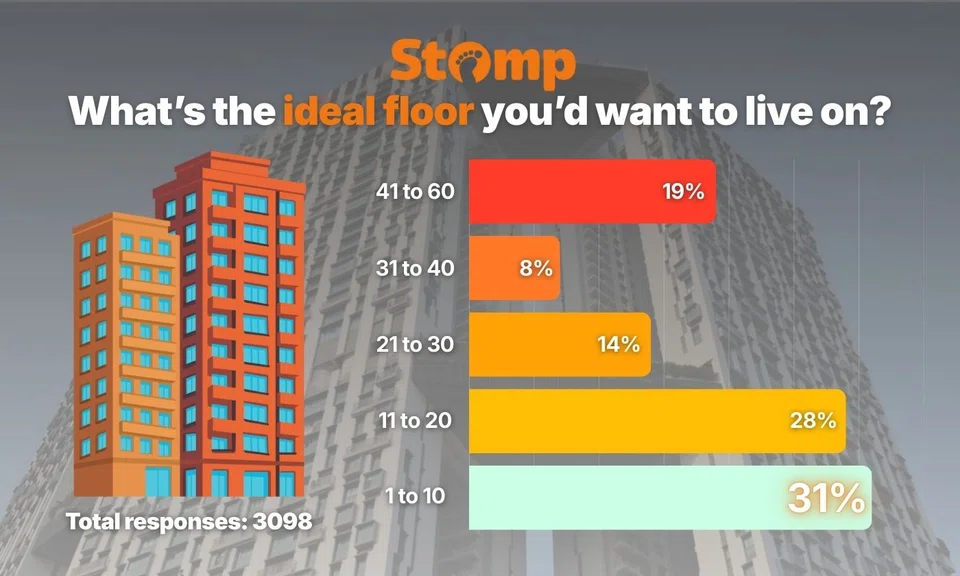
In a Reddit thread started on March 4, users discussing the project raised similar concerns, particularly about lift waiting times, fire safety on higher floors and weather-related issues.
"Imagine staying on the 60th floor and there's a thunderstorm, heavy downpour and strong gusts of wind," one wrote, while another said every lightning strike would "feel personal".
Many also cited the deadly Hong Kong fire at a high-rise residential building on Nov 26, 2025, which claimed at least 65 lives.
One commenter said he hopes there's a "good plan for the lift system".
An Ang Mo Kio resident living on the 25th floor, who only wanted to be known as Nicole, told Stomp it typically takes about a minute to reach her unit, though it can take longer during peak hours due to the crowd.
The 39-year-old civil servant said lift breakdowns occur quite frequently in her older estate, but noted that newer developments have higher-quality lifts with zoning systems — some serving floors one to 21, and others covering floors 22 to 40.
Nicole added that she has also been thinking about fire safety on higher floors, especially in light of the Hong Kong fire.
Another resident, Max Lim, who recently applied for a BTO on the 20th floor, said the 25th floor would be his upper limit. Having grown up on the sixth floor of an 18-storey block, he described the 60-storey project as "quite surreal".
While he understands the need to build taller flats due to land constraints, the civil servant in his mid 20s said there may come a point where building above 60 storeys is no longer "practical".
As Singapore is not prone to natural disasters, Mr Lim said living on a higher floor would not make him feel less safe — a factor he said would otherwise be his biggest concern.
Lifts with zoning systems, 'refuge floors' for high-rise residential buildings
As of 2021, there are 189 HDB blocks in Singapore that are over 30 storeys tall.
Stomp visited two 40-storey HDB blocks — 8 City View @ Boon Keng and 10 Bendemeer Road — as well as a 39-storey block at 149B Towner Road.
At 8 City View @ Boon Keng and 149B Towner Road, completed in 2011 and 2024 respectively, each block has two to three lifts serving all floors. It took about 34 seconds to reach the top floors when there was no crowd.
At 10C Bendeemer Road, completed in 2017, the block has four lifts — two serving floors one to 21, and two serving floors 22 to 40. It took about 41 seconds to reach the top floor without a crowd.
Across all three blocks, lift journeys to the top floors took under a minute. Each development also had multiple lifts, with one using a zoning system to serve different floor ranges.
To address fire safety concerns, the Singapore Civil Defence Force (SCDF) has published guidelines for residents in super high-rise residential buildings — those over 40 storeys — such as Pinnacle@Duxton.
Instead of evacuating all the way to ground level, residents on higher floors can head to a designated "refuge floor".
Refuge floors are specially designed safe holding areas, equipped with natural ventilation and constructed using fire-resistant materials, allowing residents to avoid descending multiple floors during an evacuation.
Under the Fire Code, refuge floors must be provided at every 20 storeys in a super high-rise residential building. They are connected across blocks, making them easily accessible to both residents and firefighters.
High-rise residential buildings 'more sustainable': Expert
Speaking to Stomp, architect Khoo Peng Beng of the Singapore University of Technology and Design highlighted a less obvious impact of high-rise living — the infrastructure needed to support it, such as roads, drains, street lamps, water pipes and electrical wiring.
Compared with low-rise developments and landed homes, which require a "very sprawling network of infrastructure", high-rise buildings allow more people to share the same facilities. This makes them more energy-efficient and easier to maintain, making them "more sustainable" in the long run, he said.
With units stacked vertically, such developments also have a "much reduced footprint", freeing up more land for greenery and open spaces. This gives architects greater flexibility to design layouts that minimise the blocking of wind and natural light.
Prof Khoo added that high-rise developments can also support more residents in well-located areas, allowing more people to benefit from central locations and nearby amenities.
On lift waiting times, Prof Khoo said lift technology today is "extremely good", noting that travelling vertically often saves more time than commuting longer horizontal distances. He also pointed to zoning systems and the potential for smarter lift technologies.
However, high-rise developments come with challenges. One key issue, he said, is designing for the natural movement of tall buildings.
Prof Khoo, who also led the Pinnacle@Duxton project, said they had to ensure that the building's movements and joints could accommodate thermal expansion, wind, and even earthquakes.
Asked whether there is such a thing as "too high" for residential buildings, he disagreed, citing advances in technology.
"It's not really the technology, but the psychology of living higher," he said.
While he acknowledged the peace, efficiency and environmental benefits of high-rise living, Prof Khoo added that a mix of low- to mid-rise developments remains important to avoid a monotonous urban landscape.

See something interesting? Contribute your story to us.
Explore more on these topics
