'Bad stench' and 'misleading signs': Confusing BTO layouts leave residents frustrated

A year after public sector executive Jersha, 30, moved into her Tampines North Build-to-Order (BTO) unit with her husband, life in the estate isn't quite as sweet as the couple had hoped it would be.
This is down to the perplexing layout of the block, which has led to confused guests, irritated private-hire drivers, and multiple cancelled rides.
With "extremely limited" access points — there is only one point of entry and exit for vehicles — Jersha told Stomp that it can take up to five minutes to drive to the couple's block after turning in. This is coupled with multiple entrances, as well as "misleading" pathways and signs.
“When (walking) through the blocks, you can’t see the outside, so you would have to blindly walk till you can find a sign,” said Jersha, who declined to give her surname.
Jersha’s frustrations echo those of Uzen Tan, a 30-year-old assistant marketing manager who will soon move into his flat at Tampines GreenOpal.
In a TikTok video uploaded in November, Mr Tan criticised the layout of his void deck, calling it the “worst” design he’s seen. The post had received 116,000 views and 3,321 likes at press time.
When Stomp visited the area recently, it took around 15 minutes to navigate from the adjacent Tampines GreenEmerald to Block 963A in GreenOpal. The team ran into several dead ends and paths that seemed to loop in circles before finding the right block.
Boon for privacy, bane for community and elderly
Another pressing issue: both Mr Tan and Jersha say that the way Housing Development Board (HDB) blocks are designed affects neighbourly interaction.
Mr Tan told Stomp that there are limited open spaces at his void deck for residents to sit and interact, unlike older blocks with tables and chairs near the lift lobby, and "a big open area where kids can play block catching or soccer".
While acknowledging that some newer estates have rooftop gardens, he noted that residents need to "actively" go to these spaces.
Noting the lack of open spaces and the presence of pillars that obstruct views at her block, Jersha added: "If the block is meant to foster a sense of community, it has not succeeded."
In addition, "service yards (face) directly onto the entrances of other units, or (are) enclosed in a way that limits sunlight" – which both "forces" interactions and makes the area feel more cramped.
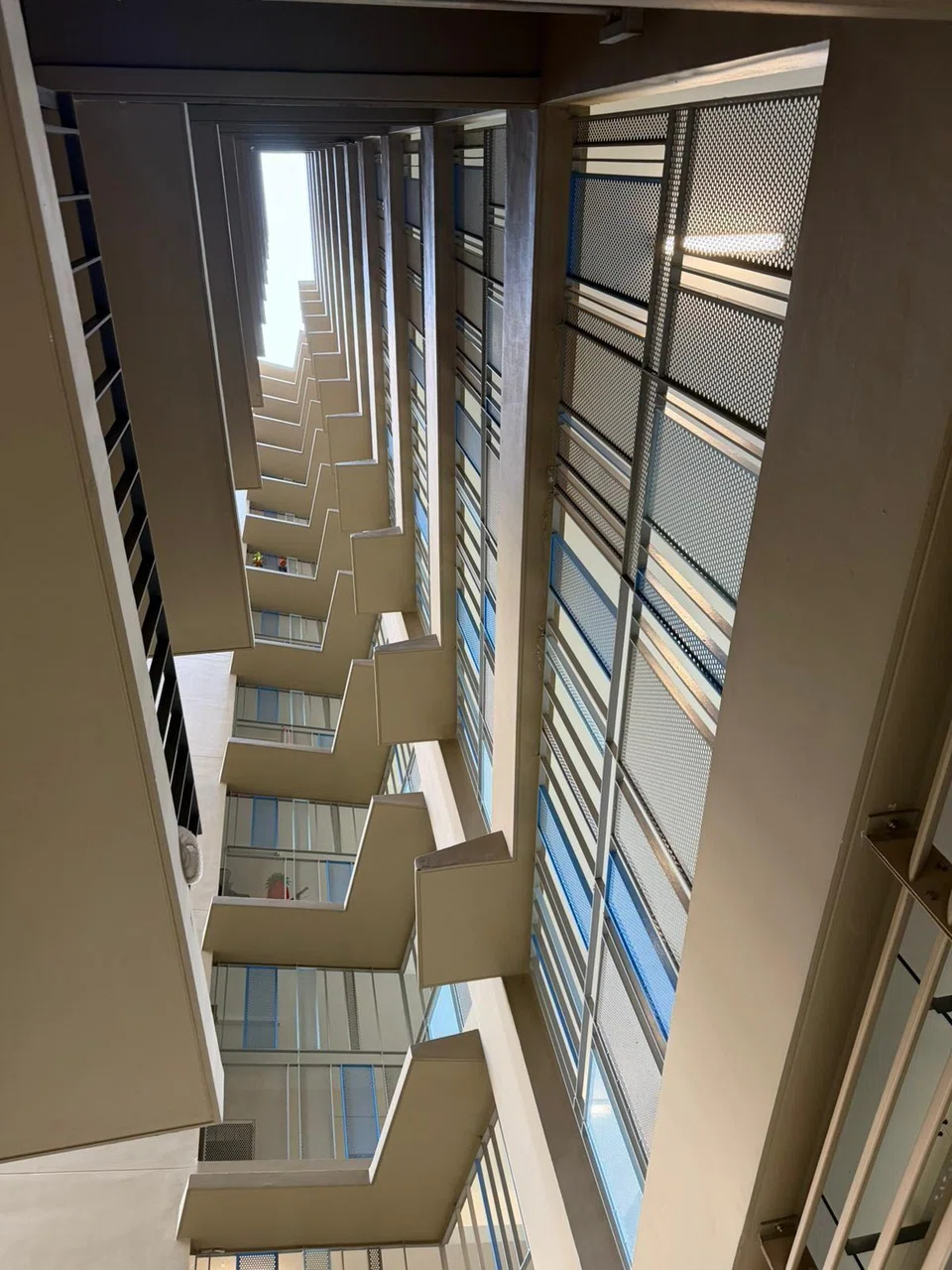
Real estate agent Prab Nathan told Stomp that many of his elderly and retired clients often find new HDB block layouts "confusing, dark or just too narrow".
Even seasoned professionals like Mr Nathan and Mandy Ei, senior marketing director at real estate agency ERA, say they sometimes struggle with newer layouts.
"I’ve occasionally felt disoriented in newer flats with multi-storey car parks, podiums, or sky terraces. On one viewing, we had to double-check unit numbers before finding the flat, showing modern designs can be less intuitive," said Ms Ei.
In a written response to a Parliamentary Question by former Member of Parliament Dr Tan Wu Meng, the Ministry of National Development (MND) said in Oct 2017 that newer blocks are taller and more compact, with fewer units per floor.
It acknowledged that this "optimises land use and provides residents with greater privacy" but results in a smaller void deck space.
However, HDB "continues to explore how to maximise community interactions".
Multiple pain points for new BTO residents
Void deck layouts and overall navigability are not the only pain points in newer HDB estates.

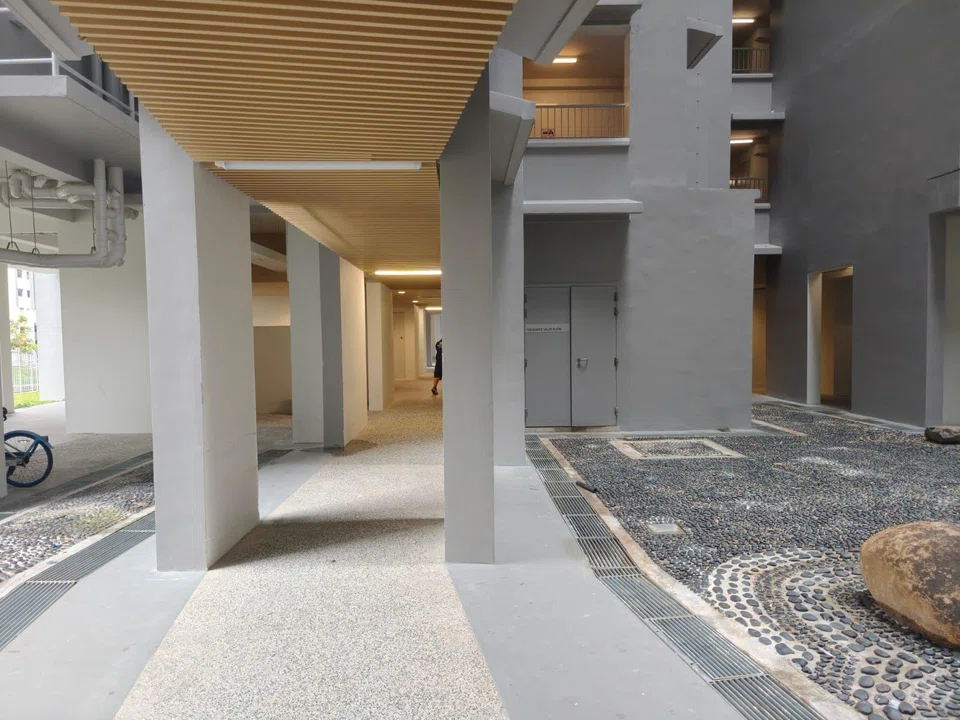
Uzen Tan told Stomp that having the refuse area next to the path that leads to the lift lobby is "the worst feature by far", as this exposes him to the stench whenever he comes and goes.
The names of BTO developments can also be a source of confusion.
Located near Tampines GreenOpal are developments with highly similar names – Tampines GreenGem, Tampines GreenJade, Tampines GreenQuartz and Tampines GreenEmerald.
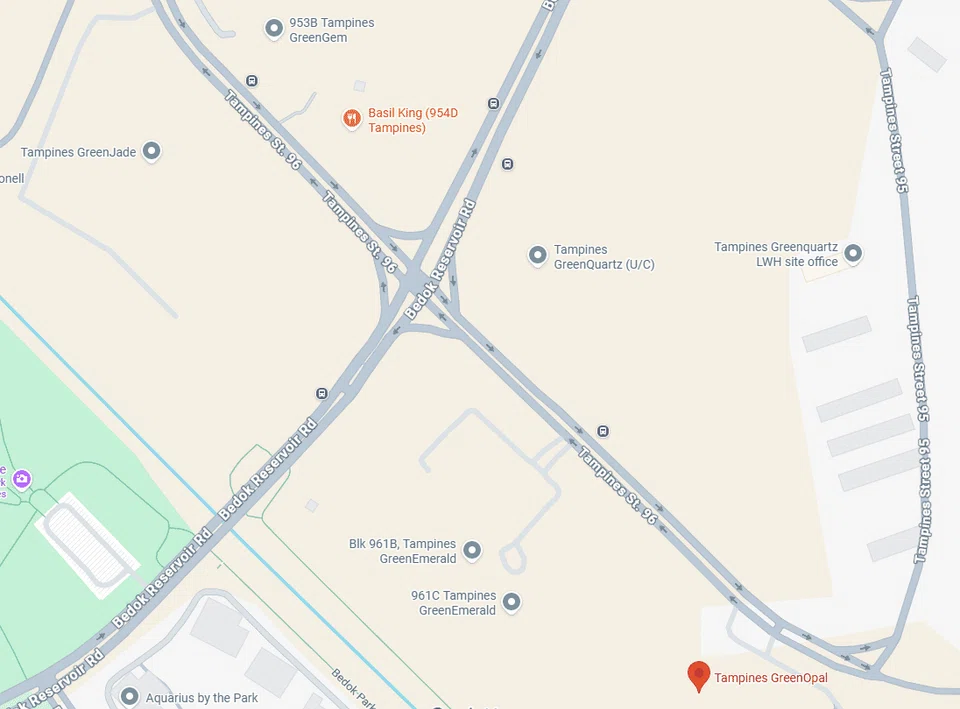
Ms Ei noted that HDB names can be "misleading".
"For example, Northshore Residences in Punggol and Macpherson Spring both sound like private condominiums, but they are standard HDB development."
Mr Nathan also points to block numbering and location as something that his clients have found puzzling. In areas like Sengkang, Anchorvale and Fernvale, the number and letter combinations "sometimes don’t make sense and seem to be all over the place," he said.
"Like (block) A is not linked to B, and C and D are not in order. Maybe map-wise they may make sense, but on the ground it can be a pain," said Mr Nathan, citing blocks 992 to 997 at Buangkok as an example.
Look at HDB ‘across time’, not as a ‘snapshot’: Architect
Architect Khoo Peng Beng of the Singapore University of Technology and Design suggested looking at HDB flats "developmentally across time" as they mirror the social-economic development of the entire nation.
Prof Khoo noted that as Singapore's housing needs evolved, so did the design of HDB blocks. Architects designing HDB estates now have to consider factors that they did not need to before, such as greenery and ensuring that the estate is car-lite and public transit-oriented.
Prof Khoo, who was part of the team that worked on Pinnacle@Duxton, noted that how an HDB block design turns out then depends on the interplay of "complex factors". If the design prioritises efficiency and individual unit build instead of void deck layout, this can translate to common areas that are not "legible" to the public.
In Jan 2024, Faishal Ibrahim, then the Minister of State for National Development, also highlighted the range of common areas to encourage Singaporeans to interact with one another. These include community pavilions, fitness corners, pet parks and community cafes.
What needs to improve?
HDB conducts post-occupancy surveys for all newly completed BTO developments, one to two years after homeowners have settled into their new homes.
Until he gets his turn, Uzen Tan has one suggestion: "Have a central walking path that connects all blocks to the main road without forcing people to follow the paths under the blocks."
Jersha would also like to see more entry and exit points for vehicles to ensure residents are "safer during emergency situations".
Residents that Stomp spoke to also wanted more open void decks that encourage community bonding and clearer signs for easier wayfinding.
In a world where everyone is perpetually online on "addictive" virtual spaces, Prof Khoo noted that the call for "more interesting (and) more active public spaces is a very important one".
Ultimately, it is the quality of these cherished public spaces that will propel Singapore's continued evolution as a design city, he added.

Explore more on these topics
See something interesting? Contribute your story to us.
