Gunshots from Aljunied MRT crow culling operation draw crowds: ‘Unnecessarily dangerous and dramatic’

Crowds of people gathered at Aljunied MRT station when gunshots sounded amid a crow-culling operation that took place at a nearby grass patch on the evening of Oct 15.
An eyewitness, Glen, told Stomp that he was passing through the area at around 7pm when he saw a crowd gathered at the MRT station, peering towards the grass patch.
He initially thought a celebrity had arrived, or that an accident or emergency had occurred, but soon realised that the green protective barrier and officers pointing guns at the sky were part of a crow culling operation.
“I also remember thinking that only in Singapore would people walk towards the sound of gunshots instead of away from it!” Glen recalled.
While he understood the rationale behind population control, he wondered if more could be done to address the root causes of the problem, suggesting the following efforts:
- Improving waste management
- Understanding why crow numbers are rising and how their behaviour is changing
- Educating the public about the issue and the actions being taken
‘Unnecessarily dangerous and dramatic’: Netizens
Photos of the operation were shared on the Singapore Wildlife Sightings and Complaint Singapore Facebook groups, showing the grass patch dotted with over 30 bodies of black birds.
One netizen shared a petition to “end urban bird culling in Singapore”, which has garnered over 2,400 signatures.
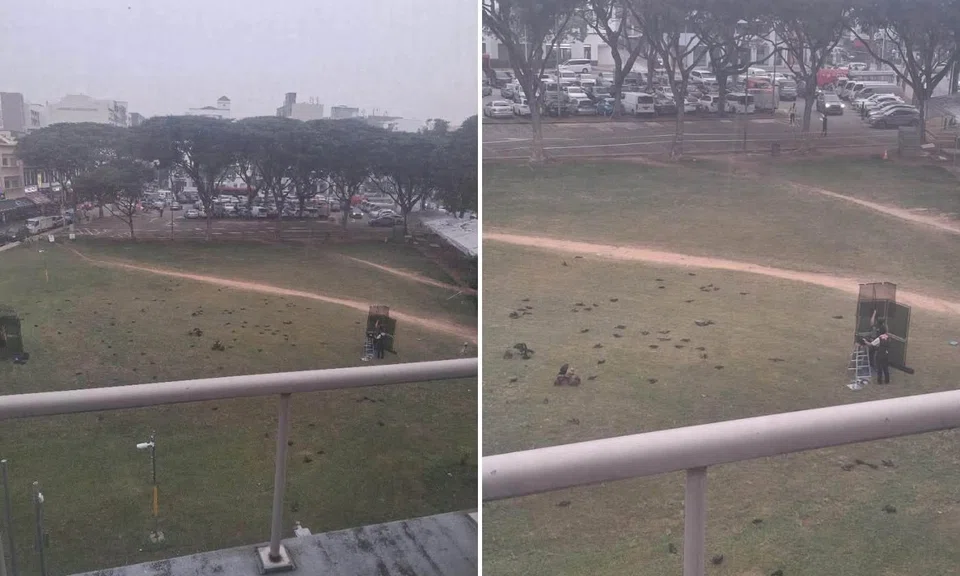
Several netizens disapproved of the culling, with one describing the operation as “heartwrenching”, “horrible and frightening”.
“Using a gun seems unnecessarily dangerous and dramatic. Why not poison?” another netizen asked.
Footage of a similar operation taking place at an open space outside Tampines 1 also went viral on Oct 15.
On July 17, the National Parks Board (NParks) said over 500 crows have been culled since shooting operations began in March, with further operations planned in Bukit Panjang, Marine Parade, and Tanah Merah.
These locations were selected due to their large crow populations that are averse to traps, NParks added.
NParks’ group director for wildlife management How Choon Beng said shooters must follow strict safety protocols, including firing pellets upwards.
Commuters support population control efforts
When Stomp visited Aljunied MRT station on the morning of Oct 16, a crow’s body remained on the grass patch, but the other equipment had been cleared away.
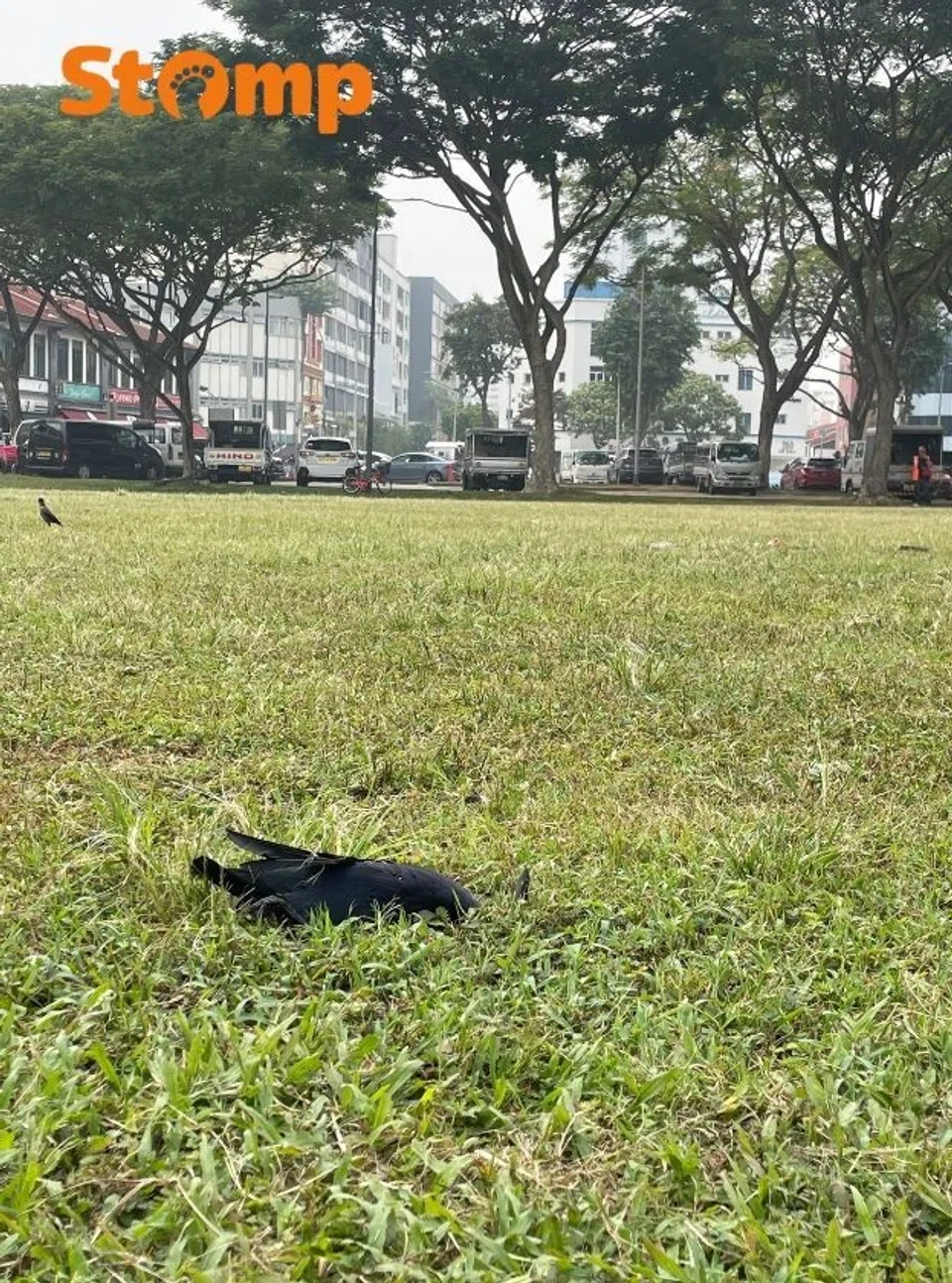
Crows could still be heard cawing from the trees, although few birds were seen flying across the area.
Several commuters Stomp spoke to were unaware of the culling operation the previous evening.
Mr Wang, a 90-year-old retiree, said he did not notice that there were excessive numbers of crows in the area when he passed by. However, he felt the culling was necessary, describing the birds as “pests” that would “attack humans”.
Another commuter, 84-year-old Lin Ben Ji, agreed that the population management measures were a step in the right direction.
“It’s important to let the public know not to feed the crows or to throw rubbish around that might attract them,” he said in Mandarin.

A 65-year-old engineer, Romeo, said he often saw bird droppings in the area, and felt the large crow population was a serious issue.
“No choice, there’s no other way because the crows populate easily,” he said, adding that the birds would often flock to nearby eateries.
However, hawkers at the nearby coffee shop, who wished to remain anonymous, said they did not notice the birds entering the eatery, which they said was largely kept clean.
Resident views birds as threat
For Aljunied resident Ms Goh, safety is her main concern.
The 34-year-old human resources manager said that she would often see at least five to 10 crows along each alley across Geylang, perched near open rubbish bins and in trees.
“Whenever I walk through Geylang, it can get quite intimidating as the crows perched on the fences and lampposts would watch me as I walk past, and it is pretty scary,” she said.
She felt that the birds pose a “real risk” to children walking through the area to get to school, particularly if they were carrying food that might attract the crows.
As for the crow culling operation, Goh described it as a “great move”.
“Given the environment in Aljunied/Geylang, with its high concentration of F&B establishments, hostels, and hotels, it would be difficult to manage the crow population without external intervention,” she added.
Shooting operations conducted in additional districts: NParks
In response to Stomp’s queries, How said that NParks has conducted crow shooting operations in over 20 districts as of October.
Operations have also commenced in additional districts such as Ang Mo Kio, Choa Chu Kang, and Geylang.
These sites were selected based on a range of factors such as:
- The presence of large numbers of crows
- Site suitability to conduct crow shooting safely
- Crow aversion to traps in the area
Since operations started on March 24, over 2,500 crows have been culled through this method.
Addressing the crow-shooting operation at the open area next to Aljunied MRT station on Oct 15, How said NParks has been managing the crow population in the area, including conducting more frequent crow nest removals and crow trapping.
However, crow shooting was introduced as the animals are highly adaptable to urban environments and can become trap-shy.
How added that the operation was carried out in accordance with strict safety protocols, including cordoning off the shooting zone and warning the public not to approach.
The public is also advised to refrain from feeding animals and ensure that food scraps are properly disposed of.
Under the Wildlife Act, offenders can be fined up to $10,000 for their first offence of feeding any wild animal. Repeat offenders may be fined up to $20,000, imprisoned up to 12 months, or both.
Editor’s note: This story has been updated with a statement from NParks.

See something interesting? Contribute your story to us.
